Thank you for visiting SNEWPapers!
Sign up free
Gazette Of The United States, & Philadelphia Daily Advertiser
Philadelphia, Philadelphia County, Pennsylvania
What is this article about?
A correspondent shares an extract from Francis Hopkinson's works depicting a 1782 court scene where Chief Justice berates grand jury for refusing to indict printer Oswald for libel against the supreme court. Urges review of related judicial essays under pseudonyms like Jurisperitus, criticizing sentiments subversive to press freedom, and warns against a certain chief justice seeking public office.
Clipping
OCR Quality
Full Text
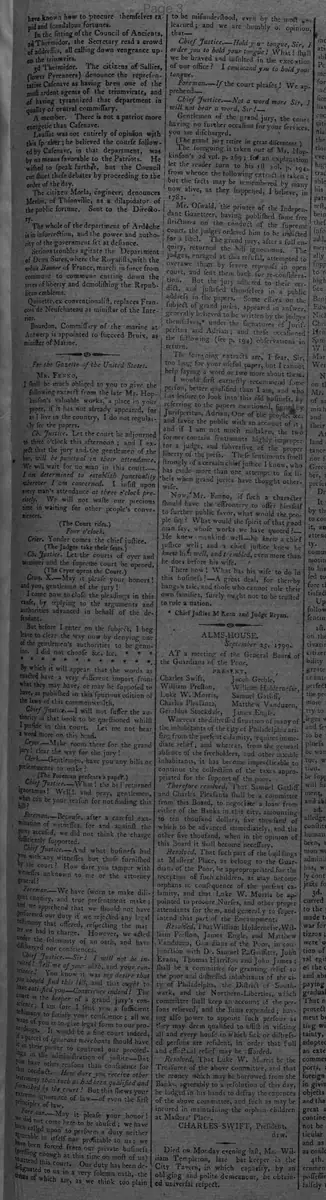
MR. FENNO,
I shall be much obliged to you to give the following extract from the late Mr. Hopkinson's valuable works, a place in your paper, if it has not already appeared, for as I live in the country, I do not regularly see the papers.
Ch. Justice. Let the court be adjourned to three o'clock this afternoon; and I expect that the jury and the gentlemen of the bar, will be punctual in their attendance. We will wait for no man in this court. I am determined to establish punctuality wherever I am concerned. I insist upon every man's attendance at three o'clock precisely. We will not waste our precious time in waiting for other people's conveniences.
(The Court rises.)
Four o'clock.
Crier. Yonder comes the chief justice.
(The Judges take their seats.)
Ch. Justice. Let the courts of oyer and terminer and the supreme court be opened.
(The Cryer opens the Court.)
Coun. X.-May it please your honors! and you, gentlemen of the jury! I come now to close the pleadings in this case, by replying to the arguments and authorities advanced in behalf of the defendant.
But before I enter on the subject, I beg leave to clear the way now by denying one of the gentlemen's authorities to be genuine. I did not choose &c. &c. * * *
By which it will appear that the words as enacted have a very different import from what they may have, or may be supposed to have, as published in this spurious edition of the laws of this commonwealth.
Chief Justice.—I will not suffer the authority of that book to be questioned whilst I preside in this court. Let me not hear a word more on this head.
Cryer.—Make room there for the grand jury! clear the way for the jury!
Clerk.—Gentlemen, have you any bills or presentments to make?
(The Foreman presents a paper.)
Chief Justice. —What! the bill I returned ignoramus! Well! and pray, gentlemen, what can be your reason for not finding this bill?
Foreman, Because, after a careful examination of witnesses, for and against the party accused, we did not think the charge sufficiently supported.
Chief Justice. And what business had you with any witnesses but those furnished by the court? How dare you tamper with witnesses unknown to me or the attorney general?
Foreman.—We have sworn to make diligent enquiry, and true presentment make; and we apprehend that we should not have performed our duty if we rejected any legal testimony that offered, respecting the matter we had in charge. However, we acted under the solemnity of an oath, and have discharged our consciences.
Chief Justice.—Sir! I will not be insulted! Tell me of your oath, and your conscience! You know it was my desire that you should find this bill, and that ought to have satisfied you—Conscience indeed! The court is the keeper of a grand jury's conscience; I am sure I sent you a sufficient testimony to satisfy your conscience; all we want of you is to give legal form to our proceedings. It would be a fine court indeed, if a parcel of ignorant merchants should have it in their power to control our proceedings in the administration of justice—But you have other reasons than conscience for this conduct. How dare you receive other testimony than such as had been qualified and furnished by the court! But this shows your extreme ignorance of law —of even the first principles of law.
Foreman.—May it please your honor! we did not come here to be abused; we have been called upon to perform a duty neither agreeable in itself nor profitable to us; we have been forced from our private business (pressing enough at this time on most of us) to attend this court. Our duty has been designated to us in a very solemn oath, the terms of which are, as we think too plain to be misunderstood, even by the most unlearned; and we are humbly of opinion, that.
Chief Justice.-Hold your tongue, Sir, I order you to hold your tongue! What! shall we be braved and insulted in the execution of our office? I command you to hold your tongue.
Foreman.--If the court pleases! We apprehend-
Chief Justice.-Not a word more Sir, I will not bear a word, Sir!-
Gentlemen of the grand jury, the court having no further occasion for your services, you are discharged.
(The grand jury retire in great discontent.)
The foregoing is taken out of Mr. Hopkinson's 2d vol. p. 269; for an explanation let the reader turn to his 1st vol. p. 194 from whence the following extract is taken; but the facts may be remembered by many now alive, as they happened, I believe, in 1782.
Mr. Oswald, the printer of the Independent Gazetteer, having published some free strictures on the conduct of the supreme court, the judges ordered him to be indicted for a libel. The grand jury, after a full enquiry, returned the bill ignoramus. The judges, enraged at this refusal, attempted to overawe them by severe reproofs in open court, and sent them back for re-consideration. But the jury adhered to their verdict, and justified themselves in a public address in the papers. Some essays on the subject of grand juries, appeared in answer, generally believed to be written by the judges themselves, * under the signatures of Jurisperitus and Adrian; and these occasioned the following (see p. 194) observations in return.
The foregoing extracts are, I fear, Sir, too long for your useful paper, but I cannot help saying a word or two more about them.
I would first earnestly recommend some person, better qualified than I am, and who has leisure to look into this old business, by referring to the papers mentioned, signed by Jurisperitus, Adrian, One of the people, &c. and favor the public with an account of it; and if I am not much mistaken, the two former contain sentiments highly improper for a judge, and subversive of this proper liberty of the press. These sentiments smell strongly of a certain chief justice I know, who has made more than one attempt to fix libels when grand juries have thought otherwise.
Now, Mr. Fenno, if such a character should have the effrontery to offer himself to further public favor, what would the people say? What would the spirit of that good man say, whose works we have quoted? He knew mankind well-he knew a chief justice well; and a chief justice knew he knew him well, and trembled, even more than he does before his wife.
There now! What has his wife to do in this business?-A great deal, for thereby hangs a tale, and those who cannot rule their own families, surely ought not to be trusted to rule a nation.
Chief Justice McKean and Judge Bryan.
What sub-type of article is it?
What themes does it cover?
What keywords are associated?
What entities or persons were involved?
Letter to Editor Details
Author
Chief Justice Mckean And Judge Bryan
Recipient
Mr. Fenno
Main Argument
the letter shares a historical extract from hopkinson illustrating judicial overreach in a 1782 libel case against printer oswald, recommends investigating judicial writings under pseudonyms that undermine press freedom, and implicitly criticizes chief justice mckean's character and fitness for public office.
Notable Details