Thank you for visiting SNEWPapers!
Sign up free
Editorial
April 5, 1862
The Emporia News
Emporia, Lyon County, Kansas
What is this article about?
Editorial condemns 'pressing' and 'jayhawking'—private theft of rebel property during Civil War—as immoral sin, equating it to stealing and urging community indignation, especially in Kansas.
Clipping
OCR Quality
95%
Excellent
Full Text
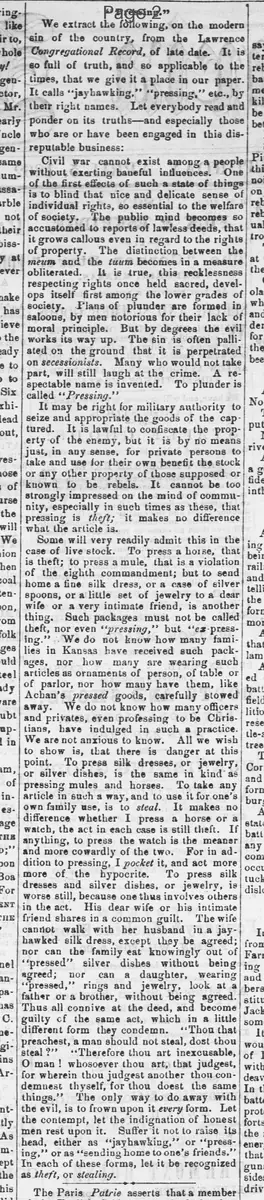
We extract the following, on the modern sin of the country, from the Lawrence Congregational Record, of late date. It is so full of truth, and so applicable to the times, that we give it a place in our paper. It calls "jayhawking," "pressing," etc., by their right names. Let everybody read and ponder on its truths—and especially those who are or have been engaged in this disreputable business:
Civil war cannot exist among a people without exerting baneful influences. One of the first effects of such a state of things is to blind that nice and delicate sense of individual rights, so essential to the welfare of society. The public mind becomes so accustomed to reports of lawless deeds, that it grows callous even in regard to the rights of property. The distinction between the meum and the tuum becomes in a measure obliterated. It is true, this recklessness respecting rights once held sacred, develops itself first among the lower grades of society. Plans of plunder are formed in saloons, by men notorious for their lack of moral principle. But by degrees the evil works its way up. The sin is often palliated on the ground that it is perpetrated on secessionists. Many who would not take part, will still laugh at the crime. A respectable name is invented. To plunder is called "Pressing."
It may be right for military authority to seize and appropriate the goods of the captured. It is lawful to confiscate the property of the enemy, but it is by no means just, in any sense, for private persons to take and use for their own benefit the stock or any other property of those supposed or known to be rebels. It cannot be too strongly impressed on the mind of community, especially in such times as these, that pressing is theft; it makes no difference what the article is.
Some will very readily admit this in the case of live stock. To press a horse, that is theft; to press a mule, that is a violation of the eighth commandment; but to send home a fine silk dress, or a case of silver spoons, or a little set of jewelry to a dear wife or a very intimate friend, is another thing. Such packages must not be called theft, nor even "pressing," but "ex-pressing." We do not know how many families in Kansas have received such packages, nor how many are wearing such articles as ornaments of person, of table or of parlor, nor how many have them, like Achan's pressed goods, carefully stowed away. We do not know how many officers and privates, even professing to be Christians, have indulged in such a practice. We are not anxious to know. All we wish to show is, that there is danger at this point. To press silk dresses, or jewelry, or silver dishes, is the same in kind as pressing mules and horses. To take any article in such a way, and to use it for one's own family use, is to steal. It makes no difference whether I press a horse or a watch, the act in each case is still theft. If anything, to press the watch is the meaner and more cowardly of the two. For in addition to pressing, I pocket it, and act more of the hypocrite. To press silk dresses and silver dishes, or jewelry, is worse still, because one thus involves others in the act. His dear wife or his intimate friend shares in a common guilt. The wife cannot walk with her husband in a jay-hawked silk dress, except they be agreed; nor can the family eat knowingly out of "pressed" silver dishes without being agreed; nor can a daughter, wearing "pressed," rings and jewelry, look at a father or a brother, without being agreed. Thus all connive at the deed, and become guilty of the same act, which in a little different form they condemn. "Thou that preachest a man should not steal, dost thou steal?" "Therefore thou art inexcusable, O man! whosoever thou art, that judgest, for wherein thou judgest another thou condemnest thyself, for thou doest the same things." The only way to do away with the evil, is to frown upon it every form. Let the contempt, let the indignation of honest men rest upon it. Suffer it not to raise its head, either as "jayhawking," or "pressing," or as "sending home to one's friends." In each of these forms, let it be recognized as theft, or stealing.
Civil war cannot exist among a people without exerting baneful influences. One of the first effects of such a state of things is to blind that nice and delicate sense of individual rights, so essential to the welfare of society. The public mind becomes so accustomed to reports of lawless deeds, that it grows callous even in regard to the rights of property. The distinction between the meum and the tuum becomes in a measure obliterated. It is true, this recklessness respecting rights once held sacred, develops itself first among the lower grades of society. Plans of plunder are formed in saloons, by men notorious for their lack of moral principle. But by degrees the evil works its way up. The sin is often palliated on the ground that it is perpetrated on secessionists. Many who would not take part, will still laugh at the crime. A respectable name is invented. To plunder is called "Pressing."
It may be right for military authority to seize and appropriate the goods of the captured. It is lawful to confiscate the property of the enemy, but it is by no means just, in any sense, for private persons to take and use for their own benefit the stock or any other property of those supposed or known to be rebels. It cannot be too strongly impressed on the mind of community, especially in such times as these, that pressing is theft; it makes no difference what the article is.
Some will very readily admit this in the case of live stock. To press a horse, that is theft; to press a mule, that is a violation of the eighth commandment; but to send home a fine silk dress, or a case of silver spoons, or a little set of jewelry to a dear wife or a very intimate friend, is another thing. Such packages must not be called theft, nor even "pressing," but "ex-pressing." We do not know how many families in Kansas have received such packages, nor how many are wearing such articles as ornaments of person, of table or of parlor, nor how many have them, like Achan's pressed goods, carefully stowed away. We do not know how many officers and privates, even professing to be Christians, have indulged in such a practice. We are not anxious to know. All we wish to show is, that there is danger at this point. To press silk dresses, or jewelry, or silver dishes, is the same in kind as pressing mules and horses. To take any article in such a way, and to use it for one's own family use, is to steal. It makes no difference whether I press a horse or a watch, the act in each case is still theft. If anything, to press the watch is the meaner and more cowardly of the two. For in addition to pressing, I pocket it, and act more of the hypocrite. To press silk dresses and silver dishes, or jewelry, is worse still, because one thus involves others in the act. His dear wife or his intimate friend shares in a common guilt. The wife cannot walk with her husband in a jay-hawked silk dress, except they be agreed; nor can the family eat knowingly out of "pressed" silver dishes without being agreed; nor can a daughter, wearing "pressed," rings and jewelry, look at a father or a brother, without being agreed. Thus all connive at the deed, and become guilty of the same act, which in a little different form they condemn. "Thou that preachest a man should not steal, dost thou steal?" "Therefore thou art inexcusable, O man! whosoever thou art, that judgest, for wherein thou judgest another thou condemnest thyself, for thou doest the same things." The only way to do away with the evil, is to frown upon it every form. Let the contempt, let the indignation of honest men rest upon it. Suffer it not to raise its head, either as "jayhawking," or "pressing," or as "sending home to one's friends." In each of these forms, let it be recognized as theft, or stealing.
What sub-type of article is it?
Moral Or Religious
Crime Or Punishment
Social Reform
What keywords are associated?
Jayhawking
Pressing
Theft
Civil War
Morality
Property Rights
Secessionists
What entities or persons were involved?
Secessionists
Officers
Privates
Christians
Editorial Details
Primary Topic
Condemnation Of Pressing And Jayhawking As Theft During Civil War
Stance / Tone
Moral Exhortation Against Theft
Key Figures
Secessionists
Officers
Privates
Christians
Key Arguments
Civil War Blinds Sense Of Individual Rights And Property
Plunder Starts Among Lower Classes But Spreads
Pressing Is Theft, Regardless Of Target Being Secessionists
Military Confiscation Is Lawful, But Private Taking Is Not
Pressing Luxury Items Like Silk Dresses Or Jewelry Is Still Theft
Involves Family And Friends In Guilt
All Forms Of Pressing Must Be Frowned Upon As Stealing