Thank you for visiting SNEWPapers!
Sign up free
The Virginia Gazette
Richmond, Williamsburg, Richmond County, Virginia
What is this article about?
British parliamentary debate in London on January 26, 1771, regarding the Spanish Ambassador's declaration on Falkland's Island. Opposition moved for papers on negotiations with Spain (agreed) and France (overruled), amid suspicions of French interference and criticism of the inadequate compromise.
Clipping
OCR Quality
Full Text
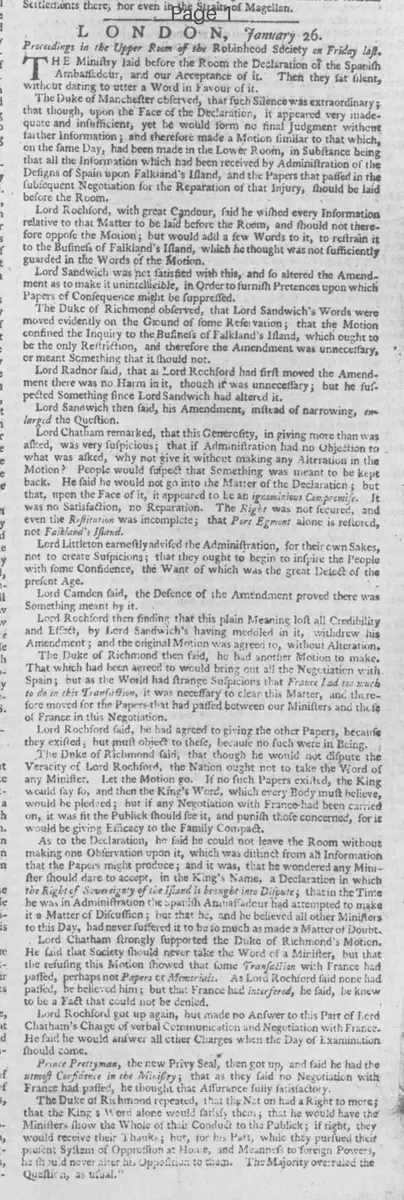
Proceedings in the Upper Room of the Robinhood Society on Friday last.
The Ministry laid before the Room the Declaration of the Spanish Ambassador, and our Acceptance of it. Then they sat silent, without daring to utter a Word in Favour of it.
The Duke of Manchester observed, that such Silence was extraordinary; that though, upon the Face of the Declaration, it appeared very inadequate and insufficient, yet he would form no final Judgment without farther Information; and therefore made a Motion similar to that which, on the same Day, had been made in the Lower Room, in Substance being that all the Information which had been received by Administration of the Designs of Spain upon Falkland's Island, and the Papers that passed in the subsequent Negotiation for the Reparation of that Injury, should be laid before the Room.
Lord Rochford, with great Candour, said he wished every Information relative to that Matter to be laid before the Room, and should not therefore oppose the Motion; but would add a few Words to it, to restrain it to the Business of Falkland's Island, which he thought was not sufficiently guarded in the Words of the Motion.
Lord Sandwich was not satisfied with this, and so altered the Amendment as to make it unintelligible, in Order to furnish Pretences upon which Papers of Consequence might be suppressed.
The Duke of Richmond observed, that Lord Sandwich's Words were moved evidently on the Ground of some Reservation; that the Motion confined the Inquiry to the Business of Falkland's Island, which ought to be the only Restriction, and therefore the Amendment was unnecessary, or meant Something that it should not.
Lord Radnor said, that as Lord Rochford had first moved the Amendment there was no Harm in it, though it was unnecessary; but he suspected Something since Lord Sandwich had altered it.
Lord Sandwich then said, his Amendment, instead of narrowing, enlarged the Question.
Lord Chatham remarked, that this Generosity, in giving more than was asked, was very suspicious; that if Administration had no Objection to what was asked, why not give it without making any Alteration in the Motion? People would suspect that Something was meant to be kept back. He said he would not go into the Matter of the Declaration; but that, upon the Face of it, it appeared to be an ignominious Compromise. It was no Satisfaction, no Reparation. The Right was not secured, and even the Restitution was incomplete; that Port Egmont alone is restored, not Falkland's Island.
Lord Littleton earnestly advised the Administration, for their own Sakes, not to create Suspicions; that they ought to begin to inspire the People with some Confidence, the Want of which was the great Defect of the present Age.
Lord Camden said, the Defence of the Amendment proved there was Something meant by it.
Lord Rochford then finding that this plain Meaning lost all Credibility and Effect, by Lord Sandwich's having meddled in it, withdrew his Amendment; and the original Motion was agreed to, without Alteration.
The Duke of Richmond then said, he had another Motion to make. That which had been agreed to would bring out all the Negotiation with Spain; but as the World had strange Suspicions that France had too much to do in this Transaction, it was necessary to clear this Matter, and therefore moved for the Papers that had passed between our Ministers and those of France in this Negotiation.
Lord Rochford said, he had agreed to giving the other Papers, because they existed, but must object to these, because no such were in Being.
The Duke of Richmond said, that though he would not dispute the Veracity of Lord Rochford, the Nation ought not to take the Word of any Minister. Let the Motion go. If no such Papers existed, the King would say so, and then the King's Word, which every Body must believe, would be pleaded; but if any Negotiation with France had been carried on, it was fit the Publick should see it, and punish those concerned, for it would be giving Efficacy to the Family Compact.
As to the Declaration, he said he could not leave the Room without making one Observation upon it, which was distinct from all Information that the Papers might produce; and it was, that he wondered any Minister should dare to accept, in the King's Name, a Declaration in which the Right of Sovereignty of the Island is brought into Dispute; that in the Time he was in Administration the Spanish Ambassador had attempted to make it a Matter of Discussion; but that he, and he believed all other Ministers to this Day, had never suffered it to be so much as made a Matter of Doubt.
Lord Chatham strongly supported the Duke of Richmond's Motion. He said that Society should never take the Word of a Minister, but that the refusing this Motion showed that some Transaction with France had passed, perhaps not Papers or Memorials. As Lord Rochford said none had passed, he believed him; but that France had interfered, he said, he knew to be a Fact that could not be denied.
Lord Rochford got up again, but made no Answer to this Part of Lord Chatham's Charge of verbal Communication and Negotiation with France. He said he would answer all other Charges when the Day of Examination should come.
Prince Prettyman, the new Privy Seal, then got up, and said he had the utmost Confidence in the Ministry; that as they said no Negotiation with France had passed, he thought that Assurance fully satisfactory.
The Duke of Richmond repeated, that the Nation had a Right to more; that the King's Word alone would satisfy them; that he would have the Ministers show the Whole of their Conduct to the Publick; if right, they would receive their Thanks; but, for his Part, while they pursued their present System of Oppression at Home, and Meanness to foreign Powers, he should never alter his Opposition to them. The Majority overruled the Question, as usual.
What sub-type of article is it?
What keywords are associated?
What entities or persons were involved?
Where did it happen?
Foreign News Details
Primary Location
Falkland's Island
Event Date
Friday Last, Reported January 26
Key Persons
Outcome
motion for spanish negotiation papers agreed to without alteration; motion for french papers overruled by majority.
Event Details
In the Upper Room of the Robinhood Society, the Ministry presented the Spanish Ambassador's declaration and Britain's acceptance, met with silence. The Duke of Manchester moved for all information on Spain's designs on Falkland's Island and related negotiations. Lord Rochford supported but proposed an amendment, altered by Lord Sandwich, leading to suspicions. Amendment withdrawn; original motion agreed. Duke of Richmond then moved for papers on French involvement, opposed by Lord Rochford claiming none existed; motion overruled. Debate highlighted suspicions of incomplete restitution and French interference in the compromise.