Thank you for visiting SNEWPapers!
Sign up free
Rhode Island American And Providence Gazette
Providence, Providence County, Rhode Island
What is this article about?
In Auburn, NY, on November 1, 1828, four-year-old Margaret Mills, daughter of Professor H. Mills, underwent a successful tracheotomy for severe croup performed by Dr. Joseph T. Pitney. After eight days of breathing through the incision, she recovered fully by December 16, 1828.
Clipping
OCR Quality
Full Text
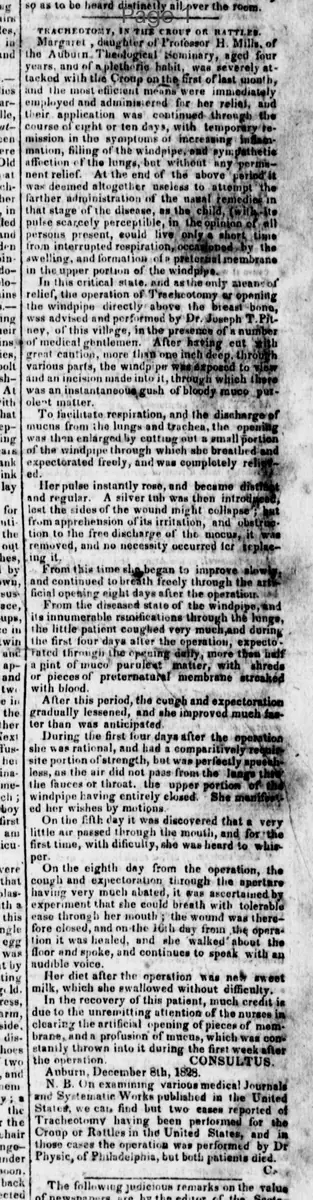
Margaret, daughter of Professor H. Mills of the Auburn Theological seminary, aged four years, and of a plethoric habit, was severely attacked with the Croup on the first of last month, and the most efficient means were immediately employed and administered for her relief, and their application was continued through the course of eight or ten days, with temporary remission in the symptoms of increasing inflammation, swelling of the windpipe, and sympathetic affection of the lungs, but without any permanent relief. At the end of the above period it was deemed altogether useless to attempt the farther administration of the usual remedies in that stage of the disease, as the child, with its pulse scarcely perceptible, in the opinion of all persons present, could live only a short time from interrupted respiration, occasioned by the swelling, and formation of a preternatural membrane in the upper portion of the windpipe. In this critical state, and as the only chance for relief, the operation of Tracheotomy or opening the windpipe directly above the breast bone, was advised and performed by Dr. Joseph T. Pitney, of this village, in the presence of a number of medical gentlemen. After having cut with great caution, more than one inch deep, through various parts, the windpipe was exposed to view and an incision made into it, through which there was an instantaneous gush of bloody mucopurulent matter.
To facilitate respiration, and the discharge of mucus from the lungs and trachea, the opening was then enlarged by cutting out a small portion of the windpipe through which she breathed and expectorated freely, and was completely relieved. Her pulse instantly rose, and became distinct and regular. A silver tube was then introduced lest the sides of the wound might collapse, from apprehension of its irritation, and obstruction to the free discharge of the mucus, it was removed, and no necessity occurred for replacing it.
From this time she began to improve slowly and continued to breathe freely through the artificial opening eight days after the operation. From the diseased state of the windpipe, and its innumerable ramifications through the lungs, the little patient coughed very much, and during the first four days after the operation, expectorated through the opening daily, more than half a pint of mucopurulent matter, with shreds or pieces of preternatural membrane streaked with blood.
After this period, the cough and expectoration gradually lessened, and she improved much faster than was anticipated.
During the first four days after the operation she was rational, and had a comparatively reduced portion of strength, but was perfectly speechless, as the air did not pass from the lungs through the larynx or throat, the upper portion of the windpipe having entirely closed. She manifested her wishes by motions.
On the fifth day it was discovered that a very little air passed through the mouth, and for the first time, with difficulty, she was heard to whisper.
On the eighth day from the operation, the cough and expectoration through the aperture having very much abated, it was ascertained by experiment that she could breathe with tolerable ease through her mouth; the wound was therefore closed, and on the 16th day from the operation it was healed, and she walked about the floor and spoke, and continues to speak with an audible voice.
Her diet after the operation was new sweet milk, which she swallowed without difficulty.
In the recovery of this patient, much credit is due to the unremitting attention of the nurses in clearing the artificial opening of pieces of membrane, and a profusion of mucus, which was constantly thrown into it during the first week after the operation.
CONSULTUS.
Auburn, December 8th, 1828.
N. B. On examining various medical Journals and Systematic Works published in the United States, we can find but two cases reported of Tracheotomy having been performed for the Croup or Rattles in the United States, and in those cases the operation was performed by Dr. Physick, of Philadelphia, but both patients died.
C.
What sub-type of article is it?
What keywords are associated?
What entities or persons were involved?
Where did it happen?
Domestic News Details
Primary Location
Auburn
Event Date
November 1, 1828
Key Persons
Outcome
the child fully recovered after the tracheotomy, with the wound healing by december 16, 1828, and she regained her ability to speak.
Event Details
Four-year-old Margaret Mills was attacked by croup on November 1, 1828, and after ineffective treatments, Dr. Joseph T. Pitney performed a tracheotomy around November 8-10, 1828. She breathed through the opening for eight days, expectorating significant mucus and membrane, then gradually resumed natural breathing and fully recovered.