Thank you for visiting SNEWPapers!
Sign up free
Story
April 6, 1933
Farmers Independent
Bagley, Clearwater County, Minnesota
What is this article about?
President Roosevelt urges Congress to enact legislation refinancing farmers' debts through mortgage adjustments, interest reductions, and federal support, with plans to extend to homeowners and tariff agreements.
Clipping
OCR Quality
100%
Excellent
Full Text
President Requests Congress to Relieve Farm Indebtedness
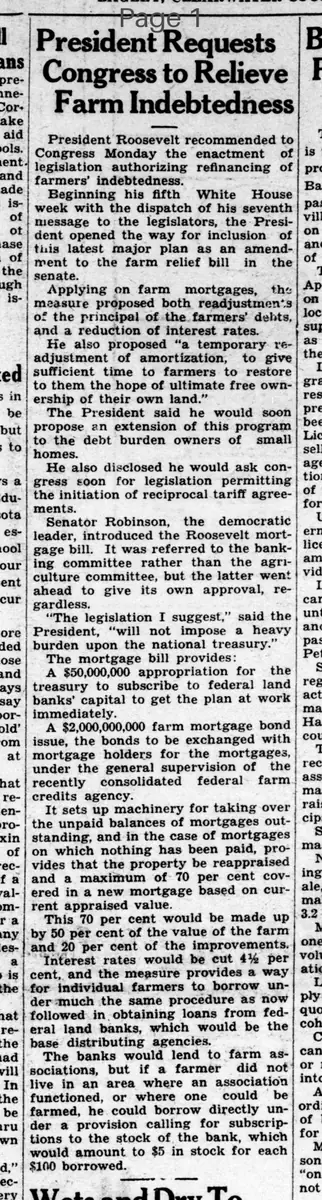
President Roosevelt recommended to Congress Monday the enactment of legislation authorizing refinancing of farmers' indebtedness.
Beginning his fifth White House week with the dispatch of his seventh message to the legislators, the President opened the way for inclusion of this latest major plan as an amendment to the farm relief bill in the senate.
Applying on farm mortgages, the measure proposed both readjustments of the principal of the farmers' debts and a reduction of interest rates. He also proposed "a temporary readjustment of amortization, to give sufficient time to farmers to restore to them the hope of ultimate free ownership of their own land."
The President said he would soon propose an extension of this program to the debt burden owners of small homes. He also disclosed he would ask congress soon for legislation permitting the initiation of reciprocal tariff agreements.
Senator Robinson, the democratic leader, introduced the Roosevelt mortgage bill. It was referred to the banking committee rather than the agriculture committee, but the latter went ahead to give its own approval, regardless.
"The legislation I suggest," said the President, "will not impose a heavy burden upon the national treasury."
The mortgage bill provides:
A $50,000,000 appropriation for the treasury to subscribe to federal land banks' capital to get the plan at work immediately.
A $2,000,000,000 farm mortgage bond issue, the bonds to be exchanged with mortgage holders for the mortgages, under the general supervision of the recently consolidated federal farm credits agency.
It sets up machinery for taking over the unpaid balances of mortgages outstanding, and in the case of mortgages on which nothing has been paid, provides that the property be reappraised and a maximum of 70 per cent covered in a new mortgage based on current appraised value.
This 70 per cent would be made up by 50 per cent of the value of the farm and 20 per cent of the improvements.
Interest rates would be cut 41 per cent, and the measure provides a way for individual farmers to borrow under much the same procedure as now followed in obtaining loans from federal land banks, which would be the base distributing agencies.
The banks would lend to farm associations, but if a farmer did not live in an area where an association functioned, or where one could be formed, he could borrow directly under a provision calling for subscriptions to the stock of the bank, which would amount to $5 in stock for each $100 borrowed.
President Roosevelt recommended to Congress Monday the enactment of legislation authorizing refinancing of farmers' indebtedness.
Beginning his fifth White House week with the dispatch of his seventh message to the legislators, the President opened the way for inclusion of this latest major plan as an amendment to the farm relief bill in the senate.
Applying on farm mortgages, the measure proposed both readjustments of the principal of the farmers' debts and a reduction of interest rates. He also proposed "a temporary readjustment of amortization, to give sufficient time to farmers to restore to them the hope of ultimate free ownership of their own land."
The President said he would soon propose an extension of this program to the debt burden owners of small homes. He also disclosed he would ask congress soon for legislation permitting the initiation of reciprocal tariff agreements.
Senator Robinson, the democratic leader, introduced the Roosevelt mortgage bill. It was referred to the banking committee rather than the agriculture committee, but the latter went ahead to give its own approval, regardless.
"The legislation I suggest," said the President, "will not impose a heavy burden upon the national treasury."
The mortgage bill provides:
A $50,000,000 appropriation for the treasury to subscribe to federal land banks' capital to get the plan at work immediately.
A $2,000,000,000 farm mortgage bond issue, the bonds to be exchanged with mortgage holders for the mortgages, under the general supervision of the recently consolidated federal farm credits agency.
It sets up machinery for taking over the unpaid balances of mortgages outstanding, and in the case of mortgages on which nothing has been paid, provides that the property be reappraised and a maximum of 70 per cent covered in a new mortgage based on current appraised value.
This 70 per cent would be made up by 50 per cent of the value of the farm and 20 per cent of the improvements.
Interest rates would be cut 41 per cent, and the measure provides a way for individual farmers to borrow under much the same procedure as now followed in obtaining loans from federal land banks, which would be the base distributing agencies.
The banks would lend to farm associations, but if a farmer did not live in an area where an association functioned, or where one could be formed, he could borrow directly under a provision calling for subscriptions to the stock of the bank, which would amount to $5 in stock for each $100 borrowed.
What sub-type of article is it?
Historical Event
What themes does it cover?
Misfortune
Recovery
What keywords are associated?
Farm Indebtedness
Mortgage Refinancing
Federal Land Banks
Interest Reduction
Roosevelt Legislation
What entities or persons were involved?
President Roosevelt
Senator Robinson
Where did it happen?
White House
Story Details
Key Persons
President Roosevelt
Senator Robinson
Location
White House
Event Date
Monday During President Roosevelt's Fifth Week In The White House
Story Details
President Roosevelt recommends legislation to refinance farmers' mortgages by readjusting principals, reducing interest rates by 41%, and providing federal funding through land banks and bond issues to alleviate indebtedness.