Thank you for visiting SNEWPapers!
Sign up free
Edwardsville Spectator
Edwardsville, Madison County, Illinois
What is this article about?
Explanatory article on US public land system by J. Meigs: defines townships and sections, details reservations for schools (over 1.6M acres) and colleges (300K+ acres), praises allodial tenure vs. feudal systems, highlighting benefits for education and property rights.
Merged-components note: The table depicts the section numbering in a township, which is integral to the explanatory content of the 'NATIONAL LANDS' article. Merging the table into the story component as it provides visual support for the textual description.
Clipping
OCR Quality
Full Text
We have been favored with the following interesting article, descriptive and explanatory of the admirable system adopted by the government for the intelligent management of the national domain, by the scientific and intelligent gentleman of the Post Office Department, to whose pen our readers and the public are frequently indebted for useful observations on the climate, soil, and products of our country, and on subjects connected with literature and science.
Nat. Intel.
A citizen of high respectability has communicated to me the following:
"There are some points relative to the Public Land system, which, I believe, are not so clearly and generally understood as they should be. Permit me to ask—
"1st. What is the section of a township?
"Though this is familiar to persons in the Land Office, I doubt whether it is distinctly understood by many who read newspapers.
"2d. What is the encouragement for Schools and Colleges in the locations of public lands? The answer would, I trust, be honorable to the government of the country, and very interesting to the friends of science.
"3d. What is the tenure of lands granted by the United States? The allodial character of the landholder accords with the free spirit of our political institutions, but perhaps this distinguishing advantage has not attracted the attention of many in the community. It is an advantage which might be more highly estimated, if viewed in contrast with the abuses and oppressions suffered by European tenantry. The land system of the United States is a novelty of such practical excellence, that I wish it to be made known distinctly, and in such a manner as to leave no question of fact."
Answer to the First Question.
SECTION.
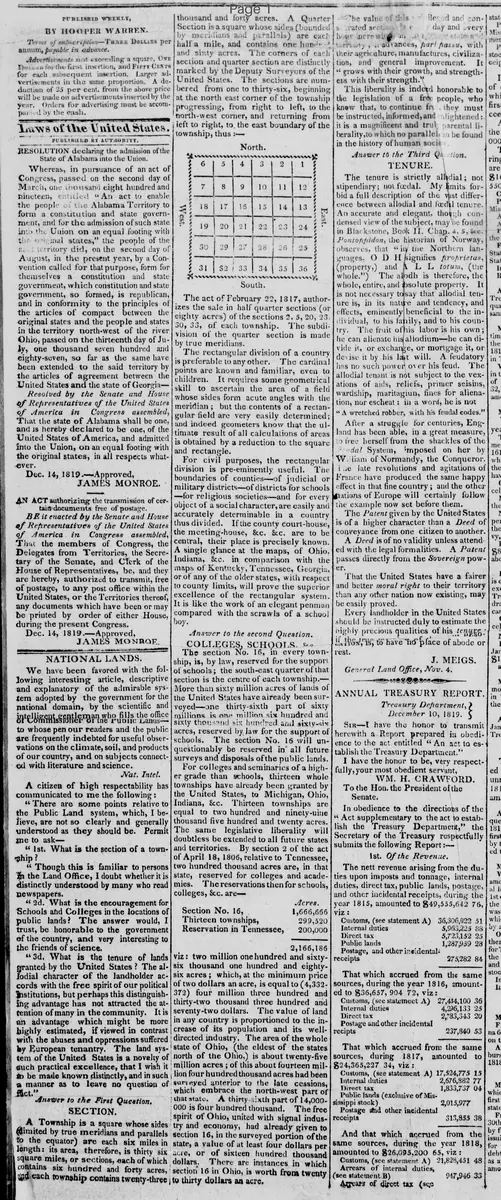
A Township is a square whose sides (limited by true meridians and parallels to the equator) are each six miles in length: its area, therefore, is thirty-six square miles, or sections, each of which contains six hundred and forty acres, and each township contains twenty-three thousand and forty acres. A Quarter Section is a square whose sides (bounded by meridians and parallels) are each half a mile, and contains one hundred and sixty acres. The corners of each section and quarter section are distinctly marked by the Deputy Surveyors of the United States. The sections are numbered from one to thirty-six, beginning at the north east corner of the township, progressing, from right to left, to the north-west corner, and returning from left to right, to the east boundary of the township, thus:
[Diagram: North to South]
The act of February 22, 1817, authorizes the sale in half quarter sections (or eighty acres) of the sections 2, 5, 20, 23, 30, 33, of each township. The subdivision of the quarter section is made by true meridians.
The rectangular division of a country is preferable to any other. The cardinal points are known and familiar, even to children. It requires some geometrical skill to ascertain the area of a field whose sides form acute angles with the meridian; but the contents of a rectangular field are very easily determined; and indeed geometers know that the ultimate result of all calculations of areas is obtained by a reduction to the square and rectangle.
For civil purposes, the rectangular division is pre-eminently useful. The boundaries of counties—of judicial or military districts—of districts for schools—for religious societies—and for every object of a social character, are easily and accurately determinable in a country thus divided. If the county court-house, the meeting-house, &c. &c. are to be central, their place is precisely known. A single glance at the maps, of Ohio, Indiana, &c. in comparison with the maps of Kentucky, Tennessee, Georgia, or of any of the older states, with respect to county limits, will prove the superior excellence of the rectangular system. It is like the work of an elegant penman compared with the scrawls of a school boy.
Answer to the second Question.
COLLEGES, SCHOOLS, &c.
The section No. 16, in every township, is, by law, reserved for the support of schools; the south-east quarter of that section is the centre of each township.—More than sixty million acres of lands of the United States have already been surveyed—one thirty-sixth part of sixty millions is one million six hundred and sixty thousand six hundred and sixty-six acres, reserved by law for the support of schools. The section No. 16 will unquestionably be reserved in all future surveys and disposals of the public lands.
For colleges and seminaries of a higher grade than schools, thirteen whole townships have already been granted by the United States, to Michigan, Ohio, Indiana, &c. Thirteen townships are equal to two hundred and ninety-nine thousand five hundred and twenty acres. The same legislative liberality will doubtless be extended to all future states and territories. By section 2 of the act of April 18, 1806, relative to Tennessee, two hundred thousand acres are, in that state, reserved for colleges and academies. The reservations therefore for schools, colleges, &c. are—
Acres.
Section No. 16, 1,666,666
Thirteen townships, 299,520
Reservation in Tennessee, 200,000
2,166,186
viz: two million one hundred and sixty-six thousand one hundred and eighty-six acres; which, at the minimum price of two dollars an acre, is equal to $4,332,372) four million three hundred and thirty-two thousand three hundred and seventy-two dollars. The value of land in any country is proportioned to the increase of its population and its well-directed industry. The area of the whole state of Ohio, (the eldest of the states north of the Ohio,) is about twenty-five million acres; of this about fourteen million four hundred thousand acres had been surveyed anterior to the late cessions, which embrace the north-west part of that state. A thirty-sixth part of 14,000,000 is four hundred thousand. The free spirit of Ohio, united with signal industry and economy, had already given to section 16, in the surveyed portion of the state, a value of at least four dollars per acre, or of sixteen hundred thousand dollars. There are instances in which section 16 in Ohio, is worth from twenty to thirty dollars an acre.
These sections are every day and every hour observed to advance, with their agriculture, manufactures, civilization, and general improvement. It "grows with their growth, and strengthens with their strength."
This liberality is indeed honorable to the legislation of a free people, who know that, to continue free, they must be instructed, informed, and enlightened: it is a magnificent and truly parental liberality, to which no parallel can be found in the history of human society.
Answer to the Third Question.
TENURE.
The tenure is strictly allodial; not stipendiary; not feudal. My limits forbid a full description of the vast difference between allodial and feudal tenure. An accurate and elegant, though condensed view of the subject, may be found in Blackstone, Book II. Chap. 4, 5, &c. Pontoppidan, the historian of Norway, observes, that "in the Northern languages, O D A L signifies proprietas, (property,) and A L L O D totum, (the whole.)" The allod is therefore, the whole, entire, and absolute property. It is not necessary to say that allodial tenure is, in its nature and tendency, and effects, eminently beneficial to the individual, to his family, and to his country. The fruit of his labor is his own; he can alienate his allodium—he can divide it, or exchange, or mortgage it, or devise it by his last will. A feudatory has no such power over his feud. The allodial tenant is not subject to the vexations of aids, reliefs, primer seisins, wardship, marriage, fines for alienation, nor escheat: in a word, he is not "A wretched robber, with his feudal codes."
After a struggle for centuries, England has been able, in a great measure, to free herself from the shackles of the feudal System, imposed on her by William of Normandy, the Conqueror. The late revolutions and agitations of France have produced the same happy effect in that fine country; and the other nations of Europe will certainly follow the example now set before them.
The Patent given by the United States is of a higher character than a Deed of conveyance from one citizen to another. A Deed is of no validity unless attended with the legal formalities. A Patent passes directly from the Sovereign power.
That the United States have a fairer and better moral right to their territory than any other nation now existing, may be easily proved.
Every landholder in the United States should be instructed duly to estimate the highly precious qualities of his tenure: if thou, is, to have no place of abode or rest.
J. MEIGS.
General Land Office, Nov. 4.
| West. | 6 | 5 | 4 | 3 | 2 | 1 |
| 7 | 8 | 9 | 10 | 11 | 12 | |
| 18 | 17 | 16 | 15 | 14 | 13 | |
| 19 | 20 | 21 | 22 | 23 | 24 | |
| 30 | 29 | 27 | 28 | 26 | 25 | |
| 31 | 32 | 33 | 34 | 35 | 36 |
What sub-type of article is it?
What themes does it cover?
What keywords are associated?
What entities or persons were involved?
Where did it happen?
Story Details
Key Persons
Location
United States
Event Date
Nov. 4
Story Details
Explanatory responses to queries on US public land system: township sections (36 sq mi, 640-acre sections), school reservations (Section 16, over 1.6M acres surveyed), college grants (13 townships + 200K acres in TN, total ~2.1M acres valued at $4.3M), and allodial tenure granting absolute property rights without feudal burdens.