Thank you for visiting SNEWPapers!
Sign up free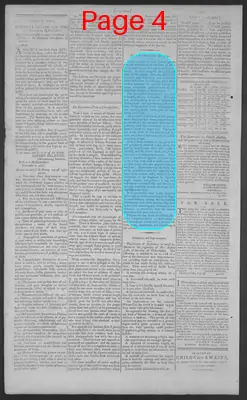
National Gazette
Philadelphia, Philadelphia County, Pennsylvania
What is this article about?
In summer 1791, distinguished gentlemen touring western New York discovered ancient Indian fortifications near the Seneca River, including a 220x55 yard fort with ditches, a half-moon outwork, and a sepulchral stone revealing engraved figures and a pottery fragment. Local Onondagas were unaware of the site.
Clipping
OCR Quality
Full Text
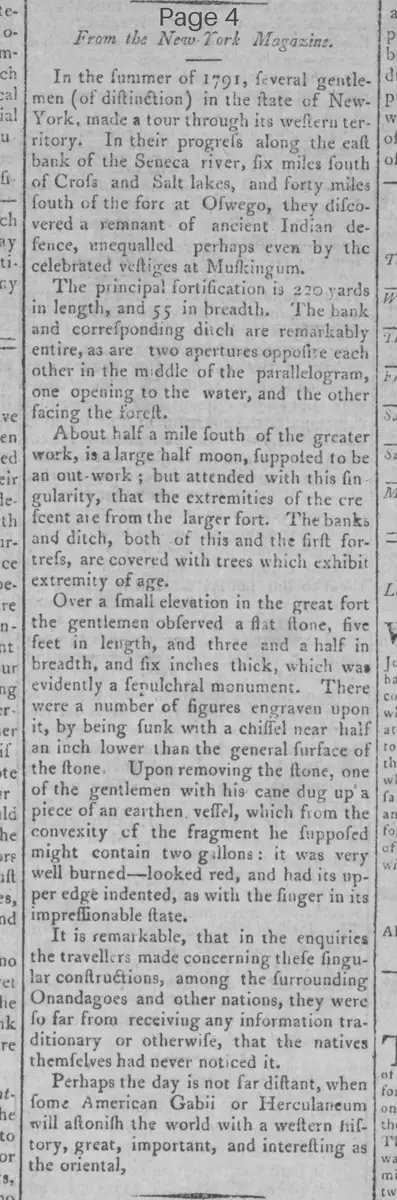
In the summer of 1791, several gentlemen (of distinction) in the state of New-York, made a tour through its western territory. In their progress along the east bank of the Seneca river, six miles south of Cross and Salt lakes, and forty miles south of the fort at Oswego, they discovered a remnant of ancient Indian defence, unequalled perhaps even by the celebrated vestiges at Muskingum.
The principal fortification is 220 yards in length, and 55 in breadth. The bank and corresponding ditch are remarkably entire, as are two apertures opposite each other in the middle of the parallelogram, one opening to the water, and the other facing the forest.
About half a mile south of the greater work, is a large half moon, supposed to be an out-work; but attended with this singularity, that the extremities of the crescent are from the larger fort. The banks and ditch, both of this and the first fortresses, are covered with trees which exhibit extremity of age.
Over a small elevation in the great fort the gentlemen observed a flat stone, five feet in length, and three and a half in breadth, and six inches thick, which was evidently a sepulchral monument. There were a number of figures engraven upon it, by being sunk with a chisel near half an inch lower than the general surface of the stone. Upon removing the stone, one of the gentlemen with his cane dug up a piece of an earthen vessel, which from the convexity of the fragment he supposed might contain two gallons: it was very well burned—looked red, and had its upper edge indented, as with the finger in its impressible state.
It is remarkable, that in the enquiries the travellers made concerning these singular constructions, among the surrounding Onandagoes and other nations, they were so far from receiving any information traditionary or otherwise, that the natives themselves had never noticed it.
Perhaps the day is not far distant, when some American Gabii or Herculaneum will astonish the world with a western history, great, important, and interesting as the oriental.
What sub-type of article is it?
What themes does it cover?
What keywords are associated?
What entities or persons were involved?
Where did it happen?
Story Details
Key Persons
Location
East Bank Of The Seneca River, Six Miles South Of Cross And Salt Lakes, And Forty Miles South Of The Fort At Oswego, State Of New York
Event Date
Summer Of 1791
Story Details
Gentlemen on tour discover ancient Indian fortification, outwork, sepulchral stone with engravings, and pottery fragment; local natives unaware of the site.