Thank you for visiting SNEWPapers!
Sign up free
Literary
January 18, 1934
The Republican
Oakland, Garrett County, Maryland
What is this article about?
Commentary on the First Epistle to the Thessalonians, attributed to Paul, written around 49-54 AD from Corinth. Discusses its historical context, founding of the Thessalonian church, Paul's commendations, warnings against impurity, emphasis on Christ's second coming, and quotes key verses on Christian conduct and a benediction.
Clipping
OCR Quality
98%
Excellent
Full Text
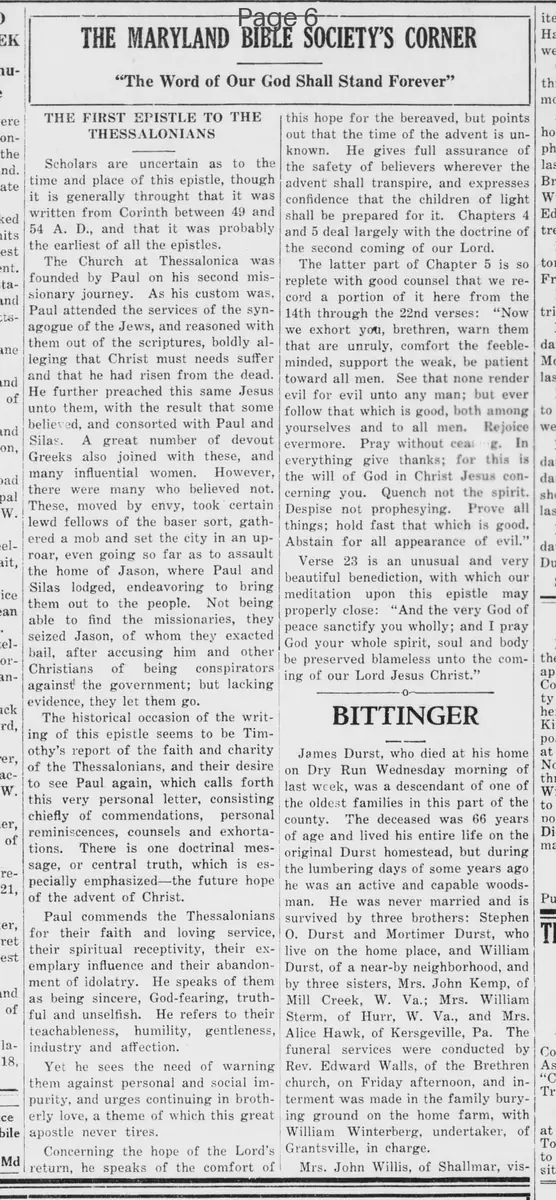
THE MARYLAND BIBLE SOCIETY'S CORNER
"The Word of Our God Shall Stand Forever"
THE FIRST EPISTLE TO THE THESSALONIANS
Scholars are uncertain as to the time and place of this epistle, though it is generally thought that it was written from Corinth between 49 and 54 A. D., and that it was probably the earliest of all the epistles.
The Church at Thessalonica was founded by Paul on his second missionary journey. As his custom was, Paul attended the services of the synagogue of the Jews, and reasoned with them out of the scriptures, boldly alleging that Christ must needs suffer and that he had risen from the dead. He further preached this same Jesus unto them, with the result that some believed and consorted with Paul and Silas. A great number of devout Greeks also joined with these, and many influential women. However, there were many who believed not. These, moved by envy, took certain lewd fellows of the baser sort, gathered a mob and set the city in an uproar, even going so far as to assault the home of Jason, where Paul and Silas lodged, endeavoring to bring them out to the people. Not being able to find the missionaries, they seized Jason, of whom they exacted bail, after accusing him and other Christians of being conspirators against the government; but lacking evidence, they let them go.
The historical occasion of the writing of this epistle seems to be Timothy's report of the faith and charity of the Thessalonians, and their desire to see Paul again, which calls forth this very personal letter, consisting chiefly of commendations, personal reminiscences, counsels and exhortations. There is one doctrinal message, or central truth, which is especially emphasized-the future hope of the advent of Christ.
Paul commends the Thessalonians for their faith and loving service, their spiritual receptivity, their exemplary influence and their abandonment of idolatry. He speaks of them as being sincere, God-fearing, truthful and unselfish. He refers to their teachableness, humility, gentleness, industry and affection.
Yet he sees the need of warning them against personal and social impurity, and urges continuing in brotherly love, a theme of which this great apostle never tires.
Concerning the hope of the Lord's return, he speaks of the comfort of this hope for the bereaved, but points out that the time of the advent is unknown. He gives full assurance of the safety of believers wherever the advent shall transpire, and expresses confidence that the children of light shall be prepared for it. Chapters 4 and 5 deal largely with the doctrine of the second coming of our Lord.
The latter part of Chapter 5 is so replete with good counsel that we record a portion of it here from the 14th through the 22nd verses: "Now we exhort you, brethren, warn them that are unruly, comfort the feebleminded, support the weak, be patient toward all men. See that none render evil for evil unto any man; but ever follow that which is good, both among yourselves and to all men. Rejoice evermore. Pray without ceasing. In everything give thanks; for this is the will of God in Christ Jesus concerning you. Quench not the spirit. Despise not prophesying. Prove all things; hold fast that which is good. Abstain from all appearance of evil."
Verse 23 is an unusual and very beautiful benediction, with which our meditation upon this epistle may properly close: "And the very God of peace sanctify you wholly; and I pray God your whole spirit, soul and body be preserved blameless unto the coming of our Lord Jesus Christ."
"The Word of Our God Shall Stand Forever"
THE FIRST EPISTLE TO THE THESSALONIANS
Scholars are uncertain as to the time and place of this epistle, though it is generally thought that it was written from Corinth between 49 and 54 A. D., and that it was probably the earliest of all the epistles.
The Church at Thessalonica was founded by Paul on his second missionary journey. As his custom was, Paul attended the services of the synagogue of the Jews, and reasoned with them out of the scriptures, boldly alleging that Christ must needs suffer and that he had risen from the dead. He further preached this same Jesus unto them, with the result that some believed and consorted with Paul and Silas. A great number of devout Greeks also joined with these, and many influential women. However, there were many who believed not. These, moved by envy, took certain lewd fellows of the baser sort, gathered a mob and set the city in an uproar, even going so far as to assault the home of Jason, where Paul and Silas lodged, endeavoring to bring them out to the people. Not being able to find the missionaries, they seized Jason, of whom they exacted bail, after accusing him and other Christians of being conspirators against the government; but lacking evidence, they let them go.
The historical occasion of the writing of this epistle seems to be Timothy's report of the faith and charity of the Thessalonians, and their desire to see Paul again, which calls forth this very personal letter, consisting chiefly of commendations, personal reminiscences, counsels and exhortations. There is one doctrinal message, or central truth, which is especially emphasized-the future hope of the advent of Christ.
Paul commends the Thessalonians for their faith and loving service, their spiritual receptivity, their exemplary influence and their abandonment of idolatry. He speaks of them as being sincere, God-fearing, truthful and unselfish. He refers to their teachableness, humility, gentleness, industry and affection.
Yet he sees the need of warning them against personal and social impurity, and urges continuing in brotherly love, a theme of which this great apostle never tires.
Concerning the hope of the Lord's return, he speaks of the comfort of this hope for the bereaved, but points out that the time of the advent is unknown. He gives full assurance of the safety of believers wherever the advent shall transpire, and expresses confidence that the children of light shall be prepared for it. Chapters 4 and 5 deal largely with the doctrine of the second coming of our Lord.
The latter part of Chapter 5 is so replete with good counsel that we record a portion of it here from the 14th through the 22nd verses: "Now we exhort you, brethren, warn them that are unruly, comfort the feebleminded, support the weak, be patient toward all men. See that none render evil for evil unto any man; but ever follow that which is good, both among yourselves and to all men. Rejoice evermore. Pray without ceasing. In everything give thanks; for this is the will of God in Christ Jesus concerning you. Quench not the spirit. Despise not prophesying. Prove all things; hold fast that which is good. Abstain from all appearance of evil."
Verse 23 is an unusual and very beautiful benediction, with which our meditation upon this epistle may properly close: "And the very God of peace sanctify you wholly; and I pray God your whole spirit, soul and body be preserved blameless unto the coming of our Lord Jesus Christ."
What sub-type of article is it?
Essay
What themes does it cover?
Religious
Moral Virtue
What keywords are associated?
First Epistle Thessalonians
Paul
Second Coming
Christian Faith
Brotherly Love
Biblical Commentary
Thessalonica Church
What entities or persons were involved?
Maryland Bible Society
Literary Details
Title
The First Epistle To The Thessalonians
Author
Maryland Bible Society
Subject
Commentary On Paul's Epistle To The Thessalonians
Key Lines
Now We Exhort You, Brethren, Warn Them That Are Unruly, Comfort The Feebleminded, Support The Weak, Be Patient Toward All Men. See That None Render Evil For Evil Unto Any Man; But Ever Follow That Which Is Good, Both Among Yourselves And To All Men. Rejoice Evermore. Pray Without Ceasing. In Everything Give Thanks; For This Is The Will Of God In Christ Jesus Concerning You. Quench Not The Spirit. Despise Not Prophesying. Prove All Things; Hold Fast That Which Is Good. Abstain From All Appearance Of Evil.
And The Very God Of Peace Sanctify You Wholly; And I Pray God Your Whole Spirit, Soul And Body Be Preserved Blameless Unto The Coming Of Our Lord Jesus Christ.