Thank you for visiting SNEWPapers!
Sign up free
Alexandria Gazette
Alexandria, Alexandria County, District Of Columbia
What is this article about?
Extract from Havana dated July 1, 1839, exposes a system of slave trading under U.S. flag protection, involving vessel sales, nominal American captains, and evasion of laws. U.S. Consul Mr. Trist is accused of aiding by providing papers and advice, with several vessels recently dispatched.
Clipping
OCR Quality
Full Text
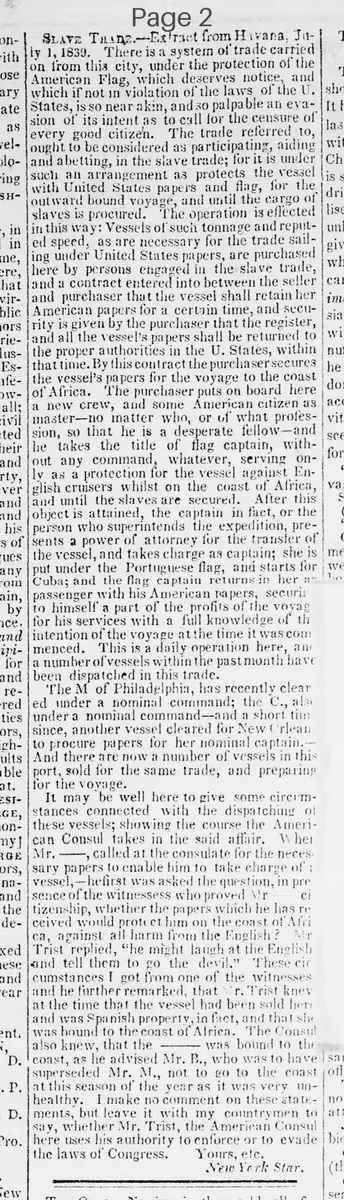
The operation is effected in this way: Vessels of such tonnage and reputed speed, as are necessary for the trade sailing under United States papers, are purchased here by persons engaged in the slave trade. and a contract entered into between the seller and purchaser that the vessel shall retain her American papers for a certain time, and security is given by the purchaser that the register, and all the vessel's papers shall be returned to the proper authorities in the U. States, within that time. By this contract the purchaser secures the vessel's papers for the voyage to the coast of Africa. The purchaser puts on board here a new crew, and some American citizen as master—no matter who, or of what profession, so that he is a desperate fellow—and he takes the title of flag captain, without any command, whatever, serving only as a protection for the vessel against English cruisers whilst on the coast of Africa, and until the slaves are secured. After this object is attained, the captain in fact, or the person who superintends the expedition, presents a power of attorney for the transfer of the vessel, and takes charge as captain; she is put under the Portuguese flag, and starts for Cuba; and the flag captain returns in her a passenger with his American papers, securing to himself a part of the profits of the voyage for his services with a full knowledge of the intention of the voyage at the time it was commenced. This is a daily operation here, and a number of vessels within the past month have been dispatched in this trade.
'The M of Philadelphia, has recently cleared under a nominal command: the C.., also under a nominal command—and a short time since, another vessel cleared for New Orleans to procure papers for her nominal captain.—And there are now a number of vessels in this port, sold for the same trade, and preparing for the voyage.
It may be well here to give some circumstances connected with the dispatching of these vessels; showing the course the American Consul takes in the said affair. When Mr. —, called at the consulate for the necessary papers to enable him to take charge of a vessel,—he first was asked the question, in presence of the witnesses who proved his citizenship, whether the papers which he has received would protect him on the coast of Africa, against all harm from the English? Mr. Trist replied, "he might laugh at the English and tell them to go the devil." These circumstances I got from one of the witnesses and he further remarked, that Mr. Trist knew at the time that the vessel had been sold her and was Spanish property in fact, and that she was bound to the coast of Africa.' The Consul also knew, that the was bound to the coast, as he advised Mr. B., who was to have superseded Mr. M., not to go to the coast at this season of the year as it was very unhealthy, I make no comment on these statements, but leave it with my countrymen to say, whether Mr. Trist, the American Consul here uses his authority to enforce or to evade the laws of Congress.
Yours, etc.
New York Star.
What sub-type of article is it?
What keywords are associated?
What entities or persons were involved?
Where did it happen?
Foreign News Details
Primary Location
Havana
Event Date
July 1, 1839
Key Persons
Outcome
multiple vessels dispatched in the past month using this method; ongoing preparations for more; u.s. consul accused of aiding evasion of slave trade laws.
Event Details
Description of a system where U.S.-flagged vessels are sold to slave traders, retaining American papers for protection during voyages to Africa's coast to procure slaves, then transferred to Portuguese flag for return to Cuba. Nominal American captains serve only for flag protection. U.S. Consul Mr. Trist provides papers knowing the purpose and advises on risks, seen as evading U.S. laws.