Thank you for visiting SNEWPapers!
Sign up free
Editorial
September 23, 1885
The Highland Weekly News
Hillsborough, Hillsboro, Highland County, Ohio
What is this article about?
Editorial excerpt from G. Dallas Lind's 'Methods in Country Schools' stresses the necessity of genuine moral and religious character in teachers, as their inner qualities inevitably shape students' moral development, quoting Dr. Holland on expression of inner truth.
Clipping
OCR Quality
95%
Excellent
Full Text
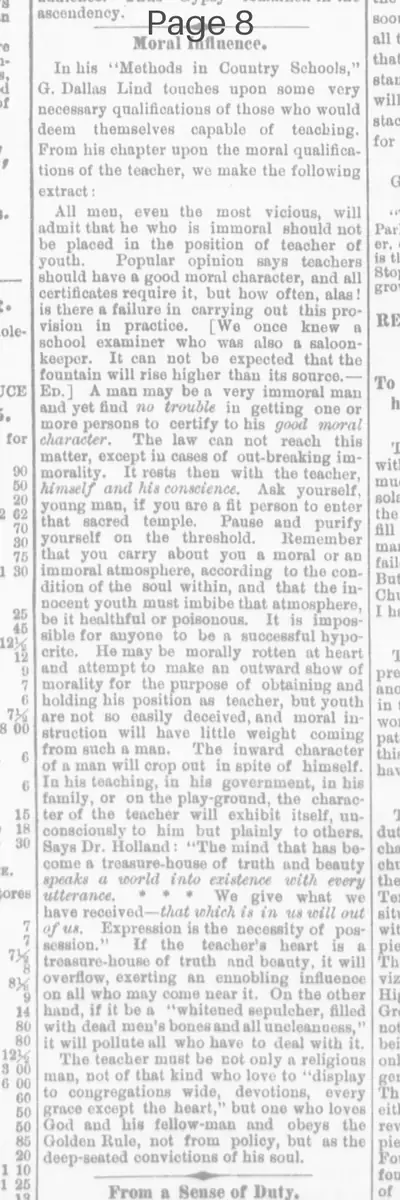
Moral Influence.
In his "Methods in Country Schools," G. Dallas Lind touches upon some very necessary qualifications of those who would deem themselves capable of teaching. From his chapter upon the moral qualifications of the teacher, we make the following extract:
All men, even the most vicious, will admit that he who is immoral should not be placed in the position of teacher of youth.
Popular opinion says teachers should have a good moral character, and all certificates require it, but how often, alas! is there a failure in carrying out this provision in practice. [We once knew a school examiner who was also a saloon-keeper. It can not be expected that the fountain will rise higher than its source.—Ed.] A man may be a very immoral man and yet find no trouble in getting one or more persons to certify to his good moral character. The law can not reach this matter, except in cases of out-breaking immorality. It rests then with the teacher himself and his conscience. Ask yourself young man, if you are a fit person to enter that sacred temple. Pause and purify yourself on the threshold. Remember that you carry about you a moral or an immoral atmosphere, according to the condition of the soul within, and that the innocent youth must imbibe that atmosphere, be it healthful or poisonous. It is impossible for anyone to be a successful hypocrite. He may be morally rotten at heart and attempt to make an outward show of morality for the purpose of obtaining and holding his position as teacher, but youth are not so easily deceived, and moral instruction will have little weight coming from such a man. The inward character of a man will crop out in spite of himself. In his teaching, in his government, in his family, or on the play-ground, the character of the teacher will exhibit itself, unconsciously to him but plainly to others.
Says Dr. Holland: "The mind that has become a treasure-house of truth and beauty speaks a world into existence with every utterance.
We give what we have received—that which is in us will out of us. Expression is the necessity of possession."
If the teacher's heart is a treasure-house of truth and beauty, it will overflow, exerting an ennobling influence on all who may come near it. On the other hand, if it be a "whitened sepulcher, filled with dead men's bones and all uncleanness," it will pollute all who have to deal with it.
The teacher must be not only a religious man, not of that kind who love to "display to congregations wide, devotions, every grace except the heart," but one who loves God and his fellow-man and obeys the Golden Rule, not from policy, but as the deep-seated convictions of his soul.
In his "Methods in Country Schools," G. Dallas Lind touches upon some very necessary qualifications of those who would deem themselves capable of teaching. From his chapter upon the moral qualifications of the teacher, we make the following extract:
All men, even the most vicious, will admit that he who is immoral should not be placed in the position of teacher of youth.
Popular opinion says teachers should have a good moral character, and all certificates require it, but how often, alas! is there a failure in carrying out this provision in practice. [We once knew a school examiner who was also a saloon-keeper. It can not be expected that the fountain will rise higher than its source.—Ed.] A man may be a very immoral man and yet find no trouble in getting one or more persons to certify to his good moral character. The law can not reach this matter, except in cases of out-breaking immorality. It rests then with the teacher himself and his conscience. Ask yourself young man, if you are a fit person to enter that sacred temple. Pause and purify yourself on the threshold. Remember that you carry about you a moral or an immoral atmosphere, according to the condition of the soul within, and that the innocent youth must imbibe that atmosphere, be it healthful or poisonous. It is impossible for anyone to be a successful hypocrite. He may be morally rotten at heart and attempt to make an outward show of morality for the purpose of obtaining and holding his position as teacher, but youth are not so easily deceived, and moral instruction will have little weight coming from such a man. The inward character of a man will crop out in spite of himself. In his teaching, in his government, in his family, or on the play-ground, the character of the teacher will exhibit itself, unconsciously to him but plainly to others.
Says Dr. Holland: "The mind that has become a treasure-house of truth and beauty speaks a world into existence with every utterance.
We give what we have received—that which is in us will out of us. Expression is the necessity of possession."
If the teacher's heart is a treasure-house of truth and beauty, it will overflow, exerting an ennobling influence on all who may come near it. On the other hand, if it be a "whitened sepulcher, filled with dead men's bones and all uncleanness," it will pollute all who have to deal with it.
The teacher must be not only a religious man, not of that kind who love to "display to congregations wide, devotions, every grace except the heart," but one who loves God and his fellow-man and obeys the Golden Rule, not from policy, but as the deep-seated convictions of his soul.
What sub-type of article is it?
Education
Moral Or Religious
What keywords are associated?
Teacher Morality
Moral Influence
Education Ethics
Hypocrisy In Teaching
Religious Conviction
What entities or persons were involved?
G. Dallas Lind
Dr. Holland
Editorial Details
Primary Topic
Moral Qualifications Of Teachers
Stance / Tone
Advocacy For Moral Integrity In Educators
Key Figures
G. Dallas Lind
Dr. Holland
Key Arguments
Immoral Individuals Should Not Teach Youth
Popular Opinion And Certificates Require Good Moral Character, But Enforcement Fails
A Teacher's Moral Atmosphere Affects Students, Whether Healthful Or Poisonous
Hypocrisy In Teachers Is Ineffective As Youth Detect It
Inner Character Inevitably Reveals Itself In Teaching And Interactions
A Teacher's Heart As A Treasure House Of Truth Influences Positively
Teachers Must Be Genuinely Religious, Loving God And Others Per The Golden Rule