Thank you for visiting SNEWPapers!
Sign up free
Literary
December 23, 1829
Morning Star
Limerick, York County, Maine
What is this article about?
Religious essay by Dr. A. Clarke from the Wesleyan Methodist Magazine expounding on the Fourth Commandment (Exodus 20:8), emphasizing the Sabbath's divine institution for rest and worship, its moral and physical benefits, historical observance, and critiques of violations including idleness, slavery, and animal labor.
Clipping
OCR Quality
98%
Excellent
Full Text
From the Wesleyan Methodist Magazine.
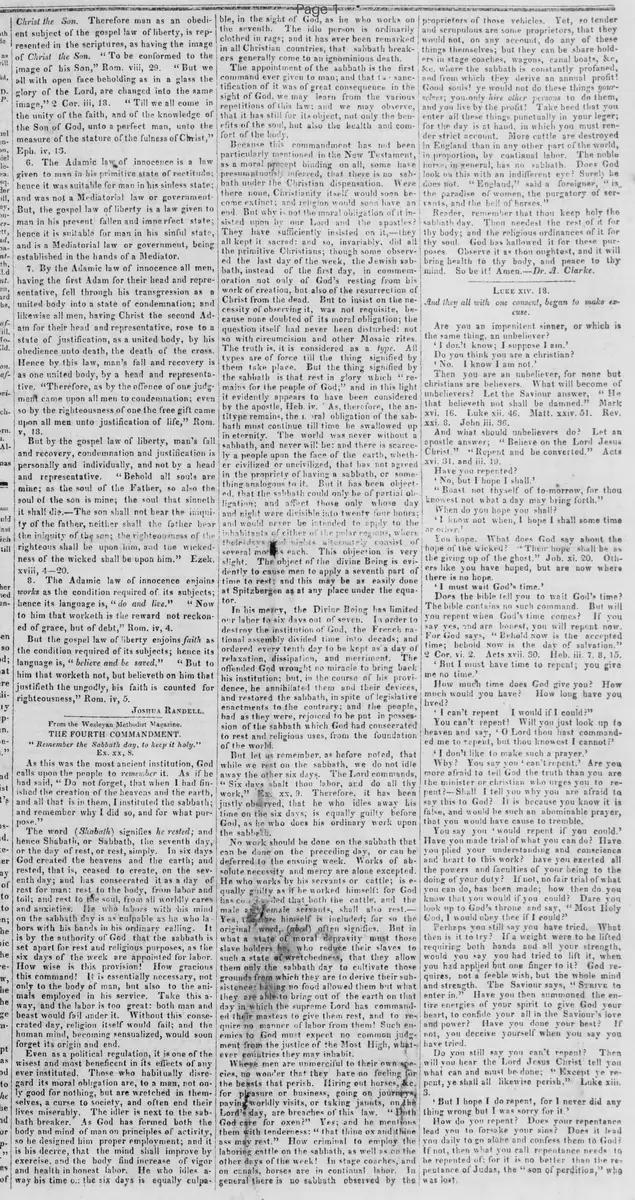
THE FOURTH COMMANDMENT.
"Remember the Sabbath day, to keep it holy."
Ex. xx, 8.
As this was the most ancient institution, God calls upon the people to remember it. As if he had said, "Do not forget, that when I had finished the creation of the heavens and the earth, and all that is in them, I instituted the sabbath; and remember why I did so, and for what purpose."
The word (Shabath) signifies he rested; and hence Shabath, or Sabbath, the seventh day, or the day of rest, or rest, simply. In six days God created the heavens and the earth: and rested, that is, ceased to create, on the seventh day; and has consecrated it as a day of rest for man: rest to the body, from labor and toil; and rest to the soul, from all worldly cares and anxieties. He who labors with his mind on the sabbath day is as culpable as he who labors with his hands in his ordinary calling. It is by the authority of God that the sabbath is set apart for rest and religious purposes, as the six days of the week are appointed for labor. How wise is this provision! How gracious this command! It is essentially necessary, not only to the body of man, but also to the animals employed in his service. Take this away, and the labor is too great: both man and beast would fail under it. Without this consecrated day, religion itself would fail; and the human mind, becoming sensualized, would soon forget its origin and end.
Even as a political regulation, it is one of the wisest and most beneficent in its effects of any ever instituted. Those who habitually disregard its moral obligation are, to a man, not only good for nothing, but are wretched in themselves, a curse to society, and often end their lives miserably. The idler is next to the sabbath breaker. As God has formed both the body and mind of man on principles of activity, so he designed him proper employment; and it is his decree, that the mind shall improve by exercise, and the body find increase of vigor and health in honest labor. He who idles away his time on the six days is equally culpable, in the sight of God, as he who works on the seventh. The idle person is ordinarily clothed in rags; and it has ever been remarked in all Christian countries, that sabbath breakers generally come to an ignominious death.
The appointment of the sabbath is the first command ever given to man; and that the sanctification of it was of great consequence in the sight of God, we may learn from the various repetitions of this law: and we may observe, that it has still for its object, not only the benefits of the soul, but also the health and comfort of the body.
Because this commandment has not been particularly mentioned in the New Testament, as a moral precept binding on all, some have presumptuously inferred, that there is no sabbath under the Christian dispensation. Were there none, Christianity itself would soon become extinct; and religion would soon have an end. But why is not the moral obligation of it insisted upon by our Lord and the apostles? They have sufficiently insisted on it.-they all kept it sacred: and so, invariably, did all the primitive Christians; though some observed the last day of the week, the Jewish sabbath, instead of the first day, in commemoration not only of God's resting from his work of creation, but also of the resurrection of Christ from the dead. But to insist on the necessity of observing it, was not requisite, because none doubted of its moral obligation; the question itself had never been disturbed: not so with circumcision and other Mosaic rites.
The truth is, it is considered as a type. All types are of force till the thing signified by them take place. But the thing signified by the sabbath is that rest in glory which "remains for the people of God;" and in this light it evidently appears to have been considered by the apostle, Heb. iv. As, therefore, the antitype remains, the moral obligation of the sabbath must continue till time be swallowed up in eternity. The world was never without a sabbath, and never will be: and there is scarcely a people upon the face of the earth, whether civilized or uncivilized, that has not agreed in the propriety of having a sabbath, or something analogous to it. But it has been objected, that the sabbath could only be of partial obligation: and affect those only whose day and night were divisible into twenty four hours: and would never be intended to apply to the inhabitants of either of the polar regions, where their days and nights alternately consist of several months each. This objection is very slight. The object of the divine Being is evidently to cause men to apply a seventh part of time to rest; and this may be as easily done at Spitzbergen as at any place under the equator.
In his mercy, the Divine Being has limited our labor to six days out of seven. In order to destroy the institution of God, the French national assembly divided time into decads; and ordered every tenth day to be kept as a day of relaxation, dissipation, and merriment. The offended God wrought no miracle to bring back his institution: but, in the course of his providence, he annihilated them and their devices, and restored the sabbath, in spite of legislative enactments to the contrary; and the people, bad as they were, rejoiced to be put in possession of the sabbath which God had consecrated to rest and religious uses, from the foundation of the world.
But let us remember, as before noted, that while we rest on the sabbath, we do not idle away the other six days. The Lord commands, "Six days shalt thou labor, and do all thy work," Ex. xx, 9. Therefore, it has been justly observed, that he who idles away his time on the six days; is equally guilty before God, as he who does his ordinary work upon the sabbath.
No work should be done on the sabbath that can be done on the preceding day, or can be deferred to the ensuing week. Works of absolute necessity and mercy are alone excepted. He who works by his servants or cattle; is equally guilty as if he worked himself: for God has commanded that both the cattle, and the male and female servants, shall also rest.- Yea, the stranger himself is included; for so the original word. (abed) often signifies. But in what a state of moral depravity must those slave holders be. who reduce their slaves to such a state of wretchedness, that they allow them only the sabbath day to cultivate those grounds from which they are to derive their subsistence: having no food allowed them but what they are able to bring out of the earth on that day in which the supreme Lord has commanded their masters to give them rest, and to require no manner of labor from them! Such enemies to God must expect no common judgment from the justice of the Most High, whatever countries they may inhabit.
Where men are unmerciful to their own species, no wonder that they have no feeling for the beasts that perish. Bringing out horses, &c. for pleasure or business, going on journeys, paying worldly visits, or taking jaunts, on the Lord's day, are breaches of this law. "Doth God care for oxen?" Yes; and he mentions them with tenderness: "that thine ox and thine ass may rest." How criminal to employ the laboring cattle on the sabbath, as well as on the other days of the week! In stage coaches, and on canals, horses are in continual labor. In general there is no sabbath observed by the proprietors of those vehicles. Yet, so tender and scrupulous are some proprietors, that they would not, on any account, do any of these things themselves; but they can be share holders in stage coaches, wagons, canal boats, &c, &c. where the sabbath is constantly profaned, and from which they derive an annual profit! Good souls! ye would not do these things yourselves; you only hire other persons to do them, and you live by the profit! Take heed that you enter all these things punctually in your ledger; for the day is at hand, in which you must render strict account. More cattle are destroyed in England than in any other part of the world, in proportion, by continual labor. The noble horse, in general, has no sabbath. Does God look on this with an indifferent eye? Surely he does not. "England," said a foreigner, "is the paradise of women, the purgatory of servants, and the hell of horses."
Reader, remember that thou keep holy the sabbath day. Thou needest the rest of it for thy body; and the religious ordinances of it for thy soul. God has hallowed it for these purposes. Observe it as thou oughtest, and it will bring health to thy body, and peace to thy mind. So be it! Amen.-Dr. A. Clarke.
THE FOURTH COMMANDMENT.
"Remember the Sabbath day, to keep it holy."
Ex. xx, 8.
As this was the most ancient institution, God calls upon the people to remember it. As if he had said, "Do not forget, that when I had finished the creation of the heavens and the earth, and all that is in them, I instituted the sabbath; and remember why I did so, and for what purpose."
The word (Shabath) signifies he rested; and hence Shabath, or Sabbath, the seventh day, or the day of rest, or rest, simply. In six days God created the heavens and the earth: and rested, that is, ceased to create, on the seventh day; and has consecrated it as a day of rest for man: rest to the body, from labor and toil; and rest to the soul, from all worldly cares and anxieties. He who labors with his mind on the sabbath day is as culpable as he who labors with his hands in his ordinary calling. It is by the authority of God that the sabbath is set apart for rest and religious purposes, as the six days of the week are appointed for labor. How wise is this provision! How gracious this command! It is essentially necessary, not only to the body of man, but also to the animals employed in his service. Take this away, and the labor is too great: both man and beast would fail under it. Without this consecrated day, religion itself would fail; and the human mind, becoming sensualized, would soon forget its origin and end.
Even as a political regulation, it is one of the wisest and most beneficent in its effects of any ever instituted. Those who habitually disregard its moral obligation are, to a man, not only good for nothing, but are wretched in themselves, a curse to society, and often end their lives miserably. The idler is next to the sabbath breaker. As God has formed both the body and mind of man on principles of activity, so he designed him proper employment; and it is his decree, that the mind shall improve by exercise, and the body find increase of vigor and health in honest labor. He who idles away his time on the six days is equally culpable, in the sight of God, as he who works on the seventh. The idle person is ordinarily clothed in rags; and it has ever been remarked in all Christian countries, that sabbath breakers generally come to an ignominious death.
The appointment of the sabbath is the first command ever given to man; and that the sanctification of it was of great consequence in the sight of God, we may learn from the various repetitions of this law: and we may observe, that it has still for its object, not only the benefits of the soul, but also the health and comfort of the body.
Because this commandment has not been particularly mentioned in the New Testament, as a moral precept binding on all, some have presumptuously inferred, that there is no sabbath under the Christian dispensation. Were there none, Christianity itself would soon become extinct; and religion would soon have an end. But why is not the moral obligation of it insisted upon by our Lord and the apostles? They have sufficiently insisted on it.-they all kept it sacred: and so, invariably, did all the primitive Christians; though some observed the last day of the week, the Jewish sabbath, instead of the first day, in commemoration not only of God's resting from his work of creation, but also of the resurrection of Christ from the dead. But to insist on the necessity of observing it, was not requisite, because none doubted of its moral obligation; the question itself had never been disturbed: not so with circumcision and other Mosaic rites.
The truth is, it is considered as a type. All types are of force till the thing signified by them take place. But the thing signified by the sabbath is that rest in glory which "remains for the people of God;" and in this light it evidently appears to have been considered by the apostle, Heb. iv. As, therefore, the antitype remains, the moral obligation of the sabbath must continue till time be swallowed up in eternity. The world was never without a sabbath, and never will be: and there is scarcely a people upon the face of the earth, whether civilized or uncivilized, that has not agreed in the propriety of having a sabbath, or something analogous to it. But it has been objected, that the sabbath could only be of partial obligation: and affect those only whose day and night were divisible into twenty four hours: and would never be intended to apply to the inhabitants of either of the polar regions, where their days and nights alternately consist of several months each. This objection is very slight. The object of the divine Being is evidently to cause men to apply a seventh part of time to rest; and this may be as easily done at Spitzbergen as at any place under the equator.
In his mercy, the Divine Being has limited our labor to six days out of seven. In order to destroy the institution of God, the French national assembly divided time into decads; and ordered every tenth day to be kept as a day of relaxation, dissipation, and merriment. The offended God wrought no miracle to bring back his institution: but, in the course of his providence, he annihilated them and their devices, and restored the sabbath, in spite of legislative enactments to the contrary; and the people, bad as they were, rejoiced to be put in possession of the sabbath which God had consecrated to rest and religious uses, from the foundation of the world.
But let us remember, as before noted, that while we rest on the sabbath, we do not idle away the other six days. The Lord commands, "Six days shalt thou labor, and do all thy work," Ex. xx, 9. Therefore, it has been justly observed, that he who idles away his time on the six days; is equally guilty before God, as he who does his ordinary work upon the sabbath.
No work should be done on the sabbath that can be done on the preceding day, or can be deferred to the ensuing week. Works of absolute necessity and mercy are alone excepted. He who works by his servants or cattle; is equally guilty as if he worked himself: for God has commanded that both the cattle, and the male and female servants, shall also rest.- Yea, the stranger himself is included; for so the original word. (abed) often signifies. But in what a state of moral depravity must those slave holders be. who reduce their slaves to such a state of wretchedness, that they allow them only the sabbath day to cultivate those grounds from which they are to derive their subsistence: having no food allowed them but what they are able to bring out of the earth on that day in which the supreme Lord has commanded their masters to give them rest, and to require no manner of labor from them! Such enemies to God must expect no common judgment from the justice of the Most High, whatever countries they may inhabit.
Where men are unmerciful to their own species, no wonder that they have no feeling for the beasts that perish. Bringing out horses, &c. for pleasure or business, going on journeys, paying worldly visits, or taking jaunts, on the Lord's day, are breaches of this law. "Doth God care for oxen?" Yes; and he mentions them with tenderness: "that thine ox and thine ass may rest." How criminal to employ the laboring cattle on the sabbath, as well as on the other days of the week! In stage coaches, and on canals, horses are in continual labor. In general there is no sabbath observed by the proprietors of those vehicles. Yet, so tender and scrupulous are some proprietors, that they would not, on any account, do any of these things themselves; but they can be share holders in stage coaches, wagons, canal boats, &c, &c. where the sabbath is constantly profaned, and from which they derive an annual profit! Good souls! ye would not do these things yourselves; you only hire other persons to do them, and you live by the profit! Take heed that you enter all these things punctually in your ledger; for the day is at hand, in which you must render strict account. More cattle are destroyed in England than in any other part of the world, in proportion, by continual labor. The noble horse, in general, has no sabbath. Does God look on this with an indifferent eye? Surely he does not. "England," said a foreigner, "is the paradise of women, the purgatory of servants, and the hell of horses."
Reader, remember that thou keep holy the sabbath day. Thou needest the rest of it for thy body; and the religious ordinances of it for thy soul. God has hallowed it for these purposes. Observe it as thou oughtest, and it will bring health to thy body, and peace to thy mind. So be it! Amen.-Dr. A. Clarke.
What sub-type of article is it?
Essay
What themes does it cover?
Religious
Moral Virtue
What keywords are associated?
Sabbath Observance
Fourth Commandment
Divine Rest
Moral Obligation
Religious Duty
Slave Labor
Animal Welfare
Christian Dispensation
What entities or persons were involved?
Dr. A. Clarke
Literary Details
Title
The Fourth Commandment.
Author
Dr. A. Clarke
Subject
Remember The Sabbath Day, To Keep It Holy. Ex. Xx, 8.
Key Lines
"Remember The Sabbath Day, To Keep It Holy."
The Word (Shabath) Signifies He Rested; And Hence Shabath, Or Sabbath, The Seventh Day, Or The Day Of Rest, Or Rest, Simply.
The Thing Signified By The Sabbath Is That Rest In Glory Which "Remains For The People Of God;"
"England," Said A Foreigner, "Is The Paradise Of Women, The Purgatory Of Servants, And The Hell Of Horses."