Thank you for visiting SNEWPapers!
Sign up free
Berkeley And Jefferson Intelligencer
Martinsburg, Berkeley County, Virginia
What is this article about?
A historical compilation from French sources detailing the discovery and settlement of Louisiana, from Ponce de Leon's 1512 quest for the Fountain of Youth, De Soto's 1539 exploration of Florida and Mississippi, Marquette and Joliet's 1673 voyage, La Salle's 1682 claim for France, Iberville's 1699 settlement, through colonial grants, the Mississippi Scheme, and cessions by treaties in 1763 and 1783.
Merged-components note: This is a continuation of the article on the history of Louisiana discovery and settlement, with the text flowing directly from one component to the next across pages.
Clippings
1 of 2
OCR Quality
Full Text
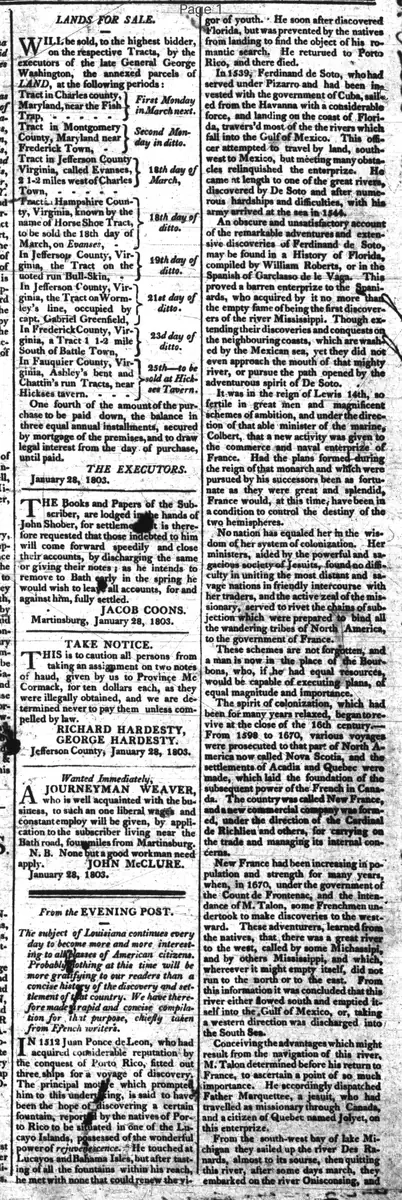
The subject of Louisiana continues every day to become more and more interesting to all classes of American citizens. Probably nothing at this time will be more gratifying to our readers than a concise history of the discovery and settlement of that country. We have therefore made a rapid and concise compilation for that purpose, chiefly taken from French writers.
In 1512 Juan Ponce de Leon, who had acquired considerable reputation by the conquest of Porto Rico, fitted out three ships for a voyage of discovery. The principal motive which prompted him to this undertaking, is said to have been the hope of discovering a certain fountain, reported by the natives of Porto Rico to be situated in one of the Lucayo Islands, possessed of the wonderful power of rejuvenescence. He touched at Lucayos and Bahama Isles, but after tasting of all the fountains within his reach, he met with none that could renew the vigor of youth. He soon after discovered Florida, but was prevented by the natives from landing to find the object of his romantic search. He returned to Porto Rico, and there died.
In 1539, Ferdinand de Soto, who had served under Pizarro and had been invested with the government of Cuba, sailed from the Havanna with a considerable force, and landing on the coast of Florida, traversed most of the rivers which fall into the Gulf of Mexico. This officer attempted to travel by land, south-west to Mexico, but meeting many obstacles relinquished the enterprize. He came at length to one of the great rivers discovered by De Soto and after numerous hardships and difficulties, with his army arrived at the sea in 1544.
An obscure and unsatisfactory account of the remarkable adventures and extensive discoveries of Ferdinand de Soto, may be found in a History of Florida, compiled by William Roberts, or in the Spanish of Garcilasso de la Vega. This proved a barren enterprize to the Spaniards, who acquired by it no more than the empty fame of being the first discoverers of the river Mississippi. Though extending their discoveries and conquests on the neighbouring coasts, which are washed by the Mexican sea, yet they did not even approach the mouth of that mighty river, or pursue the path opened by the adventurous spirit of De Soto.
It was in the reign of Lewis 14th, so fertile in great men and magnificent schemes of ambition, and under the direction of that able minister of the marine, Colbert, that a new activity was given to the commerce and naval enterprize of France. Had the plans formed during the reign of that monarch and which were pursued by his successors been as fortunate as they were great and splendid, France would, at this time, have been in a condition to control the destiny of the two hemispheres.
No nation has equaled her in the wisdom of her system of colonization. Her ministers, aided by the powerful and sagacious society of Jesuits, found no difficulty in uniting the most distant and savage nations in friendly intercourse with her traders, and the active zeal of the missionary, served to rivet the chains of subjection which were prepared to bind all the wandering tribes of North America to the government of France.
These schemes are not forgotten, and a man is now in the place of the Bourbons, who, if he had equal resources, would be capable of executing plans, of equal magnitude and importance.
The spirit of colonization, which had been for many years relaxed, began to revive at the close of the 16th century. From 1598 to 1670, various voyages were prosecuted to that part of North America now called Nova Scotia, and the settlements of Acadia and Quebec were made, which laid the foundation of the subsequent power of the French in Canada. The country was called New France, and a new commercial company was formed under the direction of the Cardinal de Richelieu and others, for carrying on the trade and managing its internal concerns.
New France had been increasing in population and strength for many years, when, in 1670, under the government of the Count de Frontenac and the intendant of M. Talon, some Frenchmen undertook to make discoveries to the westward. These adventurers, learned from the natives, that there was a great river to the west, called by some Mississippi and by others Mississippi, and which, wherever it might empty itself, did not run to the north or to the east. From this information it was concluded that this river either flowed south and emptied itself into the Gulf of Mexico, or, taking a western direction was discharged into the South Sea.
Conceiving the advantages which might result from the navigation of this river, M. Talon determined before his return to France, to ascertain a point of so much importance. He accordingly dispatched Father Marquette, a Jesuit who had travelled as missionary through Canada, and a citizen of Quebec named Joliet, on this enterprize.
From the south-west bay of Lake Michigan they sailed up the river Des Plaines almost to its source then quitting this river, after some days march, they embarked on the river Wisconsin, and
Continuing their course west they found themselves on the 17th June 1673, entering the Mississippi, in about 42 1-2 degrees north latitude. Yielding to the current, they passed down this great river to the 33d degree of latitude, the country of the Arkansas, but finding their provisions fail, and their numbers too few to encounter the perils of unknown regions, they resolved to return, not however without having been first satisfied, that the river emptied itself into the Gulf of Mexico. Father Marquette stayed among the Miamis, Joliet returned to Quebec.
The death of the former in 1675, and the departure of M. Talon for France, prevented any further prosecution of the discovery for a time.
Robert Cavelier Sieur de la Salle, educated in the College of Jesuits, was a man of bold and enterprising character. He conceived the act of penetrating to Japan or China, by a north or westerly course from Canada, and though destitute of all the means requisite for so great an undertaking, his mind was deeply occupied with this design, when the return of Joliet to Montreal, with the account of the discovery of the Mississippi, engaged his attention. He then went to France, where he was received with great favor by the chief persons of the court, who patronized his scheme. On his return to Quebec, he began his voyage, with Chevalier de Tonti, to whom he confided the care of erecting a fort at Niagara, which he had marked out.
In 1682 he descended the river Illinois, and in Feb. of the same year, entered the Mississippi, and arrived at its mouth on the 9th of April. Having taken possession, in the name of Louis 14th, of this important territory and the adjacent country, with those customary formalities, deemed requisite to secure the right of the French monarch, he returned by the Mississippi and Illinois and Canada and from thence went to France to give an account of his voyage.
A small squadron was fitted out at Rochelle in 1684 on board of which La Salle embarked for the purpose of finding the mouth of the Mississippi by the way of the Gulf of Mexico. Deceived by the force and direction of the currents they passed the Mississippi, and went about 100 leagues farther west where they landed and built a fort on the river St. Bernard. After various adventures, and suffering numerous misfortunes, aggravated by disputes among the party, La Salle and his nephew, were basely murdered by three of their treacherous companions.
In 1689 the attention of France was again directed to Louisiana, Count de Pontchartrain, then minister of the marine, sent two vessels of war under the command of the Marquis de Chateau Morand and M. d'Iberville to that country. They arrived on the coast of Florida in January 1699, d'Iberville landed on the Isle de Dauphine, in the bay of Biloxi, between the Mobile and Mississippi rivers. He then proceeded to the Mississippi and sailed up the river a considerable distance, when he received a letter by the hands of an Indian Chief, written by Chevalier de Tonti, to La Salle. The discovery of the river being thus, to his great joy, confirmed, he returned to the bay of Biloxi, where he learned that an English corvette had been at the mouth of the river, and on being ordered away, determined to return with a greater force. This information determined him to secure the possession of Louisiana. He therefore, erected a small fort on the bank of the river, in which he put four pieces of cannon. He was here agreeably surprised by the arrival of De Tonti himself with about 20 Canadians, who had before settled among the Illinois. After finishing the fort, he ascended the river as far as the Natchez, where he designed to lay the foundation of a new city, by the name of Rosalia, in honor of the Countess of Pontchartrain.
In 1710, the settlement on the Isle de Dauphine, was plundered and burnt by an English cruiser. The same year, Louis 14th, by letters patent granted the exclusive commerce of Louisiana to M. Crozat for 16 years, and the property of all the mines and minerals he might discover. Crozat instituted a new government for the colony, but met with so many difficulties and disappointments, that in 1717, he surrendered his charter to the King.
At this time, the well known Mississippi scheme was projected by the celebrated Law, and a company was formed under his direction to carry it into execution. Towards the end of the year the foundation of the city of New Orleans was laid. It is remarkable what romantic hopes this charming country in every stage of its history has enkindled from its Fountain of youth so eagerly sought by De Leon, to the prospects of Law and the more recent but it is hoped more substantial schemes of the Georgia adventurers of our own day.
The country lying east of the river, and now comprehended under the description of the Mississippi Territory, is, perhaps, in regard to soil, climate and productions, the most delightful spot in America. And is it not a subject of inexpressible regret, that those natural advantages should be rendered of no value by a jealous and hostile nation, who happens to have a small colony situated at the mouth of the river?
The country possessed and claimed by France under the name of Louisiana, was bounded on the south by the Gulph of Mexico, on the north by Canada, and on the east and west "indefinitely," comprehending a greater extent than that of the U. States. The activity, wisdom and address with which that nation has invariably pursued her magnificent schemes of colonization, in N. America we well know. In 1752, she had nearly completed a chain of forts from New Orleans to Quebec, by which the English colonies were hemmed in, and would have been confined to the country on this side the Alleghany Mountains.
These wise and gigantic projects were defeated by Great Britain, in the war of 1756. The House of Bourbon was humbled before the mighty genius of a Pitt, unquestionably the ablest war-minister, if not the greatest statesman, that England ever saw. His great and comprehensive mind embraced the whole extent and magnitude of empire, penetrated the artful schemes of the French court, and seized every occasion to cramp a cunning and dangerous enemy. He despised the feeble counsels and short-sighted views of selfish and shallow politicians, who sacrifice the solid interest and honor of the state, to the ephemeral advantages of a deceitful peace, or to whatever may in the least endanger their darling popularity.
To return. By the treaty of Paris in 1763, between Great Britain, France and Spain, all the possessions in Canada, and that part of Louisiana lying east of the Mississippi, and including the Floridas, were ceded to Great Britain. France received New Orleans and the island on which it is situated, which, with that part of Louisiana lying west of the Mississippi, she gave up to Spain.
By the treaty of 1783, the Floridas came again into the possession of Spain. In 1795 she stipulated with us for a participation of the benefits of the Mississippi; how faithful she has been in the observance—we have seen already.
What sub-type of article is it?
What themes does it cover?
What keywords are associated?
What entities or persons were involved?
Where did it happen?
Story Details
Key Persons
Location
Louisiana, Florida, Mississippi River, Gulf Of Mexico, New France, Canada
Event Date
1512 To 1795
Story Details
Compilation of explorations and settlements: Ponce de Leon seeks Fountain of Youth in 1512; De Soto discovers Mississippi in 1539-1543; French colonization under Louis XIV; Marquette and Joliet explore Mississippi in 1673; La Salle claims Louisiana for France in 1682, murdered in 1687; Iberville establishes settlements in 1699; Crozat's grant 1710-1717; Law's Mississippi Scheme and New Orleans founding; cessions by treaties 1763 and 1783.