Thank you for visiting SNEWPapers!
Sign up free
Editorial
November 18, 1813
Daily National Intelligencer
Washington, District Of Columbia
What is this article about?
This editorial reflects on humanity's habit of judging cause and effect, applying it to criticize long-standing neglect by U.S. legislatures of infrastructure (roads, canals), military preparation, and economic fostering, which contributed to war with Britain. It praises American internal prosperity and trade via wagons, contrasting British rivalry and Tory derision.
Clipping
OCR Quality
98%
Excellent
Full Text
CAUSE AND EFFECT.
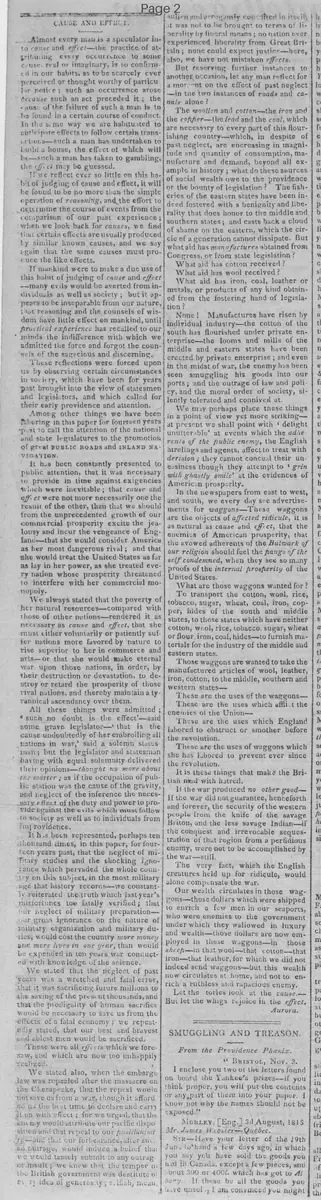
Almost every man is a speculator into cause and effect—the practice of attributing every occurrence to some cause, real or imaginary, is so confirmed in our habits, as to be scarcely ever perceived or thought worthy of particular notice; such an occurrence arose because such an act preceded it: the cause of the failure of such a man is to be found in a certain course of conduct. In the same way we are habituated to anticipate effects to follow certain transactions—such a man has undertaken to build a house, the effect of which will be—such a man has taken to gambling, the fact may be guessed. If we reflect ever so little on this habit of judging of cause and effect, it will be found to be no more than the simple operation of reasoning, and the effort to determine the course of events from the comparison of our past experience; when we look back for causes, we find that certain effects are usually produced by similar known causes, and we say again that the same causes must produce the like effects. If mankind were to make a due use of this habit of judging of cause and effect—many evils would be averted from individuals as well as society; but it appears to be inseparable from our nature, that reasoning and the counsels of wisdom have little effect on mankind, until practical experience has recalled to our minds the indifference with which we admitted the force and forgot the counsels of the sagacious and discerning. These reflections were forced upon us by observing certain circumstances in society, which have been for years past brought into the view of statesmen and legislators, and which called for their early providence and attention. Among other things we have been laboring in this paper for fourteen years past to call the attention of the national and state legislatures to the promotion of great public roads and inland navigation. It has been constantly presented to public attention, that it was necessary to provide in time against exigencies which were inevitable: that cause and effect were not more necessarily one the result of the other, than that we should from the unprecedented growth of our commercial prosperity excite the jealousy and incur the vengeance of England—that she would consider America as her most dangerous rival; and that she would treat the United States as far as lay in her power, as she treated every nation whose prosperity threatened to interfere with her commercial monopoly. We always stated that the poverty of her natural resources—compared with those of other nations—rendered it as necessary as cause and effect, that she must either voluntarily or patiently suffer nations more favored by nature to rise superior to her in commerce and arts—or that she would make eternal war upon those nations, in order, by their destruction or devastation, to destroy or retard the prosperity of those rival nations, and thereby maintain a tyrannical ascendancy over them. All these things were admitted; "such no doubt is the effect"—said some grave legislator—“that is the cause undoubtedly of her embroiling all nations in war,” said a solemn statesman; but the legislator and statesman having with equal solemnity delivered their opinions—thought no more about the matter; as if the occupation of public station was the cause of the gravity, and neglect of the inference the necessary effect of the duty and power to provide against the evils which must follow to society as well as to individuals from improvidence. It has been represented, perhaps ten thousand times, in this paper, for fourteen years past, that the neglect of military studies and the shocking ignorance which pervaded the whole country on this subject, in the most military age that history records—we constantly reiterated the truth which last year's misfortunes too fatally verified; that our neglect of military preparation—our gross ignorance on the nature of military organization and military duties, would cost the country more money and more lives in one year, than would be expended in ten years war conducted with knowledge of the science. We stated that the neglect of past years was a wretched and fatal error, that it was sacrificing future millions to the saving of the present thousands, and that the prodigality of human sacrifice would be necessary to save us from the effects of a fatal economy; we repeatedly stated, that our best and bravest and ablest men would be sacrificed. These were all effects which we foresaw, and which are now too unhappily realized. We stated also, when the embargo law was repealed after the massacre on the Chesapeake, that the repeal would not save us from a war, though it afforded us the best time to declare and carry it on with effect; or we urged, that the enemy would attribute our pacific disposition and that repeal to our pusillanimity—and that our forbearance, after such an outrage, would induce a belief that we would tamely submit to any outrage of insult; we knew that the temper of the British government was destitute of every idea of generosity; selfish, mean, sullen and arrogantly conceited in itself it was not to be brought to terms of liberality by liberal means; no nation ever experienced liberality from Great Britain; none could expect justice—here, also, we have not mistaken effects. But reserving further instances to another occasion, let any man reflect for a moment on the effect of past neglect in the two instances of roads and canals alone? The woollen and cotton—the iron and the copper—the lead and the coal, which are necessary to every part of this flourishing country—which, in despite of past neglect, are increasing in magnitude and quantity of consumption, manufacture and demand, beyond all example in history; what do these sources of social wealth owe to the providence or the bounty of legislation? The fisheries of the eastern states have been indeed fostered with a benignity and liberality that does honor to the middle and southern states; and casts back a cloud of shame on the eastern, which the circle of a generation cannot dissipate. But what aid has manufacture obtained from Congress, or from state legislation? What aid has cotton received? What aid has wool received? What aid has iron, coal, leather or metals, or products of any kind obtained from the fostering hand of legislation? None! Manufactures have risen by individual industry—the cotton of the south has flourished under private enterprise—the looms and mills of the middle and eastern states have been erected by private enterprise; and even in the midst of war, the enemy has been seen smuggling his goods into our ports; and the outrage of law and policy, and the moral order of society, silently tolerated and connived at. We may perhaps place these things in a point of view yet more striking—at present we shall point with delight unutterable at events which the adherents of the public enemy, the English hirelings and agents, affect to treat with derision: they cannot conceal their uneasiness though they attempt to 'grin with ghastly smile' at the evidences of American prosperity. In the newspapers from east to west, and south, we every day see advertisements for waggons—These waggons are the objects of affected ridicule, it is as natural as cause and effect, that the enemies of American prosperity, that the avowed adherents of the Bulwark of our religion should feel the pangs of the self condemned, when they see so many proofs of the internal prosperity of the United States. What are those waggons wanted for? To transport the cotton, wool, rice, tobacco, sugar, wheat, coal, iron, copper, hides of the south and middle states, to those states which have neither cotton, wool, rice, tobacco, sugar, wheat or flour iron, coal, hides—to furnish materials for the industry of the middle and eastern states. Those waggons are wanted to take the manufactured articles of wool, leather, iron, cotton, to the middle, southern and western states—These are the uses of the waggons These are the uses which afflict the enemies of the Union—These are the uses which England labored to obstruct or smother before the revolution. These are the uses of waggons which she has labored to prevent ever since the revolution. It is these things that make the British mad with hatred. If the war produced no other good If the war did not guarantee, henceforth and forever, the security of the western people from the knife of the savage Briton, and the less savage Indian—if the conquest and irrevocable sequestration of that region from a perfidious enemy, were not to be accomplished by the War'—still. The very fact, which the English creatures held up for ridicule, would alone compensate the war. Our wealth circulates in those waggons—those dollars which were shipped to enrich a few men in our seaports, who were enemies to the government under which they wallowed in luxury and wealth—those dollars are now employed in these Waggons—in those sheep—in that wool—that cotton—that iron—that leather, for which we did not indeed send waggons—but this wealth now circulates at home, and not to enrich a ruthless and rapacious enemy. Let the tories look at the cause.— But let the whigs rejoice in the effect. Aurora.
Almost every man is a speculator into cause and effect—the practice of attributing every occurrence to some cause, real or imaginary, is so confirmed in our habits, as to be scarcely ever perceived or thought worthy of particular notice; such an occurrence arose because such an act preceded it: the cause of the failure of such a man is to be found in a certain course of conduct. In the same way we are habituated to anticipate effects to follow certain transactions—such a man has undertaken to build a house, the effect of which will be—such a man has taken to gambling, the fact may be guessed. If we reflect ever so little on this habit of judging of cause and effect, it will be found to be no more than the simple operation of reasoning, and the effort to determine the course of events from the comparison of our past experience; when we look back for causes, we find that certain effects are usually produced by similar known causes, and we say again that the same causes must produce the like effects. If mankind were to make a due use of this habit of judging of cause and effect—many evils would be averted from individuals as well as society; but it appears to be inseparable from our nature, that reasoning and the counsels of wisdom have little effect on mankind, until practical experience has recalled to our minds the indifference with which we admitted the force and forgot the counsels of the sagacious and discerning. These reflections were forced upon us by observing certain circumstances in society, which have been for years past brought into the view of statesmen and legislators, and which called for their early providence and attention. Among other things we have been laboring in this paper for fourteen years past to call the attention of the national and state legislatures to the promotion of great public roads and inland navigation. It has been constantly presented to public attention, that it was necessary to provide in time against exigencies which were inevitable: that cause and effect were not more necessarily one the result of the other, than that we should from the unprecedented growth of our commercial prosperity excite the jealousy and incur the vengeance of England—that she would consider America as her most dangerous rival; and that she would treat the United States as far as lay in her power, as she treated every nation whose prosperity threatened to interfere with her commercial monopoly. We always stated that the poverty of her natural resources—compared with those of other nations—rendered it as necessary as cause and effect, that she must either voluntarily or patiently suffer nations more favored by nature to rise superior to her in commerce and arts—or that she would make eternal war upon those nations, in order, by their destruction or devastation, to destroy or retard the prosperity of those rival nations, and thereby maintain a tyrannical ascendancy over them. All these things were admitted; "such no doubt is the effect"—said some grave legislator—“that is the cause undoubtedly of her embroiling all nations in war,” said a solemn statesman; but the legislator and statesman having with equal solemnity delivered their opinions—thought no more about the matter; as if the occupation of public station was the cause of the gravity, and neglect of the inference the necessary effect of the duty and power to provide against the evils which must follow to society as well as to individuals from improvidence. It has been represented, perhaps ten thousand times, in this paper, for fourteen years past, that the neglect of military studies and the shocking ignorance which pervaded the whole country on this subject, in the most military age that history records—we constantly reiterated the truth which last year's misfortunes too fatally verified; that our neglect of military preparation—our gross ignorance on the nature of military organization and military duties, would cost the country more money and more lives in one year, than would be expended in ten years war conducted with knowledge of the science. We stated that the neglect of past years was a wretched and fatal error, that it was sacrificing future millions to the saving of the present thousands, and that the prodigality of human sacrifice would be necessary to save us from the effects of a fatal economy; we repeatedly stated, that our best and bravest and ablest men would be sacrificed. These were all effects which we foresaw, and which are now too unhappily realized. We stated also, when the embargo law was repealed after the massacre on the Chesapeake, that the repeal would not save us from a war, though it afforded us the best time to declare and carry it on with effect; or we urged, that the enemy would attribute our pacific disposition and that repeal to our pusillanimity—and that our forbearance, after such an outrage, would induce a belief that we would tamely submit to any outrage of insult; we knew that the temper of the British government was destitute of every idea of generosity; selfish, mean, sullen and arrogantly conceited in itself it was not to be brought to terms of liberality by liberal means; no nation ever experienced liberality from Great Britain; none could expect justice—here, also, we have not mistaken effects. But reserving further instances to another occasion, let any man reflect for a moment on the effect of past neglect in the two instances of roads and canals alone? The woollen and cotton—the iron and the copper—the lead and the coal, which are necessary to every part of this flourishing country—which, in despite of past neglect, are increasing in magnitude and quantity of consumption, manufacture and demand, beyond all example in history; what do these sources of social wealth owe to the providence or the bounty of legislation? The fisheries of the eastern states have been indeed fostered with a benignity and liberality that does honor to the middle and southern states; and casts back a cloud of shame on the eastern, which the circle of a generation cannot dissipate. But what aid has manufacture obtained from Congress, or from state legislation? What aid has cotton received? What aid has wool received? What aid has iron, coal, leather or metals, or products of any kind obtained from the fostering hand of legislation? None! Manufactures have risen by individual industry—the cotton of the south has flourished under private enterprise—the looms and mills of the middle and eastern states have been erected by private enterprise; and even in the midst of war, the enemy has been seen smuggling his goods into our ports; and the outrage of law and policy, and the moral order of society, silently tolerated and connived at. We may perhaps place these things in a point of view yet more striking—at present we shall point with delight unutterable at events which the adherents of the public enemy, the English hirelings and agents, affect to treat with derision: they cannot conceal their uneasiness though they attempt to 'grin with ghastly smile' at the evidences of American prosperity. In the newspapers from east to west, and south, we every day see advertisements for waggons—These waggons are the objects of affected ridicule, it is as natural as cause and effect, that the enemies of American prosperity, that the avowed adherents of the Bulwark of our religion should feel the pangs of the self condemned, when they see so many proofs of the internal prosperity of the United States. What are those waggons wanted for? To transport the cotton, wool, rice, tobacco, sugar, wheat, coal, iron, copper, hides of the south and middle states, to those states which have neither cotton, wool, rice, tobacco, sugar, wheat or flour iron, coal, hides—to furnish materials for the industry of the middle and eastern states. Those waggons are wanted to take the manufactured articles of wool, leather, iron, cotton, to the middle, southern and western states—These are the uses of the waggons These are the uses which afflict the enemies of the Union—These are the uses which England labored to obstruct or smother before the revolution. These are the uses of waggons which she has labored to prevent ever since the revolution. It is these things that make the British mad with hatred. If the war produced no other good If the war did not guarantee, henceforth and forever, the security of the western people from the knife of the savage Briton, and the less savage Indian—if the conquest and irrevocable sequestration of that region from a perfidious enemy, were not to be accomplished by the War'—still. The very fact, which the English creatures held up for ridicule, would alone compensate the war. Our wealth circulates in those waggons—those dollars which were shipped to enrich a few men in our seaports, who were enemies to the government under which they wallowed in luxury and wealth—those dollars are now employed in these Waggons—in those sheep—in that wool—that cotton—that iron—that leather, for which we did not indeed send waggons—but this wealth now circulates at home, and not to enrich a ruthless and rapacious enemy. Let the tories look at the cause.— But let the whigs rejoice in the effect. Aurora.
What sub-type of article is it?
Infrastructure
Economic Policy
War Or Peace
What keywords are associated?
Cause And Effect
Infrastructure Neglect
Military Preparation
British Rivalry
American Prosperity
Internal Trade
War Justification
What entities or persons were involved?
England
British Government
National And State Legislatures
Tories
Whigs
Aurora
Editorial Details
Primary Topic
Neglect Of Infrastructure, Military Preparation, And Economic Policy Leading To War With Britain
Stance / Tone
Patriotic Exhortation Criticizing Legislative Neglect And Praising American Prosperity
Key Figures
England
British Government
National And State Legislatures
Tories
Whigs
Aurora
Key Arguments
Neglect Of Public Roads And Inland Navigation Has Hindered Commerce Despite Natural Prosperity.
Britain's Jealousy Of U.S. Commercial Growth Inevitably Leads To War As Cause And Effect.
Failure To Prepare Militarily Has Cost Lives And Money, As Foreseen.
Repeal Of Embargo After Chesapeake Incident Encouraged British Aggression.
Lack Of Legislative Support For Manufactures, Cotton, Wool, Iron, Etc., Yet They Thrive Via Private Enterprise.
Advertisements For Wagons Demonstrate Internal Trade And Prosperity, Ridiculing British Agents.
War Secures Western Territories And Circulates Wealth Domestically, Benefiting The Nation.