Thank you for visiting SNEWPapers!
Sign up free
The National Intelligencer And Washington Advertiser
Washington, District Of Columbia
What is this article about?
In 1801, Levi Hollingsworth sued William Duane for libel in US Circuit Court, Philadelphia. Duane, editor of the Aurora, challenged jurisdiction claiming Pennsylvania citizenship. Evidence showed Duane born in New York colony in 1760 but raised in Ireland and British dominions until 1795. Court ruled him an alien, allowing jurisdiction.
Clipping
OCR Quality
Full Text
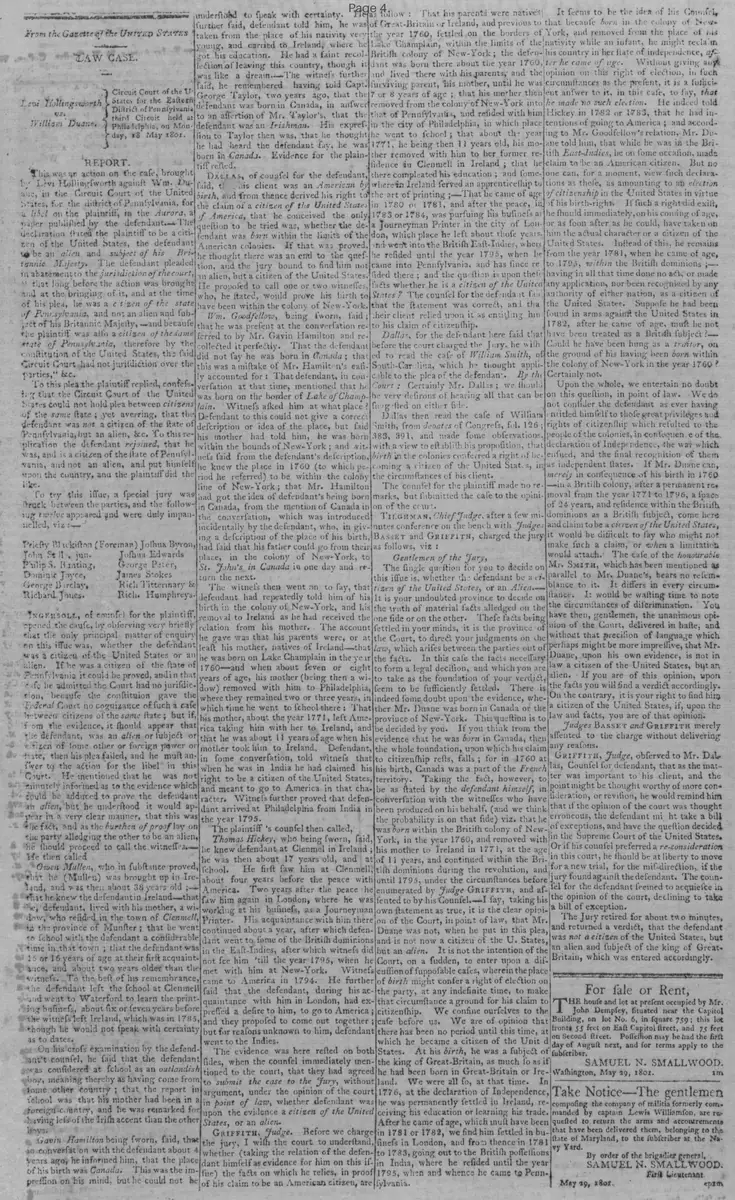
Circuit Court of the United States for the Eastern District of Pennsylvania, third Circuit held at Philadelphia, on Monday, 18 May 1801.
This was an action on the case, brought by Levi Hollingsworth against Wm. Duane, in the Circuit Court of the United States, for the district of Pennsylvania, for a libel on the plaintiff, in the Aurora, a newspaper published by the defendant. The declaration stated the plaintiff to be a citizen of the United States, the defendant to be an alien and subject of his Britannic Majesty. The defendant pleaded in abatement to the jurisdiction of the court, 'that long before the action was brought and at the bringing of it, and at the time of his plea, he was a citizen of the state of Pennsylvania, and not an alien and subject of his Britannic Majesty, -and because the plaintiff was also a citizen of the same state of Pennsylvania, therefore by the constitution of the United States, the said Circuit Court had not jurisdiction over the parties,' &c.
To this plea the plaintiff replied, confessing that the Circuit Court of the United States could not hold plea between citizens of the same state; yet averring, that the defendant was not a citizen of the state of Pennsylvania, but an alien, &c. To this replication the defendant rejoined, that he was, and is a citizen of the state of Pennsylvania, and not an alien, and put himself upon the country, and the plaintiff did the like.
To try this issue, a special jury was struck between the parties, and the following twelve appeared and were duly impanelled, viz:--
Priety Blackiston (Foreman) Joshua Byron, John Sell. jun. Joshua Edwards Philip S. Physick, George Potter, Dominic Joyce, James Stokes George Barclay. Rich. Tittermary & Richard Jones. Rich. Humphreys.
Ingersoll, of counsel for the plaintiff opened the cause, by observing very briefly that the only principal matter of enquiry on this issue was, whether the defendant was a citizen of the United States or an alien. If he was a citizen of the state of Pennsylvania it could be proved, and in that case he admitted the Court had no jurisdiction, because the constitution gave the Federal Court no cognizance of such a case between citizens of the same state; but if, from the evidence, it should appear that the defendant, was an alien or subject or citizen of some other or foreign power or state, then his plea failed, and he must answer to the action for the libel in this Court. He mentioned that he was not minutely informed as to the evidence which would be adduced to prove the defendant an alien, but he understood it would appear in a very clear manner, that this was the fact, and as the burthen of proof lay on the party alleging the other to be an alien. he should proceed to call the witnesses.--
He then called Oren Mullen, who in substance proved, that he (Mullen) was brought up in Ireland, and was then about 38 years old ;-- that he knew the defendant in Ireland that e. defendant, lived with his mother, a widow, who resided in the town of Clonmell in the province of Munster : that he went to school with the defendant a considerable time in that town : that the defendant was 15 or 16 years of age at their first acquaintance, and about two years older than the witness. To the best of his remembrance, the defendant left the school at Clonmell and went to Waterford to learn the printing business, about six or seven years before the witness left Ireland, which was in 1785, though he would not speak with certainty as to dates.
On his cross examination by the defendant's counsel, he said that the defendant was considered at school as an outlandish boy, meaning thereby as having come from some other country ; that the report in school was that his mother had been in a foreign country, and he was remarked for having less of the Irish accent than the other boys.
Gavin Hamilton being sworn, said, that in conversation with the defendant about 4 years ago, he informed him, that the place of his birth was Canada. This was the impression on his mind, but he could not be understood to speak with certainty. He further said, defendant told him, he was taken from the place of his nativity very young, and carried to Ireland, where he got his education. He had a faint recollection of leaving this country, though it was like a dream. The witness further said, he remembered having told Capt. George Taylor, two years ago, that the defendant was born in Canada, in answer to an assertion of Mr. Taylor's, that the defendant was an Irishman. His expression to Taylor then was, that he thought he had heard the defendant say, he was born in Canada. Evidence for the plaintiff rested.
Dallas, of counsel for the defendant, said, this client was an American by birth, and from thence derived his right to the claim of a citizen of this United States of America, that he conceived the only question to be tried was, whether the defendant was born within the limits of the American colonies. If that was proved, he thought there was an end to the question, and the jury bound to find him not an alien, but a citizen of the United States. He proposed to call one or two witnesses, who, he stated, would prove his birth to have been within the Colony of New-York.
Wm. Goodfellow, being sworn, said; that he was present at the conversation referred to by Mr. Gavin Hamilton and recollected it perfectly. That the defendant did not say he was born in Canada; that this was a mistake of Mr. Hamilton's easily accounted for : That defendant, in conversation at that time, mentioned that he was born on the border of Lake Champlain. Witness asked him at what place? Defendant to this could not give a correct description or idea of the place, but said his mother had told him, he was born within the bounds of New-York; and witness said from the defendant's description, he knew the place in 1760 (to which period he referred) to be within the colony line of New-York; that Mr. Hamilton had got the idea of defendant's being born in Canada, from the mention of Canada in the conversation, which was introduced incidentally by the defendant, who, in giving a description of the place of his birth, had said that his father could go from their place, in the colony of New-York, to St. John's in Canada in one day and return the next.
The witness then went on to say, that defendant had repeatedly told him of his birth in the colony of New-York, and his removal to Ireland as he had received the relation from his mother. The account he gave was that his parents were, or at least his mother, natives of Ireland--that he was born on Lake Champlain in the year 1760--and when about seven or eight years of age, his mother (being then a widow) removed with him to Philadelphia, where they remained two or three years, in which time he went to school there: That his mother, about the year 1771, left America taking him with her to Ireland, and that he was about 11 years of age when his mother took him to Ireland.
Defendant, in some conversation, told witness that when he was in India he had claimed his right to be a citizen of the United States, and meant to go to America in that character. Witness further proved that defendant arrived at Philadelphia from India in the year 1795.
The plaintiff's counsel then called, Thomas Hickey, who being sworn, said, he knew defendant at Clonmel in Ireland; he was then about 17 years old, and at school. He first saw him at Clonmel, about four years before the peace with America. Two years after the peace he saw him again in London, where he was working at his business, as a Journeyman Printer. His acquaintance with him there continued about a year, after which defendant went to some of the British dominions in the East-Indies, after which witness did not see him 'till the year 1795, when he met with him at New-York. Witness came to America in 1794. He further said that the defendant, during his acquaintance with him in London, had expressed a desire to him, to go to America; and they proposed to come out together; but for reasons unknown to him, defendant went to the Indies.
The evidence was here rested on both sides, when the counsel immediately mentioned to the court, that they had agreed to submit the case to the Jury, without argument, under the opinion of the court in point of law, whether defendant was upon the evidence a citizen of the United States, or an alien.
Griffith, Judge. Before we charge the jury, I wish the court to understand, whether (taking the relation of the defendant himself as evidence for him on this issue) the facts on which he relies, in proof of his claim to be an American citizen, are as follow : That his parents were natives of Great-Britain or Ireland, and previous to the year 1760, settled on the borders of Lake Champlain, within the limits of the British colony of New-York: the defendant was born there about the year 1760, and lived there with his parents, and the surviving parent, his mother, until he was 7 or 8 years of age ; that his mother then removed from the colony of New-York into that of Pennsylvania and resided with him in the city of Philadelphia, in which place he went to school; that about the year 1771. he being then 11 years old, his mother removed with him to her former residence in Clonmel in Ireland ; that he there completed his education ; and somewhere in Ireland served an apprenticeship to the art of printing ;--That he came of age in 1780 or 1781, and after the peace, in 1783 or 1784, was pursuing his business as a Journeyman Printer in the city of London, which place he left about those years. and went into the British East-Indies, where he resided until the year 1795, when he came into Pennsylvania, and has since resided there ; and the question is upon these facts whether he is a citizen of the United States ? The counsel for the defendant said that the statement was correct, and that their client relied upon it as entitling him to his claim of citizenship.
Dallas, for the defendant here said that before the court charged the Jury, he wished to read the case of William Smith, of South-Carolina, which he thought applicable to the plea of the defendant. By the Court : Certainly Mr. Dallas; we should be very desirous of hearing all that can be suggested on either side.
Dallas then read the case of William Smith, from debates of Congress, vol. 1 26 : 383, 391, and made some observations. with a view to establish his proposition, that birth in the colonies conferred a right of becoming a citizen of the United States, in the circumstances of his client.
The counsel for the plaintiff made no remarks, but submitted the case to the opinion of the court.
TILGHMAN, Chief Judge, after a few minutes conference on the bench with Judges BASSET and GRIFFITH, charged the jury as follows, viz :
Gentlemen of the Jury,
The single question for you to decide on this issue is, whether the defendant be a citizen of the United States, or an Alien.-- It is your undoubted province to decide on the truth of material facts alleged on the one side or on the other. These facts being settled in your minds, it is the province of the Court, to direct your judgments on the law, which arises between the parties out of the facts. In this case the facts necessary to form a legal decision, and which you are to take as the foundation of your verdict, seem to be sufficiently settled. There is indeed some doubt upon the evidence, whether Mr. Duane was born in Canada or the province of New-York. This question is to be decided by you. If you think from the evidence that he was born in Canada, then the whole foundation, upon which his claim to citizenship rests, falls ; for in 1760 at his birth, Canada was a part of the French territory. Taking the fact, however, to be as stated by the defendant himself, in conversation with the witnesses who have been produced on his behalf, (and we think the probability is on that side) viz. that he was born within the British colony of New-York, in the year 1760, and removed with his mother to Ireland in 1771, at the age of 11 years, and continued within the British dominions during the revolution, and until 1795, under the circumstances before enumerated by Judge GRIFFITH, and assented to by his Counsel,--I say, taking his own statement as true, it is the clear opinion of the Court, in point of law, that Mr. Duane was not, when he put in this plea, and is not now a citizen of the U. States, but an alien. It is not the intention of the Court, on a sudden, to enter upon a discussion of supposable cases, wherein the place of birth might confer a right of election on the party, at any indefinite time, to make that circumstance a ground for his claim to citizenship. We confine ourselves to the case before us. We are of opinion that there has been no period until this time, at which he became a citizen of the United States. At his birth, he was a subject of the king of Great-Britain, as much so as if he had been born in Great-Britain or Ireland. We were all so, at that time. In 1776, at the declaration of Independence, he was permanently settled in Ireland, receiving his education or learning his trade. After he came of age, which must have been in 1781 or 1782, we find him settled in business in London, and from thence in 1781 to 1783, going out to the British possessions in India, where he resided until the year 1795, when and whence he came to Pennsylvania.
It seems to be the idea of his Counsel. that because born in the colony of New-York, and removed from the place of his nativity while an infant, he might reclaim his country in her state of independence, after he came of age. Without giving any opinion on this right of election, in such circumstances as the present, it is a sufficient answer to it, in this case, to say, that he made no such election. He indeed told Hickey in 1782 or 1783, that he had intentions of going to America ; and according to Mr. Goodfellow's relation, Mr. Duane told him, that while he was in the British East-Indies, he on some occasion, made claim to be an American citizen. But no one can, for a moment, view such declarations as these, as amounting to an election of citizenship in the United States in virtue of his birth-right. If such a right did exist, he should immediately, on his coming of age, or as soon after as he could, have taken on him the actual character of a citizen of the United States. Instead of this, he remains from the year 1781, when he came of age, to 1795, within the British dominions ;-- having in all that time done no act, or made any application, nor been recognized by any authority of either nation, as a citizen of the United States. Suppose he had been found in arms against the United States in 1782, after he came of age, must he not have been treated as a British subject ?- Could he have been hung as a traitor, on the ground of his having been born within the colony of New-York in the year 1760? Certainly not.
Upon the whole, we entertain no doubt on this question, in point of law. We do not consider the defendant as ever having entitled himself to those great privileges and rights of citizenship which resulted to the people of the colonies, in consequence of the declaration of Independence, the war which ensued, and the final recognition of them as independent states. If Mr. Duane can, merely in consequence of his birth in 1760 in a British colony, after a permanent removal from the year 1771 to 1795, a space of 24 years, and residence within the British dominions as a British subject, come here and claim to be a citizen of the United States, it would be difficult to say who might not make such a claim, or when a limitation would attach. The case of the honourable Mr. SMITH, which has been mentioned as parallel to Mr. Duane's, bears no resemblance to it. It differs in every circumstance. It would be wasting time to note the circumstances of discrimination. You have then, gentlemen, the unanimous opinion of the Court, delivered in haste, and without that precision of language which perhaps might be more impressive, that Mr. Duane, upon his own evidence, is not in law a citizen of the United States, but an alien. If you are of this opinion, upon the facts you will find a verdict accordingly. On the contrary, it is your right to find him a citizen of the United States, if, upon the law and facts, you are of that opinion.
Judges BASSET and GRIFFITH merely assented to the charge without delivering any reasons.
GRIFFITH, Judge, observed to Mr. Dallas, Counsel for defendant, that as the matter was important to his client, and the point might be thought worthy of more consideration, or revision, he would remind him that if the opinion of the court was thought erroneous, the defendant might take a bill of exceptions, and have the question decided in the Supreme Court of the United States. Or if his counsel preferred a re-consideration in this court, he should be at liberty to move for a new trial, for the mis-direction, if the jury found against the defendant. The counsel for the defendant seemed to acquiesce in the opinion of the court, declining to take a bill of exception.
The Jury retired for about two minutes, and returned a verdict, that the defendant was not a citizen of the United States, but an alien and subject of the king of Great-Britain, which was entered accordingly.
What sub-type of article is it?
What themes does it cover?
What keywords are associated?
What entities or persons were involved?
Where did it happen?
Story Details
Key Persons
Location
Philadelphia, Pennsylvania
Event Date
18 May 1801
Story Details
Levi Hollingsworth sued William Duane for libel published in the Aurora newspaper. Duane pleaded Pennsylvania citizenship to abate jurisdiction, claiming birth in New York colony in 1760. Evidence showed he was removed to Ireland as a child and lived in British dominions until 1795. The court ruled Duane an alien, upholding jurisdiction; jury found accordingly.