Thank you for visiting SNEWPapers!
Sign up free
The New Hampshire Gazette And Historical Chronicle
Portsmouth, Greenland, Rockingham County, New Hampshire
What is this article about?
A letter defends the use of iron lightning rods for protecting buildings from lightning, citing the recent undamaged Springfield house incident despite a strike on the opposite end. The writer argues rods attract and convey electrical fluid, addresses potential issues like rod size or quantity, and dismisses prejudices against them.
Clipping
OCR Quality
Full Text
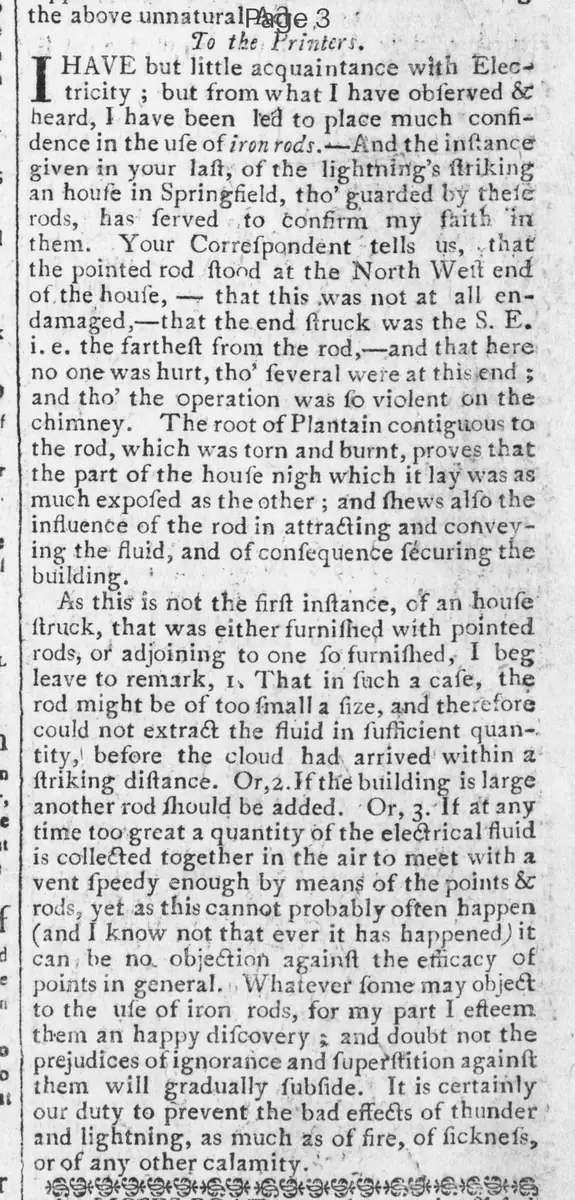
I HAVE but little acquaintance with Electricity; but from what I have observed & heard, I have been led to place much confidence in the use of iron rods. And the instance given in your last, of the lightning's striking a house in Springfield, tho' guarded by these rods, has served to confirm my faith in them. Your Correspondent tells us, that the pointed rod stood at the North West end of the house, -- that this was not at all undamaged,--that the end struck was the S. E. i. e. the farthest from the rod.--and that here no one was hurt, tho' several were at this end; and tho' the Operation was so violent on the chimney. The soot of Plantain contiguous to the rod, which was torn and burnt, proves that the part of the house nigh which it lay was as much exposed as the other : and shews also the influence of the rod in attracting and conveying the fluid, and of consequence securing the building.
As this is not the first instance of a house struck that was either furnished with pointed rods, or adjoining to one so furnished, I beg leave to remark, I. That in such a case, the rod might be of too small a size, and therefore could not extract the fluid in sufficient quantity before the cloud had arrived within a striking distance. Or. 2. If the building is large another rod should be added. Or. 3. If at any time too great a quantity of the electrical fluid is collected together in the air to meet with a vent speedy enough by means of the points & rods, yet as this cannot probably often happen (and I know not that ever it has happened) it can be no objection against the efficacy of points in general. Whatever some may object to the use of iron rods, for my part I esteem them an happy discovery : and doubt not the prejudices of ignorance and superstition against them will gradually subside. It is certainly our duty to prevent the bad effects of thunder and lightning, as much as of fire, of sickness, or of any other calamity.
What sub-type of article is it?
What themes does it cover?
What keywords are associated?
What entities or persons were involved?
Letter to Editor Details
Recipient
To The Printers
Main Argument
iron lightning rods effectively protect buildings by attracting and conveying electrical fluid, as evidenced by the undamaged springfield house; objections due to insufficient rods or rare overloads do not undermine their general efficacy, and prejudices against them should subside.
Notable Details