Thank you for visiting SNEWPapers!
Sign up free
Editorial
December 13, 1880
Sacramento Daily Record Union
Sacramento, Sacramento County, California
What is this article about?
Editorial criticizes Congressman Randolph's compromise amendment for reinstating General Fitz-John Porter, arguing it is inadequate and that full restoration with original rank and back pay is required to vindicate his unjust Civil War court-martial conviction.
Clipping
OCR Quality
98%
Excellent
Full Text
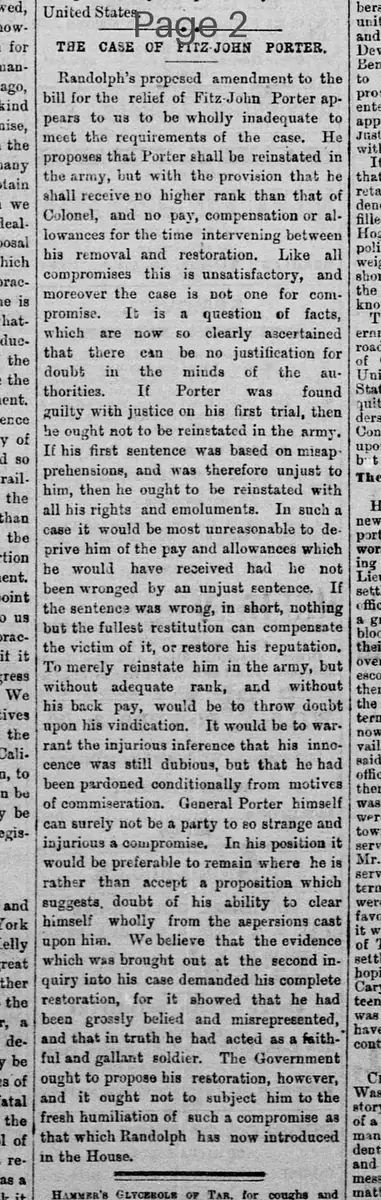
THE CASE OF FITZ-JOHN PORTER.
Randolph's proposed amendment to the bill for the relief of Fitz-John Porter appears to us to be wholly inadequate to meet the requirements of the case. He proposes that Porter shall be reinstated in the army, but with the provision that he shall receive no higher rank than that of Colonel, and no pay, compensation or allowances for the time intervening between his removal and restoration. Like all compromises this is unsatisfactory, and moreover the case is not one for compromise. It is a question of facts, which are now so clearly ascertained that there can be no justification for doubt in the minds of the authorities. If Porter was found guilty with justice on his first trial, then he ought not to be reinstated in the army. If his first sentence was based on misapprehensions, and was therefore unjust to him, then he ought to be reinstated with all his rights and emoluments. In such a case it would be most unreasonable to deprive him of the pay and allowances which he would have received had he not been wronged by an unjust sentence. If the sentence was wrong, in short, nothing but the fullest restitution can compensate the victim of it, or restore his reputation. To merely reinstate him in the army, but without adequate rank, and without his back pay, would be to throw doubt upon his vindication. It would be to warrant the injurious inference that his innocence was still dubious, but that he had been pardoned conditionally from motives of commiseration. General Porter himself can surely not be a party to so strange and injurious a compromise. In his position it would be preferable to remain where he is rather than accept a proposition which suggests doubt of his ability to clear himself wholly from the aspersions cast upon him. We believe that the evidence which was brought out at the second inquiry into his case demanded his complete restoration, for it showed that he had been grossly belied and misrepresented, and that in truth he had acted as a faithful and gallant soldier. The Government ought to propose his restoration, however, and it ought not to subject him to the fresh humiliation of such a compromise as that which Randolph has now introduced in the House.
Randolph's proposed amendment to the bill for the relief of Fitz-John Porter appears to us to be wholly inadequate to meet the requirements of the case. He proposes that Porter shall be reinstated in the army, but with the provision that he shall receive no higher rank than that of Colonel, and no pay, compensation or allowances for the time intervening between his removal and restoration. Like all compromises this is unsatisfactory, and moreover the case is not one for compromise. It is a question of facts, which are now so clearly ascertained that there can be no justification for doubt in the minds of the authorities. If Porter was found guilty with justice on his first trial, then he ought not to be reinstated in the army. If his first sentence was based on misapprehensions, and was therefore unjust to him, then he ought to be reinstated with all his rights and emoluments. In such a case it would be most unreasonable to deprive him of the pay and allowances which he would have received had he not been wronged by an unjust sentence. If the sentence was wrong, in short, nothing but the fullest restitution can compensate the victim of it, or restore his reputation. To merely reinstate him in the army, but without adequate rank, and without his back pay, would be to throw doubt upon his vindication. It would be to warrant the injurious inference that his innocence was still dubious, but that he had been pardoned conditionally from motives of commiseration. General Porter himself can surely not be a party to so strange and injurious a compromise. In his position it would be preferable to remain where he is rather than accept a proposition which suggests doubt of his ability to clear himself wholly from the aspersions cast upon him. We believe that the evidence which was brought out at the second inquiry into his case demanded his complete restoration, for it showed that he had been grossly belied and misrepresented, and that in truth he had acted as a faithful and gallant soldier. The Government ought to propose his restoration, however, and it ought not to subject him to the fresh humiliation of such a compromise as that which Randolph has now introduced in the House.
What sub-type of article is it?
Military Affairs
Legal Reform
What keywords are associated?
Fitz John Porter
Army Reinstatement
Military Justice
Back Pay
Court Martial
Civil War General
What entities or persons were involved?
Fitz John Porter
Randolph
The Government
The House
Editorial Details
Primary Topic
Full Reinstatement Of Fitz John Porter
Stance / Tone
Advocacy For Complete Vindication And Restoration
Key Figures
Fitz John Porter
Randolph
The Government
The House
Key Arguments
Randolph's Amendment Is Inadequate Compromise
Case Demands Full Facts Based Justice, No Doubt
If Unjustly Convicted, Restore With Rank And Back Pay
Partial Reinstatement Implies Lingering Doubt
Evidence From Second Inquiry Proves Porter's Innocence And Gallantry
Government Should Propose Full Restoration