Thank you for visiting SNEWPapers!
Sign up free
The Southern Press
Washington, District Of Columbia
What is this article about?
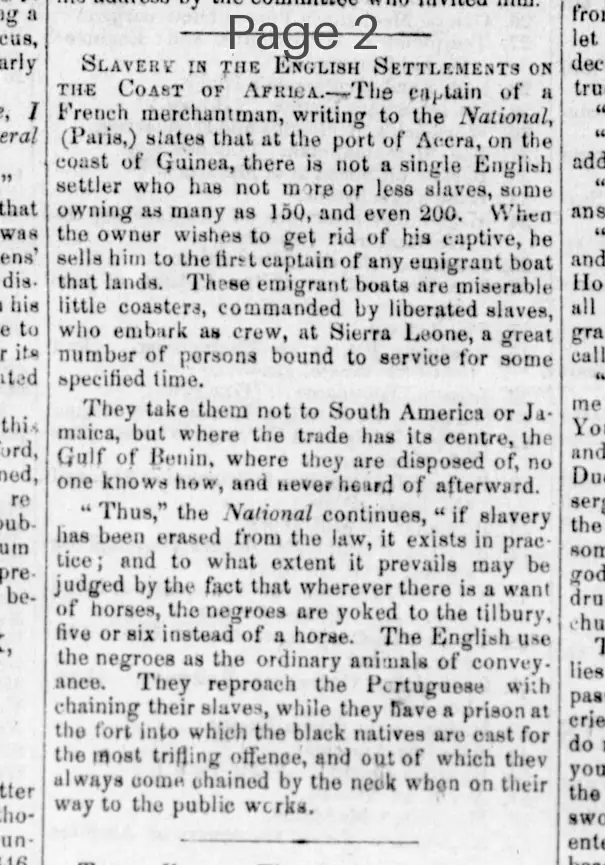
A French merchant captain reports widespread slavery among English settlers in Acera on the Guinea coast, where slaves are sold to emigrant boats bound for the Gulf of Benin. Despite legal abolition, negroes are used as beasts of burden and imprisoned harshly.
Clipping
OCR Quality
Full Text
They take them not to South America or Jamaica, but where the trade has its centre, the Gulf of Benin, where they are disposed of, no one knows how, and never heard of afterward. "Thus," the National continues, "if slavery has been erased from the law, it exists in practice; and to what extent it prevails may be judged by the fact that wherever there is a want of horses, the negroes are yoked to the tilbury, five or six instead of a horse. The English use the negroes as the ordinary animals of conveyance. They reproach the Portuguese with chaining their slaves, while they have a prison at the fort into which the black natives are cast for the most trifling offence, and out of which they always come chained by the neck when on their way to the public works."
What sub-type of article is it?
What keywords are associated?
Where did it happen?
Foreign News Details
Primary Location
Acera, On The Coast Of Guinea
Outcome
slavery persists in practice despite legal abolition; slaves sold to emigrant boats for gulf of benin; negroes used as draft animals and harshly imprisoned.
Event Details
Captain of French merchantman reports every English settler in Acera owns slaves, up to 200; owners sell captives to emigrant coasters commanded by liberated slaves from Sierra Leone, who transport them to Gulf of Benin for unknown disposal. National notes slavery exists despite erasure from law, with negroes yoked to vehicles and imprisoned at fort for trifling offenses, emerging chained for public works. English criticize Portuguese chaining while practicing similar.