Thank you for visiting SNEWPapers!
Sign up free
The Daily Advertiser
New York, New York County, New York
What is this article about?
The London Society for promoting the abolition of the slave trade corresponds with the Pennsylvania Society, acknowledging received certificates, requesting documents on slave treatment, updating on British anti-slavery petitions and parliamentary inquiries, countering economic arguments against abolition, criticizing the U.S. Constitution's 21-year slave trade clause, and proposing collaboration including outreach to France.
Clipping
OCR Quality
Full Text
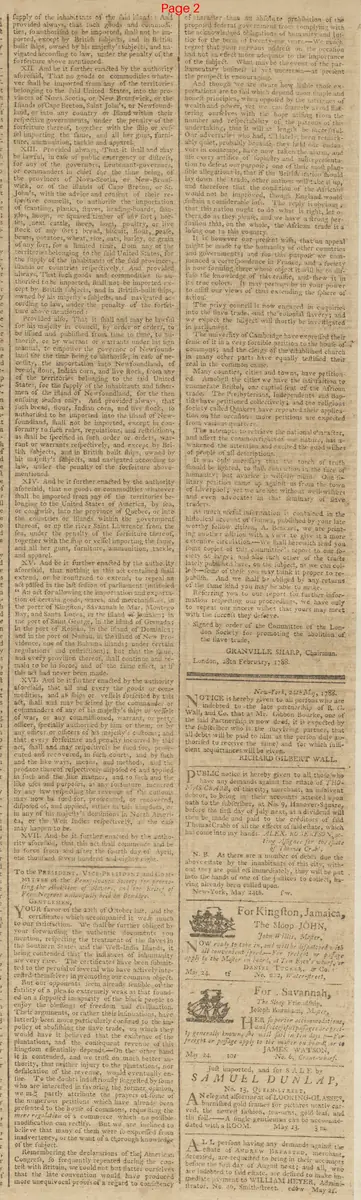
GENTLEMEN,
OUR favor of the 20th of October last, and the certificates which accompanied it were much to our satisfaction. We shall be further obliged by your forwarding the authentic documents you mention, respecting the treatment of the slaves in the Southern States and the West-India Islands, it being contended that the instances of inhumanity are very rare. The certificates have been submitted to the perusal of several who have actively interested themselves in promoting our common object.
But our opponents seem already sensible of the futility of a plea so extremely weak as that founded on a supposed incapacity of the black people to enjoy the blessings of freedom and civilization. Their arguments, or rather their insinuations, have latterly been more particularly confined to the impolicy of abolishing the slave trade, on which they would have it believed that the existence of the plantations, and the consequent revenue of this kingdom essentially depends. On the other hand it is contended, and we trust on much better authority, that neither injury to the plantations, nor defalcation of the revenue, would eventually ensue. To the doubts industriously suggested by some who are interested in favoring the former opinion, we may partly attribute the prayers of one of the numerous petitions which have already been presented to the house of commons, requesting the mere regulation of a commerce which no possible modification can rectify. But we are inclined to believe that many of them were so expressed from inadvertency, or the want of a thorough knowledge of the subject.
Remembering the declarations of the American Congress, so frequently repeated during the contest with Britain, we could not but flatter ourselves that the late convention would have produced more unequivocal proofs of a regard to consistency of character than an absolute prohibition of the proposed federal government from complying with the acknowledged obligations of humanity and justice for the term of twenty-one years. We much regret that your nervous address on the occasion had not an effect more adequate to the importance of the subject. What may be the event of the parliamentary business is yet uncertain—at present the prospect is encouraging.
And though we are aware how liable those expectations are to fail which depend upon simple and honest principles, when opposed by the intrigues of wealth and power, yet we can scarcely avoid flattering ourselves with the hope arising from the number and respectability of the patrons of this undertaking, that it will at length be successful.
Our adversaries who had, till lately, been remarkably quiet, probably because they held our endeavors in contempt, have now taken the alarm, and use every artifice of sophistry and misrepresentation to defeat our purpose; one of their most plausible allegations is, that if the British nation should lay down the trade, other nations will take it up, and therefore that the condition of the African would not be improved, though England would sustain a considerable loss. The reply is obvious; that this nation ought to do what is right, let others do as they please, and we have a strong persuasion that, on the whole, the African trade is a losing one to this country.
It is however our present wish, that an appeal might be made to the humanity of other countries and governments; and for this purpose we commenced a correspondence in France, and a society is now forming there whose object it will be to diffuse the knowledge of this traffic, and show it in its true colors. It may perhaps be in your power to assist our views of thus extending the sphere of action.
The privy council is now engaged in enquiries into the slave trade, and the colonial slavery; and we expect the subject will shortly be investigated in parliament.
The university of Cambridge have expressed their sense of it in a very forcible petition to the house of commons; and the clergy of the established church in many other parts have equally testified their zeal in the common cause.
Many counties, cities and towns, have petitioned. Amongst the cities we have the satisfaction to enumerate Bristol, one capital seat of the African trade. The Presbyterians, Independents and Baptists have petitioned collectively; and the religious society called Quakers have repeated their application on the occasion: more petitions are expected from various quarters.
The attempts to retrieve the national character, and assert the common rights of our nature, has awakened the attention and excited the good wishes of people of all descriptions.
It was only necessary that the torch of truth should be lighted, to flash conviction in the face of humanity; but avarice is wilfully blind. One solitary petition came up against us from the town of Liverpool; yet we are not without well-wishers and even advocates in that seminary of slave traders.
As much useful information is contained in the historical account of Guinea, published by your late worthy fellow citizen, A. Bennett, we are printing another edition with a view to give it a more extensive circulation. We shall herewith send you some copies of this committee's report to our society at large; and also such other of the tracts lately published here, on the subject, as we can collect—one of these you may think it proper to re-publish. And we shall be obliged by any returns of the same kind you may be able to make.
Referring you to our report for further information respecting our proceedings, we have only to repeat our sincere wishes that yours may meet with the success they deserve.
Signed by order of the Committee of the London Society for promoting the abolition of the slave trade,
GRANVILLE SHARP, Chairman.
London, 28th February, 1788.
What sub-type of article is it?
What themes does it cover?
What keywords are associated?
What entities or persons were involved?
Letter to Editor Details
Author
Granville Sharp, Chairman Of The London Society For Promoting The Abolition Of The Slave Trade
Recipient
The President, Vice President And Committee Of The Pennsylvania Society For Promoting The Abolition Of Slavery, And The Relief Of Free Negroes Unlawfully Held In Bondage
Main Argument
the letter provides updates on british anti-slavery efforts, counters opponents' economic and moral arguments against abolishing the slave trade, expresses disappointment in the u.s. constitution's 21-year delay on the issue, and calls for international collaboration to promote abolition.
Notable Details