Thank you for visiting SNEWPapers!
Sign up free
Editorial
November 4, 1789
Gazette Of The United States
New York, New York County, New York
What is this article about?
In a private letter from Amsterdam dated October 16, 1780, John Adams argues that Britain lacks the military and financial resources to subdue America and preserve its empire, due to the country's vastness, determined populace, and allied threats from France and Spain.
Clipping
OCR Quality
98%
Excellent
Full Text
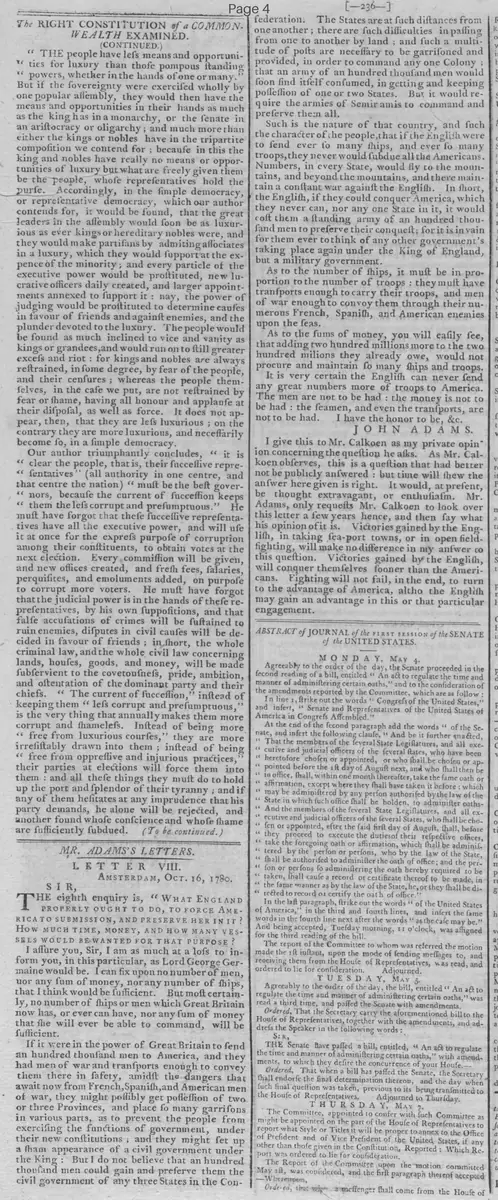
MR. ADAMS'S LETTERS.
LETTER VIII.
AMSTERDAM, OCT. 16, 1780.
SIR,
The eighth enquiry is, "WHAT ENGLAND PROPERLY OUGHT TO DO, TO FORCE AMERICA TO SUBMISSION, AND PRESERVE HER EMPIRE? HOW MUCH TIME, MONEY, AND HOW MANY VESSELS WOULD BE WANTED FOR THAT PURPOSE?"
I assure you, Sir, I am as much at a loss to inform you, in this particular, as Lord George Germain would be. I can fix upon no number of men, nor any sum of money, nor any number of ships, that I think would be sufficient. But most certainly, no number of ships or men which Great Britain now has, or ever can have, nor any sum of money that she will ever be able to command, will be sufficient.
If it were in the power of Great Britain to send an hundred thousand men to America, and they had men of war and transports enough to convey them there in safety, amidst the dangers that await them now from French, Spanish, and American men of war, they might possibly get possession of two or three Provinces, and place so many garrisons in various parts, as to prevent the people from exercising the functions of government, under their new constitutions; and they might set up a sham appearance of a civil government under the King: But I do not believe that an hundred thousand men could gain and preserve them the civil government of any three States in the Confederation. The States are at such distances from one another; there are such difficulties in passing from one to another by land; and such a multitude of posts are necessary to be garrisoned and provided, in order to command any one Colony; that an army of an hundred thousand men would soon find itself consumed, in getting and keeping possession of one or two States. But it would require the armies of Semiramis to command and preserve them all.
Such is the nature of that country, and such the character of the people, that if the English were to send ever so many ships, and ever so many troops, they never would subdue all the Americans. Numbers, in every State, would fly to the mountains, and beyond the mountains, and there maintain a constant war against the English. In short, the English, if they could conquer America, which they never can, nor any one State in it, it would cost them a standing army of an hundred thousand men to preserve their conquest; for it is in vain for them ever to think of any other government's taking place again under the King of England, but a military government.
As to the number of ships, it must be in proportion to the number of troops: they must have transports enough to carry their troops, and men of war enough to convoy them through their numerous French, Spanish, and American enemies upon the seas.
As to the sums of money, you will easily see, that adding two hundred millions more to the two hundred millions they already owe, would not procure and maintain so many ships and troops.
It is very certain the English can never send any great numbers more of troops to America. The men are not to be had: the money is not to be had: the seamen, and even the transports, are not to be had. I have the honor to be, &c.
JOHN ADAMS.
I give this to Mr. Calkoen as my private opinion concerning the question he asks. As Mr. Calkoen observes, this is a question that had better not be publicly answered: but time will show the answer here given is right. It would, at present, be thought extravagant, or enthusiasm. Mr. Adams only requests Mr. Calkoen to look over this letter a few years hence, and then say what his opinion of it is. Victories gained by the English, in taking sea-port towns, or in open field-fighting, will make no difference in my answer to this question. Victories gained by the English, will conquer themselves sooner than the Americans. Fighting will not fail, in the end, to turn to the advantage of America, altho the English may gain an advantage in this or that particular engagement.
LETTER VIII.
AMSTERDAM, OCT. 16, 1780.
SIR,
The eighth enquiry is, "WHAT ENGLAND PROPERLY OUGHT TO DO, TO FORCE AMERICA TO SUBMISSION, AND PRESERVE HER EMPIRE? HOW MUCH TIME, MONEY, AND HOW MANY VESSELS WOULD BE WANTED FOR THAT PURPOSE?"
I assure you, Sir, I am as much at a loss to inform you, in this particular, as Lord George Germain would be. I can fix upon no number of men, nor any sum of money, nor any number of ships, that I think would be sufficient. But most certainly, no number of ships or men which Great Britain now has, or ever can have, nor any sum of money that she will ever be able to command, will be sufficient.
If it were in the power of Great Britain to send an hundred thousand men to America, and they had men of war and transports enough to convey them there in safety, amidst the dangers that await them now from French, Spanish, and American men of war, they might possibly get possession of two or three Provinces, and place so many garrisons in various parts, as to prevent the people from exercising the functions of government, under their new constitutions; and they might set up a sham appearance of a civil government under the King: But I do not believe that an hundred thousand men could gain and preserve them the civil government of any three States in the Confederation. The States are at such distances from one another; there are such difficulties in passing from one to another by land; and such a multitude of posts are necessary to be garrisoned and provided, in order to command any one Colony; that an army of an hundred thousand men would soon find itself consumed, in getting and keeping possession of one or two States. But it would require the armies of Semiramis to command and preserve them all.
Such is the nature of that country, and such the character of the people, that if the English were to send ever so many ships, and ever so many troops, they never would subdue all the Americans. Numbers, in every State, would fly to the mountains, and beyond the mountains, and there maintain a constant war against the English. In short, the English, if they could conquer America, which they never can, nor any one State in it, it would cost them a standing army of an hundred thousand men to preserve their conquest; for it is in vain for them ever to think of any other government's taking place again under the King of England, but a military government.
As to the number of ships, it must be in proportion to the number of troops: they must have transports enough to carry their troops, and men of war enough to convoy them through their numerous French, Spanish, and American enemies upon the seas.
As to the sums of money, you will easily see, that adding two hundred millions more to the two hundred millions they already owe, would not procure and maintain so many ships and troops.
It is very certain the English can never send any great numbers more of troops to America. The men are not to be had: the money is not to be had: the seamen, and even the transports, are not to be had. I have the honor to be, &c.
JOHN ADAMS.
I give this to Mr. Calkoen as my private opinion concerning the question he asks. As Mr. Calkoen observes, this is a question that had better not be publicly answered: but time will show the answer here given is right. It would, at present, be thought extravagant, or enthusiasm. Mr. Adams only requests Mr. Calkoen to look over this letter a few years hence, and then say what his opinion of it is. Victories gained by the English, in taking sea-port towns, or in open field-fighting, will make no difference in my answer to this question. Victories gained by the English, will conquer themselves sooner than the Americans. Fighting will not fail, in the end, to turn to the advantage of America, altho the English may gain an advantage in this or that particular engagement.
What sub-type of article is it?
War Or Peace
Military Affairs
What keywords are associated?
American Revolution
British Conquest
Military Impossibility
American Resistance
Geographical Challenges
Financial Strain
Allied Threats
What entities or persons were involved?
John Adams
Lord George Germain
Great Britain
America
France
Spain
Mr. Calkoen
Editorial Details
Primary Topic
British Inability To Force American Submission
Stance / Tone
Confident Assertion Of American Resilience Against British Conquest
Key Figures
John Adams
Lord George Germain
Great Britain
America
France
Spain
Mr. Calkoen
Key Arguments
No Feasible Number Of Troops, Ships, Or Funds Can Subdue America
Geography And Distances Between States Make Full Control Impossible
American People Would Resist Via Guerrilla Warfare In Mountains
Even Conquering Parts Would Require Permanent 100,000 Man Army
British Resources Are Exhausted And Insufficient
Allied Naval Threats From France, Spain, And America Prevent Safe Transport
Temporary Victories Won't Change The Outcome; War Favors America Long Term