Thank you for visiting SNEWPapers!
Sign up free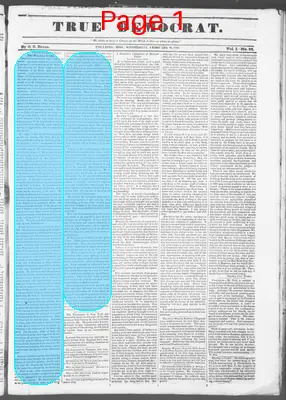
Editorial
February 25, 1846
True Democrat
Paulding, Jasper County, Mississippi
What is this article about?
Editorial from Washington Union urges end to prolonged House debate on Oregon notice to Britain, supports President Polk's policy, calls for Democratic party unity against Whig opposition, and anticipates tariff reduction discussions.
Clipping
OCR Quality
96%
Excellent
Full Text
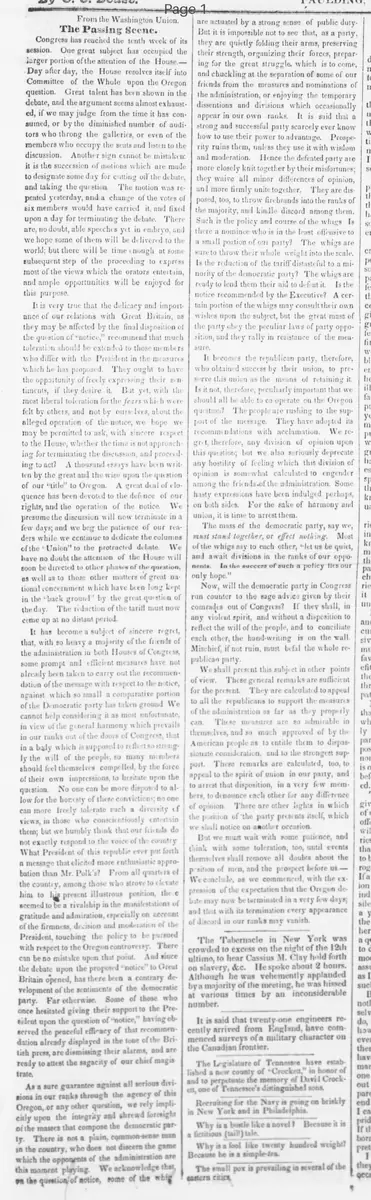
From the Washington Union.
The Passing Scene.
Congress has reached the tenth week of its session. One great subject has occupied the larger portion of the attention of the House.— Day after day, the House resolves itself into Committee of the Whole upon the Oregon question. Great talent has been shown in the debate, and the argument seems almost exhausted, if we may judge from the time it has consumed, or by the diminished number of auditors who throng the galleries, or even of the members who occupy the seats and listen to the discussion. Another sign cannot be mistaken: it is the succession of motions which are made to designate some day for cutting off the debate, and taking the question. The motion was repeated yesterday, and a change of the votes of six members would have carried it, and fixed upon a day for terminating the debate. There are, no doubt, able speeches yet in embryo, and we hope some of them will be delivered to the world; but there will be time enough at some subsequent step of the proceeding to express most of the views which the orators entertain, and ample opportunities will be enjoyed for this purpose.
It is very true that the delicacy and importance of our relations with Great Britain, as they may be affected by the final disposition of the question of "notice," recommend that much toleration should be extended to those members who differ with the President in the measures which he has proposed. They ought to have the opportunity of freely expressing their sentiments, if they desire it. But yet, with the most liberal toleration for the fears which were felt by others, and not by ourselves, about the alleged operation of the notice, we hope we may be permitted to ask, with sincere respect to the House, whether the time is not approaching for terminating the discussion, and proceeding to act? A thousand essays have been written by the great and the wise upon the question of our "title" to Oregon. A great deal of eloquence has been devoted to the defence of our rights, and the operation of the notice. We presume the discussion will now terminate in a few days; and we beg the patience of our readers while we continue to dedicate the columns of the "Union" to the protracted debate. We have no doubt the attention of the House will soon be directed to other phases of the question, as well as to those other matters of great national concernment which have been long kept in the "back ground" by the great question of the day. The reduction of the tariff must now come up at no distant period.
It has become a subject of sincere regret, that, with so heavy a majority of the friends of the administration in both Houses of Congress, some prompt and efficient measures have not already been taken to carry out the recommendation of the message with respect to the notice, against which so small a comparative portion of the Democratic party has taken ground. We cannot help considering it as most unfortunate, in view of the general harmony which prevails in our ranks out of the doors of Congress, that in a body which is supposed to reflect so strongly the will of the people, so many members should feel themselves compelled, by the force of their own impressions, to hesitate upon the question. No one can be more disposed to allow for the honesty of these convictions; no one can more freely tolerate such a diversity of views, in those who conscientiously entertain them; but we humbly think that our friends do not exactly respond to the voice of the country. What President of this republic ever put forth a message that elicited more enthusiastic approbation than Mr. Polk's? From all quarters of the country, among those who strove to elevate him to his present illustrious position, there seemed to be a rivalry in the manifestations of gratitude and admiration, specially on account of the firmness, decision and moderation of the President, touching the policy to be pursued with respect to the Oregon controversy. There can be no mistake upon that point. And since the debate upon the proposed "notice" to Great Britain opened, has there been a contrary development of the sentiments of the democratic party. Far otherwise. Some of those who once hesitated giving their support to the President upon the question of "notice," having observed the peaceful efficacy of that recommendation already displayed in the tone of the British press, are dismissing their alarms, and are ready to attest the sagacity of our chief magistrate.
As a sure guarantee against all serious divisions in our ranks through the agency of this Oregon, or any other question, we rely implicitly upon the integrity and sheer foresight of the masses that compose the democratic party. There is not a plain, common-sense man in the country, who does not discern the game which the opponents of the administration are this moment playing. We acknowledge that, on the question of notice, some of the whigs are actuated by a strong sense of public duty. But it is impossible not to see that, as a party, they are quietly folding their arms, preserving their strength, organizing their forces, preparing for the great struggle which is to come, and chuckling at the separation of some of our friends from the measures and nominations of the administration, or enjoying the temporary dissentions and divisions which occasionally appear in our own ranks. It is said that a strong and successful party scarcely ever knows how to use their power to advantage. Prosperity ruins them, unless they use it with wisdom and moderation. Hence the defeated party are more closely knit together by their misfortunes: they waive all minor differences of opinion, and more firmly unite together. They are disposed, too, to throw firebrands into the ranks of the majority, and kindle discord among them. Such is the policy and course of the whigs. Is there a nominee who is in the least offensive to a small portion of our party? The whigs are sure to throw their whole weight into the scale. Is the reduction of the tariff distasteful to a minority of the democratic party? The whigs are ready to lend them their aid to defeat it. Is the notice recommended by the Executive? A certain portion of the whigs may consult their own wishes upon the subject, but the great mass of the party obey the peculiar laws of party opposition, and they rally in resistance of the measure.
It becomes the republican party, therefore, who obtained success by their union, to preserve this union as the means of retaining it. Is it not, therefore, peculiarly important that we should all be able to co-operate on the Oregon question? The people are rushing to the support of the message. They have adopted its recommendations with acclamation. We regret, therefore, any division of opinion upon this question; but we also seriously deprecate any hostility of feeling which this division of opinion is somewhat calculated to engender among the friends of the administration. Some hasty expressions have been indulged perhaps on both sides. For the sake of harmony and union, it is time to arrest them.
The mass of the democratic party, say we, must stand together, or effect nothing. Most of the whigs say to each other, "let us be quiet, and await divisions in the ranks of our opponents. In the success of such a policy lies our only hope."
Now, will the democratic party in Congress run counter to the sage advice given by their comrades out of Congress? If they shall, in any violent spirit, and without a disposition to reflect the will of the people, and to conciliate each other, the hand-writing is on the wall. Mischief, if not ruin, must fall the whole republican party.
We shall present this subject in other points of view. These general remarks are sufficient for the present. They are calculated to appeal to all the republicans to support the measures of the administration as far as they properly can. These measures are so admirable in themselves, and so much approved of by the American people as to entitle them to dispassionate consideration, and to the strongest support. These remarks are calculated, too, to appeal to the spirit of union in our party, and to arrest that disposition, in a very few members, to denounce each other for any difference of opinion. There are other lights in which the position of the party presents itself, which we shall notice on another occasion.
But we must wait with some patience, and think with some toleration, too, until events themselves shall remove all doubts about the position of men, and the prospect before us—
We conclude, as we commenced, with the expression of the expectation that the Oregon debate may now be terminated in a very few days; and that with its termination every appearance of discord in our ranks may vanish.
The Passing Scene.
Congress has reached the tenth week of its session. One great subject has occupied the larger portion of the attention of the House.— Day after day, the House resolves itself into Committee of the Whole upon the Oregon question. Great talent has been shown in the debate, and the argument seems almost exhausted, if we may judge from the time it has consumed, or by the diminished number of auditors who throng the galleries, or even of the members who occupy the seats and listen to the discussion. Another sign cannot be mistaken: it is the succession of motions which are made to designate some day for cutting off the debate, and taking the question. The motion was repeated yesterday, and a change of the votes of six members would have carried it, and fixed upon a day for terminating the debate. There are, no doubt, able speeches yet in embryo, and we hope some of them will be delivered to the world; but there will be time enough at some subsequent step of the proceeding to express most of the views which the orators entertain, and ample opportunities will be enjoyed for this purpose.
It is very true that the delicacy and importance of our relations with Great Britain, as they may be affected by the final disposition of the question of "notice," recommend that much toleration should be extended to those members who differ with the President in the measures which he has proposed. They ought to have the opportunity of freely expressing their sentiments, if they desire it. But yet, with the most liberal toleration for the fears which were felt by others, and not by ourselves, about the alleged operation of the notice, we hope we may be permitted to ask, with sincere respect to the House, whether the time is not approaching for terminating the discussion, and proceeding to act? A thousand essays have been written by the great and the wise upon the question of our "title" to Oregon. A great deal of eloquence has been devoted to the defence of our rights, and the operation of the notice. We presume the discussion will now terminate in a few days; and we beg the patience of our readers while we continue to dedicate the columns of the "Union" to the protracted debate. We have no doubt the attention of the House will soon be directed to other phases of the question, as well as to those other matters of great national concernment which have been long kept in the "back ground" by the great question of the day. The reduction of the tariff must now come up at no distant period.
It has become a subject of sincere regret, that, with so heavy a majority of the friends of the administration in both Houses of Congress, some prompt and efficient measures have not already been taken to carry out the recommendation of the message with respect to the notice, against which so small a comparative portion of the Democratic party has taken ground. We cannot help considering it as most unfortunate, in view of the general harmony which prevails in our ranks out of the doors of Congress, that in a body which is supposed to reflect so strongly the will of the people, so many members should feel themselves compelled, by the force of their own impressions, to hesitate upon the question. No one can be more disposed to allow for the honesty of these convictions; no one can more freely tolerate such a diversity of views, in those who conscientiously entertain them; but we humbly think that our friends do not exactly respond to the voice of the country. What President of this republic ever put forth a message that elicited more enthusiastic approbation than Mr. Polk's? From all quarters of the country, among those who strove to elevate him to his present illustrious position, there seemed to be a rivalry in the manifestations of gratitude and admiration, specially on account of the firmness, decision and moderation of the President, touching the policy to be pursued with respect to the Oregon controversy. There can be no mistake upon that point. And since the debate upon the proposed "notice" to Great Britain opened, has there been a contrary development of the sentiments of the democratic party. Far otherwise. Some of those who once hesitated giving their support to the President upon the question of "notice," having observed the peaceful efficacy of that recommendation already displayed in the tone of the British press, are dismissing their alarms, and are ready to attest the sagacity of our chief magistrate.
As a sure guarantee against all serious divisions in our ranks through the agency of this Oregon, or any other question, we rely implicitly upon the integrity and sheer foresight of the masses that compose the democratic party. There is not a plain, common-sense man in the country, who does not discern the game which the opponents of the administration are this moment playing. We acknowledge that, on the question of notice, some of the whigs are actuated by a strong sense of public duty. But it is impossible not to see that, as a party, they are quietly folding their arms, preserving their strength, organizing their forces, preparing for the great struggle which is to come, and chuckling at the separation of some of our friends from the measures and nominations of the administration, or enjoying the temporary dissentions and divisions which occasionally appear in our own ranks. It is said that a strong and successful party scarcely ever knows how to use their power to advantage. Prosperity ruins them, unless they use it with wisdom and moderation. Hence the defeated party are more closely knit together by their misfortunes: they waive all minor differences of opinion, and more firmly unite together. They are disposed, too, to throw firebrands into the ranks of the majority, and kindle discord among them. Such is the policy and course of the whigs. Is there a nominee who is in the least offensive to a small portion of our party? The whigs are sure to throw their whole weight into the scale. Is the reduction of the tariff distasteful to a minority of the democratic party? The whigs are ready to lend them their aid to defeat it. Is the notice recommended by the Executive? A certain portion of the whigs may consult their own wishes upon the subject, but the great mass of the party obey the peculiar laws of party opposition, and they rally in resistance of the measure.
It becomes the republican party, therefore, who obtained success by their union, to preserve this union as the means of retaining it. Is it not, therefore, peculiarly important that we should all be able to co-operate on the Oregon question? The people are rushing to the support of the message. They have adopted its recommendations with acclamation. We regret, therefore, any division of opinion upon this question; but we also seriously deprecate any hostility of feeling which this division of opinion is somewhat calculated to engender among the friends of the administration. Some hasty expressions have been indulged perhaps on both sides. For the sake of harmony and union, it is time to arrest them.
The mass of the democratic party, say we, must stand together, or effect nothing. Most of the whigs say to each other, "let us be quiet, and await divisions in the ranks of our opponents. In the success of such a policy lies our only hope."
Now, will the democratic party in Congress run counter to the sage advice given by their comrades out of Congress? If they shall, in any violent spirit, and without a disposition to reflect the will of the people, and to conciliate each other, the hand-writing is on the wall. Mischief, if not ruin, must fall the whole republican party.
We shall present this subject in other points of view. These general remarks are sufficient for the present. They are calculated to appeal to all the republicans to support the measures of the administration as far as they properly can. These measures are so admirable in themselves, and so much approved of by the American people as to entitle them to dispassionate consideration, and to the strongest support. These remarks are calculated, too, to appeal to the spirit of union in our party, and to arrest that disposition, in a very few members, to denounce each other for any difference of opinion. There are other lights in which the position of the party presents itself, which we shall notice on another occasion.
But we must wait with some patience, and think with some toleration, too, until events themselves shall remove all doubts about the position of men, and the prospect before us—
We conclude, as we commenced, with the expression of the expectation that the Oregon debate may now be terminated in a very few days; and that with its termination every appearance of discord in our ranks may vanish.
What sub-type of article is it?
Foreign Affairs
Partisan Politics
War Or Peace
What keywords are associated?
Oregon Question
Party Unity
Democratic Party
President Polk
Notice To Britain
Whig Opposition
Congress Debate
What entities or persons were involved?
President Polk
Democratic Party
Whigs
Congress
House Of Representatives
Great Britain
Editorial Details
Primary Topic
Support For President's Oregon Notice Policy And Democratic Party Unity In Congress
Stance / Tone
Supportive Of Administration, Urging Party Unity And End To Debate
Key Figures
President Polk
Democratic Party
Whigs
Congress
House Of Representatives
Great Britain
Key Arguments
Debate On Oregon Notice Has Exhausted Arguments And Should Terminate Soon
President Polk's Message On Oregon Policy Received Widespread Approbation
Democratic Party Must Maintain Unity To Counter Whig Opposition
Whigs Exploit Divisions Within Democrats
Prompt Action Needed To Implement Notice Despite Minority Hesitations
Tariff Reduction To Follow Oregon Debate