Thank you for visiting SNEWPapers!
Sign up free
Letter to Editor
August 3, 1796
Gazette Of The United States, & Philadelphia Daily Advertiser
Philadelphia, Philadelphia County, Pennsylvania
What is this article about?
A cautionary letter to the public about the risks of purchasing accommodation notes below face value in Philadelphia, citing a 1795 English court case (Wiffen v. Roberts) where the indorsee could only recover the amount actually paid, not the full bill amount. This applies to promissory notes, protecting fair traders from usurers.
Clipping
OCR Quality
95%
Excellent
Full Text
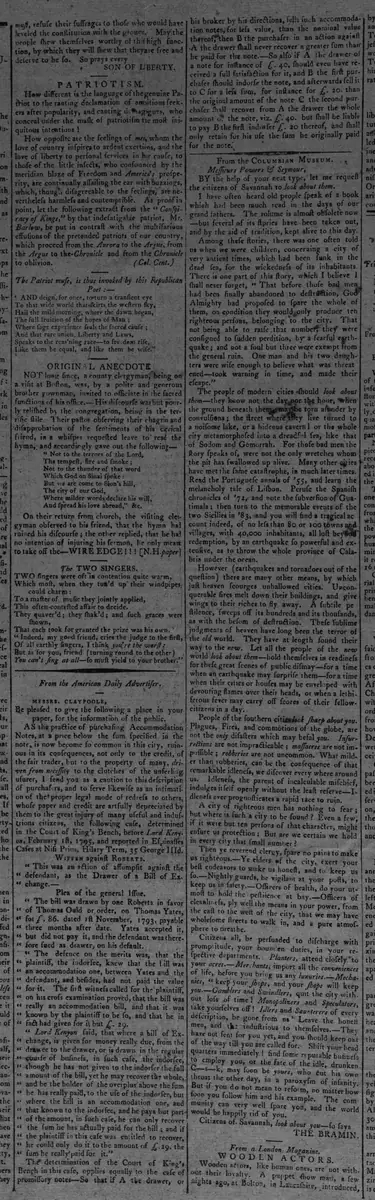
From the American Daily Advertiser.
MESSRS. CLAYPOOLE,
Be pleased to give the following a place in your paper, for the information of the public.
AS the practice of purchasing Accommodation Notes, at a price below the sum specified in the note, is now become so common in this city, ruinous in its consequences, not only to the credit, of the fair trader, but to the property of many, driven from necessity to the clutches of the unfeeling usurer, I send you as a caution to this description of purchasers, and to serve likewise as an intimation of the proper legal mode of redress to others, whose paper and credit are artfully depreciated by them to the great injury of many useful and industrious citizens, the following case, determined in the Court of King's Bench, before Lord Kenyon on, February 11, 1795, and reported in Espinasse's Cases at Nisi Prius, Hilary Term, 35 George III.d.
Wiffen against Roberts.
" This was an action of assumpsit against the defendant, as the Drawer of a Bill of Ex.
" change.—
Plea of the general Issue.
" The bill was drawn by one Roberts in favor
" of Thomas Ould or order, on Thomas Yates,
" for £. 86. dated 11 November, 1793, payable
" three months after date. Yates accepted it,
" but did not pay it, and the defendant was there.
" fore sued as drawer, on his default.
" The defence on the merits was, that the
". plaintiff, the indorsee, knew that the bill was
" an accommodation one, between Yates and the
" defendant, and besides, had not paid the value
" for it. The first witness called for the plaintiff.
" on his cross examination proved, that the bill was
" really an accommodation bill, and that it was
" known by the plaintiff to be so, and that he in
" fact had given for it but £. 29.
" Lord Kenyon said, that where a bill of Ex.
" change, is given for money really due, from the
" drawee to the drawer, or is drawn in the regular
" course of business, in such case, the indorsee,
" though he has not given to the indorser the full
" amount of the bill, yet he may recover the whole,
" and be the holder of the overplus above the sum
" he has really paid, to the use of the indorser, but
" where the bill is an accommodation one, and
" that known to the indorsee, and he pays but part
" of the amount, in such case, he can only recover
" the sum he has actually paid for the bill ; and if
" the plaintiff in this case was entitled to recover,
" he could only do it to the amount of £. 29. the
" sum he really paid for it."
The determination of the Court of King's Bench in this case, applies equally to the case of promissory notes-So that if A the drawer, or his broker by his directions, sells such accommoda.
tion notes, for less value, than the nominal value thereof, then B the purchaser in an action against A the drawer shall never recover a greater sum than he paid for the note. -So also if A the drawer of a note for instance of £. 40, should even have re-
ceived a full satisfaction for it, and B the first pur-
chaer should indorse the note, and afterwards sell it to C for a less sum, for instance for £. 20. than the original amount of the note C the second pur.
chaer shall recover from A the drawer the whole amount o. the note, viz. £. 40. but shall be liable to pay B the first indorser £. 20 thereof, and shall only retain for his use the sum he originally paid for the note.
MESSRS. CLAYPOOLE,
Be pleased to give the following a place in your paper, for the information of the public.
AS the practice of purchasing Accommodation Notes, at a price below the sum specified in the note, is now become so common in this city, ruinous in its consequences, not only to the credit, of the fair trader, but to the property of many, driven from necessity to the clutches of the unfeeling usurer, I send you as a caution to this description of purchasers, and to serve likewise as an intimation of the proper legal mode of redress to others, whose paper and credit are artfully depreciated by them to the great injury of many useful and industrious citizens, the following case, determined in the Court of King's Bench, before Lord Kenyon on, February 11, 1795, and reported in Espinasse's Cases at Nisi Prius, Hilary Term, 35 George III.d.
Wiffen against Roberts.
" This was an action of assumpsit against the defendant, as the Drawer of a Bill of Ex.
" change.—
Plea of the general Issue.
" The bill was drawn by one Roberts in favor
" of Thomas Ould or order, on Thomas Yates,
" for £. 86. dated 11 November, 1793, payable
" three months after date. Yates accepted it,
" but did not pay it, and the defendant was there.
" fore sued as drawer, on his default.
" The defence on the merits was, that the
". plaintiff, the indorsee, knew that the bill was
" an accommodation one, between Yates and the
" defendant, and besides, had not paid the value
" for it. The first witness called for the plaintiff.
" on his cross examination proved, that the bill was
" really an accommodation bill, and that it was
" known by the plaintiff to be so, and that he in
" fact had given for it but £. 29.
" Lord Kenyon said, that where a bill of Ex.
" change, is given for money really due, from the
" drawee to the drawer, or is drawn in the regular
" course of business, in such case, the indorsee,
" though he has not given to the indorser the full
" amount of the bill, yet he may recover the whole,
" and be the holder of the overplus above the sum
" he has really paid, to the use of the indorser, but
" where the bill is an accommodation one, and
" that known to the indorsee, and he pays but part
" of the amount, in such case, he can only recover
" the sum he has actually paid for the bill ; and if
" the plaintiff in this case was entitled to recover,
" he could only do it to the amount of £. 29. the
" sum he really paid for it."
The determination of the Court of King's Bench in this case, applies equally to the case of promissory notes-So that if A the drawer, or his broker by his directions, sells such accommoda.
tion notes, for less value, than the nominal value thereof, then B the purchaser in an action against A the drawer shall never recover a greater sum than he paid for the note. -So also if A the drawer of a note for instance of £. 40, should even have re-
ceived a full satisfaction for it, and B the first pur-
chaer should indorse the note, and afterwards sell it to C for a less sum, for instance for £. 20. than the original amount of the note C the second pur.
chaer shall recover from A the drawer the whole amount o. the note, viz. £. 40. but shall be liable to pay B the first indorser £. 20 thereof, and shall only retain for his use the sum he originally paid for the note.
What sub-type of article is it?
Informative
Persuasive
What themes does it cover?
Commerce Trade
What keywords are associated?
Accommodation Notes
Bills Of Exchange
Promissory Notes
Usury
King's Bench
Lord Kenyon
Legal Recovery
Philadelphia Commerce
What entities or persons were involved?
Messrs. Claypoole
Letter to Editor Details
Recipient
Messrs. Claypoole
Main Argument
purchasers of accommodation notes below face value can only recover the amount they paid in legal action against the drawer, as per a 1795 king's bench ruling, serving as caution against usury and protection for fair traders.
Notable Details
Case: Wiffen Against Roberts
Court: King's Bench Before Lord Kenyon, February 11, 1795
Reported In Espinasse's Cases At Nisi Prius, Hilary Term, 35 George Iii
Bill Details: £86, Dated November 11, 1793, Payable Three Months After
Ruling: Indorsee Recovers Only Amount Paid (£29) For Known Accommodation Bill