Thank you for visiting SNEWPapers!
Sign up free
Lancaster Daily Intelligencer
Lancaster, Lancaster County, Pennsylvania
What is this article about?
On May 29, 1882, in Washington, DC, Democratic House members held a conference to appoint a committee led by Randall, Blackburn, Carlisle, and Kenna to manage resistance against arbitrary rulings in a contested election case. House proceedings featured debates over dilatory motions, with Republicans like Reed clashing against Democrats, drawing large crowds.
Clipping
OCR Quality
Full Text
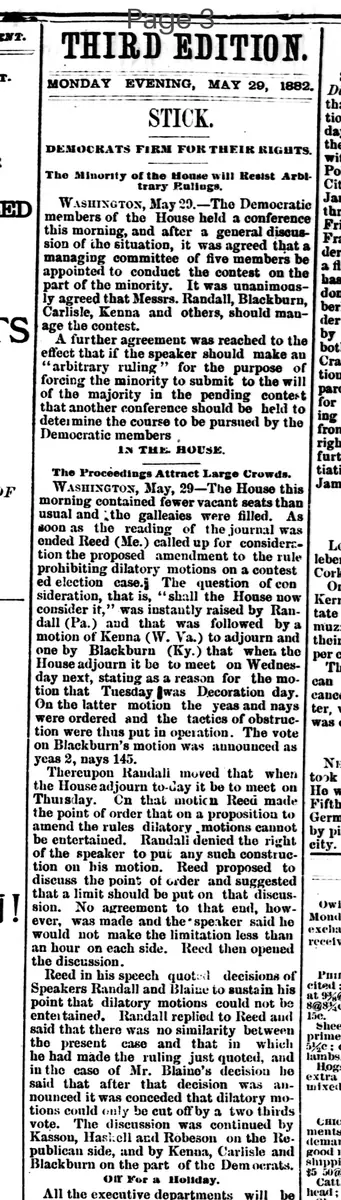
STICK. DEMOCRATS FIRM FOR THEIR RIGHTS The Minority of the House Will Resist Arbitrary Rulings.
WASHINGTON, May 29.-The Democratic members of the House held a conference this morning, and after a general discussion of the situation, it was agreed that a managing committee of five members be appointed to conduct the contest on the part of the minority. It was unanimously agreed that Messrs. Randall, Blackburn, Carlisle, Kenna and others, should manage the contest. A further agreement was reached to the effect that if the speaker should make an "arbitrary ruling" for the purpose of forcing the minority to submit to the will of the majority in the pending contest that another conference should be held to determine the course to be pursued by the Democratic members.
In THE HOUSE. The Proceedings Attract Large Crowds.
WASHINGTON, May 29-The House this morning contained fewer vacant seats than usual and the galleries were filled. As soon as the reading of the journal was ended Reed (Me.) called up for consideration the proposed amendment to the rule prohibiting dilatory motions on a contested election case. The question of consideration, that is, "shall the House now consider it," was instantly raised by Randall (Pa.) and that was followed by a motion of Kenna (W. Va.) to adjourn and one by Blackburn (Ky.) that when the House adjourn it be to meet on Wednesday next, stating as a reason for the motion that Tuesday was Decoration day. On the latter motion the yeas and nays were ordered and the tactics of obstruction were thus put in operation. The vote on Blackburn's motion was announced as yeas 2, nays 145. Thereupon Randall moved that when the House adjourn to-day it be to meet on Thursday. On that motion Reed made the point of order that on a proposition to amend the rules dilatory motions cannot be entertained. Randall denied the right of the speaker to put any such construction on his motion. Reed proposed to discuss the point of order and suggested that a limit should be put on that discussion. No agreement to that end, however, was made and the speaker said he would not make the limitation less than an hour on each side. Reed then opened the discussion. Reed in his speech quoted decisions of Speakers Randall and Blaine to sustain his point that dilatory motions could not be entertained. Randall replied to Reed and said that there was no similarity between the present case and that in which he had made the ruling just quoted, and in the case of Mr. Blaine's decision he said that after that decision was announced it was conceded that dilatory motions could only be cut off by a two thirds vote. The discussion was continued by Kasson, Haskell and Robeson on the Republican side, and by Kenna, Carlisle and Blackburn on the part of the Democrats.
What sub-type of article is it?
What keywords are associated?
What entities or persons were involved?
Where did it happen?
Domestic News Details
Primary Location
Washington
Event Date
May 29, 1882
Key Persons
Outcome
democratic motions to adjourn defeated (yeas 2, nays 145); ongoing debate on point of order regarding dilatory motions in contested election case.
Event Details
Democratic House members confer to appoint a managing committee to resist arbitrary rulings by the Speaker in a contested election. In the House, Reed proposes rule amendment against dilatory motions; Democrats raise objections and motions to adjourn, leading to ordered yeas and nays and extended discussion citing past rulings by Speakers Randall and Blaine.