Thank you for visiting SNEWPapers!
Sign up free
Literary
January 10, 1752
The Virginia Gazette
Richmond, Williamsburg, Richmond County, Virginia
What is this article about?
The essayist reflects on his own procrastination in composing the piece, using it to philosophize on the universal folly of delaying inevitable tasks, the perils of idleness and fear, and the urgency of diligent action given life's brevity.
Merged-components note: The epigraph is a Latin quote from Horace that introduces the philosophical essay on procrastination, forming a single literary component.
Clipping
OCR Quality
95%
Excellent
Full Text
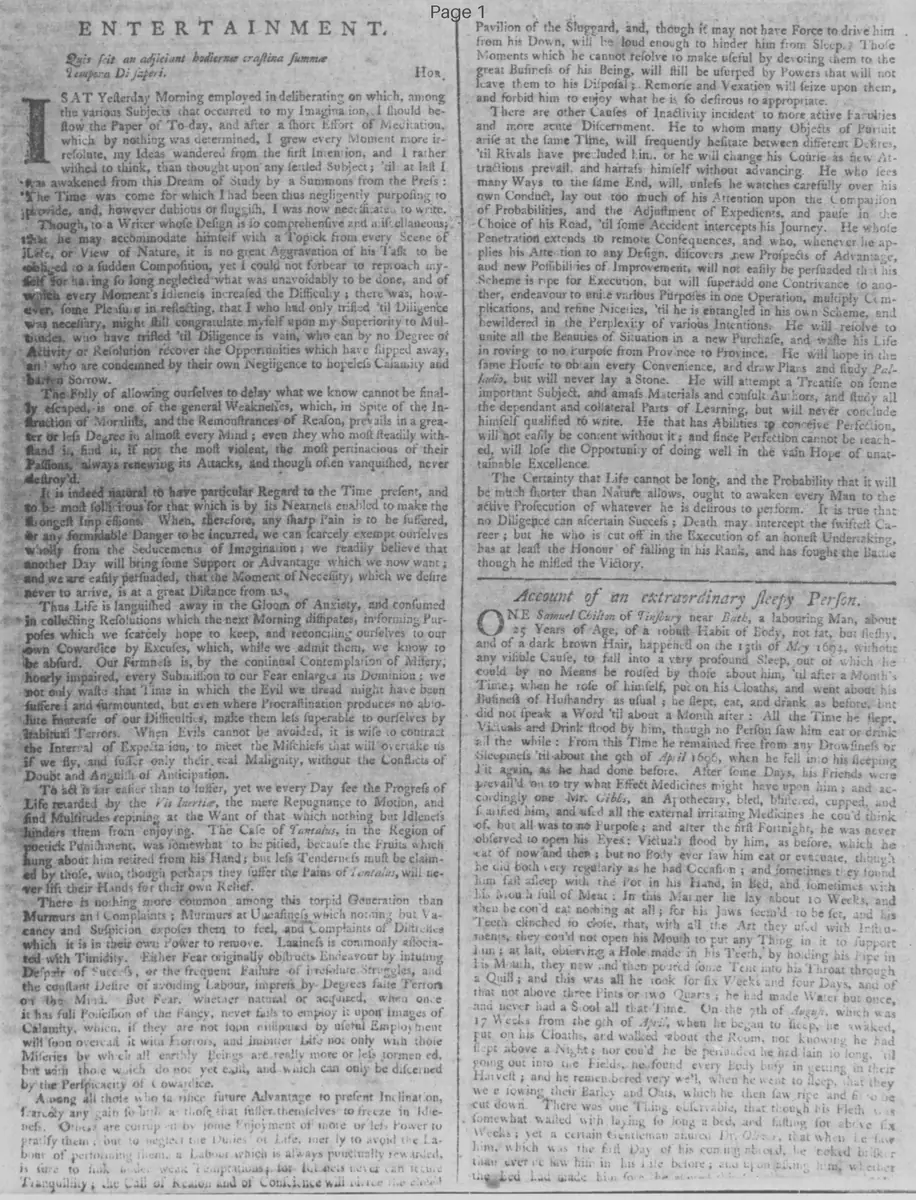
Quis scit an adjiciant hodierna crastina summa tempora di superi. Hor.
Yesterday Morning employed in deliberating on which, among the various Subjects that occurred to my Imagination, I should bestow the Paper of To-day, and after a short Effort of Meditation, which by nothing was determined, I grew every Moment more irresolute, my Ideas wandered from the first Intention, and I rather wished to think, than thought upon any settled Subject; 'til at last I was awakened from this Dream of Study by a Summons from the Press.
The Time was come for which I had been thus negligently purposing to provide, and, however dubious or sluggish, I was now necessitated to write. Though, to a Writer whose Design is so comprehensive and so miscellaneous; as he may accommodate himself with a Topick from every Scene of Life, or View of Nature, it is no great Aggravation of his Task to be obliged to a sudden Composition, yet I could not forbear to reproach myself for having so long neglected what was unavoidably to be done, and of which every Moment's Idleness increased the Difficulty; there was, however, some Pleasure in reflecting, that I who had only trifled 'til Diligence was necessary, might still congratulate myself upon my Superiority to Multitudes, who have trifled 'til Diligence is vain, who can by no Degree of Activity or Resolution recover the Opportunities which have slipped away, and who are condemned by their own Negligence to hopeless Calamity and bitter Sorrow.
The Folly of allowing ourselves to delay what we know cannot be finally escaped, is one of the general Weaknesses, which, in Spite of the Instruction of Moralists, and the Remonstrances of Reason, prevails in a greater or less Degree in almost every Mind; even they who most steadily withstand it, find it, if not the most violent, the most pertinacious of their Passions, always renewing its Attacks, and though often vanquished, never destroy'd.
It is indeed natural to have particular Regard to the Time present, and to be most solicitous for that which is by its Nearness enabled to make the strongest Impressions. When, therefore, any sharp Pain is to be suffered, or any formidable Danger to be incurred, we can scarcely exempt ourselves wholly from the Seduction of Imagination; we readily believe that another Day will bring some Support or Advantage which we now want; and we are easily persuaded, that the Moment of Necessity, which we desire never to arrive, is at a great Distance from us.
Thus Life is languished away in the Gloom of Anxiety, and consumed in collecting Resolutions which the next Morning dissipates, in forming Purposes which we scarcely hope to keep, and reconciling ourselves to our own Cowardice by Excuses, which, while we admit them, we know to be absurd. Our Firmness is, by the continual Contemplation of Misery, hourly impaired, every Submission to our Fear enlarges its Dominion; we not only waste that Time in which the Evil we dread might have been suffered and surmounted, but even where Procrastination produces no absolute Increase of our Difficulties, make them less superable to ourselves by habitual Terrors. When Evils cannot be avoided, it is wise to contract the Interval of Expectation, to meet the Mischiefs that will overtake us if we fly, and suffer their real Malignity, without the Conflicts of Doubt and Anguish of Anticipation.
To hope is easier than to suffer, yet we every Day see the Progress of Life retarded by the Vis Inertia, the mere Repugnance to Motion, and find Multitudes repining at the Want of that which nothing but Idleness hinders them from enjoying. The Case of Tantalus, in the Region of poetick Punishment, was somewhat to be pitied, because the Fruits which hung about him retired from his Hand; but less Tenderness must be claimed by those, who, though perhaps they suffer the Pains of Tantalus, will never lift their Hands for their own Relief.
There is nothing more common among this torpid Generation than Murmurs and Complaints; Murmurs at Uneasinesses which nothing but Vacancy and Suspicion exposes them to feel, and Complaints of Difficulties which it is in their own Power to remove. Laziness is commonly associated with Timidity. Either Fear originally obstructs Endeavour by infusing Despair of Success, or the frequent Failure of irresolute Struggles, and the constant Desire of avoiding Labour, impress by Degrees a Fear on the Mind. But Fear, whether natural or acquired, when once it has full Possession of the Fancy, never fails to employ it upon images of Calamity, which, if they are not soon eclipsed by useful Employment will soon overcast it with Horrors, and imbitter Life not only with those Miseries by which all earthly Beings are really more or less tormented, but with those which do not yet exist, and which only can be discerned by the Perspicacity of Cowardice.
Among all those who sacrifice future Advantage to present Inclination, scarcely any gain so little as those that suffer themselves to freeze in Idleness, or are corrupted by some Enjoyment of more or less Power to gratify their Appetites, or to neglect the Duties of Life, merely to avoid the Labour of performing them, a Labour which is always proportionably rewarded, is sure to sink back, weak and copious; for idleness teics can incur Tranquility; the Call of Reason and of Conscience will pierce the Pavilion of the Sluggard, and, though it may not have Force to drive him from his Down, will be loud enough to hinder him from Sleep. Those Moments which he cannot resolve to make useful by devoting them to the great Business of his Being, will still be usurped by Powers that will not leave them to his Disposal; Remorse and Vexation will seize upon them, and forbid him to enjoy what he is so desirous to appropriate.
There are other Causes of Inactivity incident to more active Faculties and more acute Discernment. He to whom many Objects of Pursuit arise at the same Time, will frequently hesitate between different Desires, 'til Rivals have precluded him, or he will change his Course as new Attractions prevail, and harass himself without advancing. He who sees many Ways to the same End, will, unless he watches carefully over his own Conduct, lay out too much of his Attention upon the Comparison of Probabilities, and the Adjustment of Expedients, and pause in the Choice of his Road, 'til some Accident intercepts his Journey. He whose Penetration extends to remote Consequences, and who, whenever he applies his Attention to any Design, discovers new Prospects of Advantage, and new Possibilities of Improvement, will not easily be persuaded that his Scheme is ripe for Execution, but will superadd one Contrivance to another, endeavour to unite various Purposes in one Operation, multiply Complications, and refine Niceties, 'til he is entangled in his own Scheme, and bewildered in the Perplexity of various Intentions. He will resolve to unite all the Beauties of Situation in a new Purchase, and waste his Life in roving to no Purpose from Province to Province. He will hope in the same House to obtain every Convenience, and draw Plans and study Palladio, but will never lay a Stone. He will attempt a Treatise on one important Subject, and amass Materials and consult Authorities, and study all the dependent and collateral Parts of Learning, but will never conclude himself qualified to write. He that has Abilities to conceive Perfection, will not easily be content without it; and since Perfection cannot be reached, will lose the Opportunity of doing well in the vain Hope of unattainable Excellence.
The Certainty that Life cannot be long, and the Probability that it will be much shorter than Nature allows, ought to awaken every Man to the active Prosecution of whatever he is desirous to perform. It is true that no Diligence can ascertain Success; Death may intercept the swiftest Career; but he who is cut off in the Execution of an honest Undertaking, has at least the Honour of falling in his Rank, and has fought the Battle though he missed the Victory.
Yesterday Morning employed in deliberating on which, among the various Subjects that occurred to my Imagination, I should bestow the Paper of To-day, and after a short Effort of Meditation, which by nothing was determined, I grew every Moment more irresolute, my Ideas wandered from the first Intention, and I rather wished to think, than thought upon any settled Subject; 'til at last I was awakened from this Dream of Study by a Summons from the Press.
The Time was come for which I had been thus negligently purposing to provide, and, however dubious or sluggish, I was now necessitated to write. Though, to a Writer whose Design is so comprehensive and so miscellaneous; as he may accommodate himself with a Topick from every Scene of Life, or View of Nature, it is no great Aggravation of his Task to be obliged to a sudden Composition, yet I could not forbear to reproach myself for having so long neglected what was unavoidably to be done, and of which every Moment's Idleness increased the Difficulty; there was, however, some Pleasure in reflecting, that I who had only trifled 'til Diligence was necessary, might still congratulate myself upon my Superiority to Multitudes, who have trifled 'til Diligence is vain, who can by no Degree of Activity or Resolution recover the Opportunities which have slipped away, and who are condemned by their own Negligence to hopeless Calamity and bitter Sorrow.
The Folly of allowing ourselves to delay what we know cannot be finally escaped, is one of the general Weaknesses, which, in Spite of the Instruction of Moralists, and the Remonstrances of Reason, prevails in a greater or less Degree in almost every Mind; even they who most steadily withstand it, find it, if not the most violent, the most pertinacious of their Passions, always renewing its Attacks, and though often vanquished, never destroy'd.
It is indeed natural to have particular Regard to the Time present, and to be most solicitous for that which is by its Nearness enabled to make the strongest Impressions. When, therefore, any sharp Pain is to be suffered, or any formidable Danger to be incurred, we can scarcely exempt ourselves wholly from the Seduction of Imagination; we readily believe that another Day will bring some Support or Advantage which we now want; and we are easily persuaded, that the Moment of Necessity, which we desire never to arrive, is at a great Distance from us.
Thus Life is languished away in the Gloom of Anxiety, and consumed in collecting Resolutions which the next Morning dissipates, in forming Purposes which we scarcely hope to keep, and reconciling ourselves to our own Cowardice by Excuses, which, while we admit them, we know to be absurd. Our Firmness is, by the continual Contemplation of Misery, hourly impaired, every Submission to our Fear enlarges its Dominion; we not only waste that Time in which the Evil we dread might have been suffered and surmounted, but even where Procrastination produces no absolute Increase of our Difficulties, make them less superable to ourselves by habitual Terrors. When Evils cannot be avoided, it is wise to contract the Interval of Expectation, to meet the Mischiefs that will overtake us if we fly, and suffer their real Malignity, without the Conflicts of Doubt and Anguish of Anticipation.
To hope is easier than to suffer, yet we every Day see the Progress of Life retarded by the Vis Inertia, the mere Repugnance to Motion, and find Multitudes repining at the Want of that which nothing but Idleness hinders them from enjoying. The Case of Tantalus, in the Region of poetick Punishment, was somewhat to be pitied, because the Fruits which hung about him retired from his Hand; but less Tenderness must be claimed by those, who, though perhaps they suffer the Pains of Tantalus, will never lift their Hands for their own Relief.
There is nothing more common among this torpid Generation than Murmurs and Complaints; Murmurs at Uneasinesses which nothing but Vacancy and Suspicion exposes them to feel, and Complaints of Difficulties which it is in their own Power to remove. Laziness is commonly associated with Timidity. Either Fear originally obstructs Endeavour by infusing Despair of Success, or the frequent Failure of irresolute Struggles, and the constant Desire of avoiding Labour, impress by Degrees a Fear on the Mind. But Fear, whether natural or acquired, when once it has full Possession of the Fancy, never fails to employ it upon images of Calamity, which, if they are not soon eclipsed by useful Employment will soon overcast it with Horrors, and imbitter Life not only with those Miseries by which all earthly Beings are really more or less tormented, but with those which do not yet exist, and which only can be discerned by the Perspicacity of Cowardice.
Among all those who sacrifice future Advantage to present Inclination, scarcely any gain so little as those that suffer themselves to freeze in Idleness, or are corrupted by some Enjoyment of more or less Power to gratify their Appetites, or to neglect the Duties of Life, merely to avoid the Labour of performing them, a Labour which is always proportionably rewarded, is sure to sink back, weak and copious; for idleness teics can incur Tranquility; the Call of Reason and of Conscience will pierce the Pavilion of the Sluggard, and, though it may not have Force to drive him from his Down, will be loud enough to hinder him from Sleep. Those Moments which he cannot resolve to make useful by devoting them to the great Business of his Being, will still be usurped by Powers that will not leave them to his Disposal; Remorse and Vexation will seize upon them, and forbid him to enjoy what he is so desirous to appropriate.
There are other Causes of Inactivity incident to more active Faculties and more acute Discernment. He to whom many Objects of Pursuit arise at the same Time, will frequently hesitate between different Desires, 'til Rivals have precluded him, or he will change his Course as new Attractions prevail, and harass himself without advancing. He who sees many Ways to the same End, will, unless he watches carefully over his own Conduct, lay out too much of his Attention upon the Comparison of Probabilities, and the Adjustment of Expedients, and pause in the Choice of his Road, 'til some Accident intercepts his Journey. He whose Penetration extends to remote Consequences, and who, whenever he applies his Attention to any Design, discovers new Prospects of Advantage, and new Possibilities of Improvement, will not easily be persuaded that his Scheme is ripe for Execution, but will superadd one Contrivance to another, endeavour to unite various Purposes in one Operation, multiply Complications, and refine Niceties, 'til he is entangled in his own Scheme, and bewildered in the Perplexity of various Intentions. He will resolve to unite all the Beauties of Situation in a new Purchase, and waste his Life in roving to no Purpose from Province to Province. He will hope in the same House to obtain every Convenience, and draw Plans and study Palladio, but will never lay a Stone. He will attempt a Treatise on one important Subject, and amass Materials and consult Authorities, and study all the dependent and collateral Parts of Learning, but will never conclude himself qualified to write. He that has Abilities to conceive Perfection, will not easily be content without it; and since Perfection cannot be reached, will lose the Opportunity of doing well in the vain Hope of unattainable Excellence.
The Certainty that Life cannot be long, and the Probability that it will be much shorter than Nature allows, ought to awaken every Man to the active Prosecution of whatever he is desirous to perform. It is true that no Diligence can ascertain Success; Death may intercept the swiftest Career; but he who is cut off in the Execution of an honest Undertaking, has at least the Honour of falling in his Rank, and has fought the Battle though he missed the Victory.
What sub-type of article is it?
Essay
What themes does it cover?
Moral Virtue
What keywords are associated?
Procrastination
Idleness
Diligence
Moral Weakness
Life Shortness
Literary Details
Subject
On Procrastination And Idleness
Key Lines
The Folly Of Allowing Ourselves To Delay What We Know Cannot Be Finally Escaped, Is One Of The General Weaknesses, Which, In Spite Of The Instruction Of Moralists, And The Remonstrances Of Reason, Prevails In A Greater Or Less Degree In Almost Every Mind;
To Hope Is Easier Than To Suffer, Yet We Every Day See The Progress Of Life Retarded By The Vis Inertia, The Mere Repugnance To Motion, And Find Multitudes Repining At The Want Of That Which Nothing But Idleness Hinders Them From Enjoying.
The Certainty That Life Cannot Be Long, And The Probability That It Will Be Much Shorter Than Nature Allows, Ought To Awaken Every Man To The Active Prosecution Of Whatever He Is Desirous To Perform.