Thank you for visiting SNEWPapers!
Sign up free
Story
November 23, 1876
The Daily Gazette
Wilmington, New Castle County, Delaware
What is this article about?
Analysis of U.S. Constitution's bar on federal officeholders as presidential electors, eligibility questions for resigned senators, vacancy fillings, and state responses in Vermont and Rhode Island amid disputed 1876 election favoring Tilden.
Clipping
OCR Quality
98%
Excellent
Full Text
Political Devices,
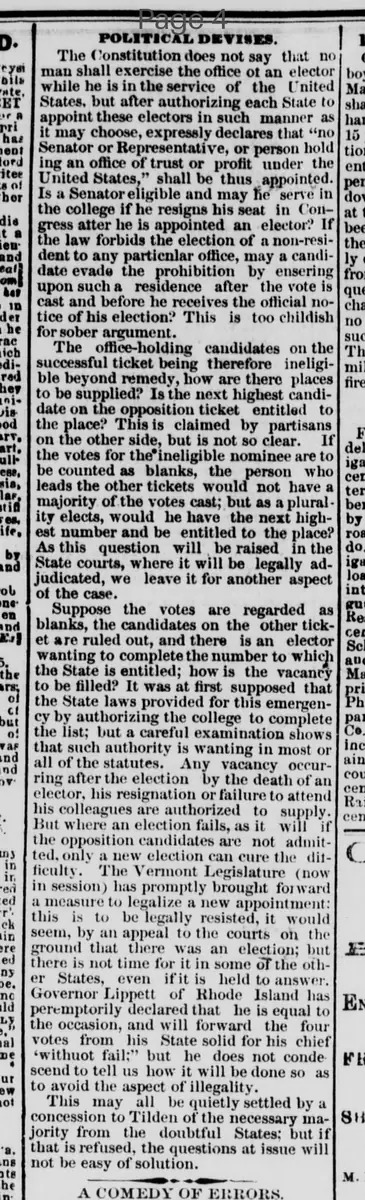
The Constitution does not say that no man shall exercise the office of an elector while he is in the service of the United States, but after authorizing each State to appoint these electors in such manner as it may choose, expressly declares that "no Senator or Representative, or person holding an office of trust or profit under the United States," shall be thus appointed.
Is a Senator eligible and may he serve in the college if he resigns his seat in Congress after he is appointed an elector? If the law forbids the election of a non-resident to any particular office, may a candidate evade the prohibition by entering upon such a residence after the vote is cast and before he receives the official notice of his election? This is too childish for sober argument.
The office-holding candidates on the successful ticket being therefore ineligible beyond remedy, how are their places to be supplied? Is the next highest candidate on the opposition ticket entitled to the place? This is claimed by partisans on the other side, but is not so clear. If the votes for the ineligible nominee are to be counted as blanks, the person who leads the other tickets would not have a majority of the votes cast; but as a plurality elects, would he have the next highest number and be entitled to the place?
As this question will be raised in the State courts, where it will be legally adjudicated, we leave it for another aspect of the case.
Suppose the votes are regarded as blanks, the candidates on the other ticket are ruled out, and there is an elector wanting to complete the number to which the State is entitled; how is the vacancy to be filled? It was at first supposed that the State laws provided for this emergency by authorizing the college to complete the list; but a careful examination shows that such authority is wanting in most or all of the statutes. Any vacancy occurring after the election by the death of an elector, his resignation or failure to attend his colleagues are authorized to supply. But where an election fails, as it will if the opposition candidates are not admitted, only a new election can cure the difficulty. The Vermont Legislature (now in session) has promptly brought forward a measure to legalize a new appointment; this is to be legally resisted, it would seem, by an appeal to the courts on the ground that there was an election; but there is not time for it in some of the other States, even if it is held to answer.
Governor Lippett of Rhode Island has peremptorily declared that he is equal to the occasion, and will forward the four votes from his State solid for his chief "without fail;" but he does not condescend to tell us how it will be done so as to avoid the aspect of illegality.
This may all be quietly settled by a concession to Tilden of the necessary majority from the doubtful States: but if that is refused, the questions at issue will not be easy of solution.
The Constitution does not say that no man shall exercise the office of an elector while he is in the service of the United States, but after authorizing each State to appoint these electors in such manner as it may choose, expressly declares that "no Senator or Representative, or person holding an office of trust or profit under the United States," shall be thus appointed.
Is a Senator eligible and may he serve in the college if he resigns his seat in Congress after he is appointed an elector? If the law forbids the election of a non-resident to any particular office, may a candidate evade the prohibition by entering upon such a residence after the vote is cast and before he receives the official notice of his election? This is too childish for sober argument.
The office-holding candidates on the successful ticket being therefore ineligible beyond remedy, how are their places to be supplied? Is the next highest candidate on the opposition ticket entitled to the place? This is claimed by partisans on the other side, but is not so clear. If the votes for the ineligible nominee are to be counted as blanks, the person who leads the other tickets would not have a majority of the votes cast; but as a plurality elects, would he have the next highest number and be entitled to the place?
As this question will be raised in the State courts, where it will be legally adjudicated, we leave it for another aspect of the case.
Suppose the votes are regarded as blanks, the candidates on the other ticket are ruled out, and there is an elector wanting to complete the number to which the State is entitled; how is the vacancy to be filled? It was at first supposed that the State laws provided for this emergency by authorizing the college to complete the list; but a careful examination shows that such authority is wanting in most or all of the statutes. Any vacancy occurring after the election by the death of an elector, his resignation or failure to attend his colleagues are authorized to supply. But where an election fails, as it will if the opposition candidates are not admitted, only a new election can cure the difficulty. The Vermont Legislature (now in session) has promptly brought forward a measure to legalize a new appointment; this is to be legally resisted, it would seem, by an appeal to the courts on the ground that there was an election; but there is not time for it in some of the other States, even if it is held to answer.
Governor Lippett of Rhode Island has peremptorily declared that he is equal to the occasion, and will forward the four votes from his State solid for his chief "without fail;" but he does not condescend to tell us how it will be done so as to avoid the aspect of illegality.
This may all be quietly settled by a concession to Tilden of the necessary majority from the doubtful States: but if that is refused, the questions at issue will not be easy of solution.
What sub-type of article is it?
Historical Event
Mystery
What themes does it cover?
Justice
Fortune Reversal
What keywords are associated?
Electoral College
Constitutional Eligibility
Elector Vacancies
1876 Election
Tilden
Vermont Legislature
Rhode Island Governor
What entities or persons were involved?
Tilden
Governor Lippett
Where did it happen?
Vermont, Rhode Island, United States
Story Details
Key Persons
Tilden
Governor Lippett
Location
Vermont, Rhode Island, United States
Story Details
Constitutional debate on federal officeholders' ineligibility as electors, vacancy resolution challenges, state legislative responses, and potential electoral concession to Tilden amid disputed appointments.