Thank you for visiting SNEWPapers!
Sign up free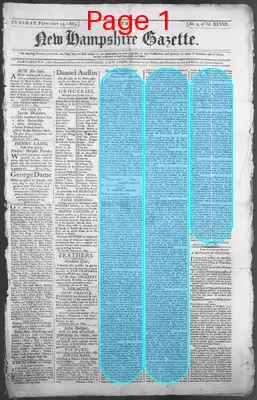
Story
February 15, 1803
The New Hampshire Gazette
Portsmouth, Rockingham County, New Hampshire
What is this article about?
Correspondence between Samuel Adams and Thomas Paine in 1802-1803, where Adams expresses concern over Paine's 'Age of Reason' promoting infidelity, and Paine defends his deism, belief in God, and critiques organized religion and political intrigue.
Clipping
OCR Quality
92%
Excellent
Full Text
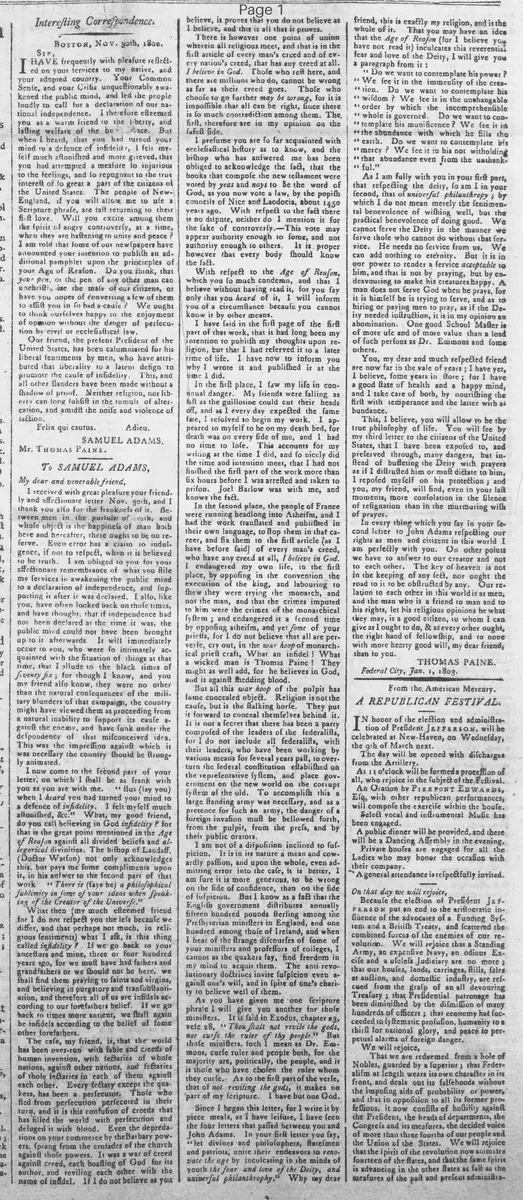
Interesting Correspondence.
Boston, Nov. 30th, 1802.
SIR,
I HAVE frequently with pleasure reflected
on your services to my native, and
your adopted country. Your Common
Sense, and your Crisis unquestionably awa-
kend the public mind, and led the people
loudly to call for a declaration of our na-
tional independence. I therefore esteemed
you as a warm friend to the liberty, and
lasting welfare of the business. Peace. But
when I heard, that you had turned your
mind to a defence of infidelity, I felt my-
self much astonished and more grieved, that
you had attempted a measure so injurious
to the feelings, and so repugnant to the true
interest of so great a part of the citizens of
the United States. The people of New-
England, if you will allow me to use a
Scripture phrase, are fast returning to their
first love. Will you excite among them
the spirit of angry controversy, at a time,
when they are hastening to unity and peace?
I am told that some of our newspapers have
announced your intention to publish an ad-
ditional pamphlet upon the principles of
your Age of Reason. Do you think, that
your pen, or the pen of any other man can
unchristianize the mass of our citizens, or
have you hopes of converting a few of them
to assist you in so bad a cause? We ought
to think ourselves happy in the enjoyment
of opinion without the danger of persecu-
tion by civil or ecclesiastical law.
Our friend, the present President of the
United States, has been calumniated for his
liberal sentiments by men, who have attri-
buted that liberality to a latent design to
promote the cause of infidelity. This, and
all other slanders have been made without a
shadow of proof. Neither religion, nor lib-
erty can long subsist in the tumult of alter-
cation, and amidst the noise and violence of
reaction.
Felix qui potuit rerum cognoscere causas.
Adieu.
SAMUEL ADAMS.
Mr. Thomas Paine.
To SAMUEL ADAMS,
My dear and venerable friend,
I received with great pleasure your friend-
ly and affectionate letter Nov. 30th, and I
thank you also for the frankness of it. Be-
tween men in the pursuit of truth, and
whose object is the happiness of man both
here and hereafter, there ought to be no re-
erve. Even error has a claim to indul-
gence, if not to respect, when it is believed
to be truth. I am obliged to you for your
affectionate remembrance of what you stile
my services in awakening the public mind
to a declaration of independence, and up-
porting it after it was declared. I also, like
you, have often looked back on those times,
and have thought, that if independence had
not been declared at the time it was, the
public mind could not have been brought
up to it afterwards. It will immediately
occur to you, who were so intimately ac-
quainted with the situation of things at that
time, that I allude to the black times of
seventy six; for though I know, and you
my friend also know, they were no other
than the natural consequences of the mili-
tary blunders of that campaign, the country
might have viewed them as proceeding from
a natural inability to support its cause a-
gainst the enemy, and have sunk under the
despandency of that misconceived idea.
This was the impression against which it
was necessary the country should be strong-
ly animated.
I now come to the second part of your
letter, on which I shall be as frank with
you as you are with me. "But (say you)
when I heard you had turned your mind to
a defence of infidelity. I felt myself much
astonished, &c." What, my good friend,
do you call believing in God infidelity? for
that is the great point mentioned in the Age
of Reason against all divided beliefs and al-
legorical divinities. The bishop of Llandaff,
(Doctor Watson) not only acknowledges
this, but pays me some compliments upon
it, in his answer to the second part of that
work "There is (says he) a philosophical
sublimity in some of your ideas when speak-
ing of the Creator of the Universe."
What then (my much esteemed friend
for I do not respect you the less because we
differ, and that perhaps not much, in reli-
gious sentiments) what I ask, is this thing
called infidelity?. If we go back to your
ancestors and mine, three or four hundred
years ago, for we must have had fathers and
grandfathers or we should not be here, we
shall find them praying to saints and virgins,
and believing in purgatory and transubstanti-
ation, and therefore all of us are infidels ac-
cording to our forefathers belief. If we go
back to times more ancient, we shall again
be infidels according to the belief of some
other forefathers.
The case, my friend, is, that the world
has been over-run with fable and creeds of
human invention, with sectsaries of whole
nations, against other nations. and sectaries
of those sectsaries in each of them against
each other. Every sectary except the qua-
kers, has been a persecutor. Those who
fled from persecution persecuted in their
turn, and it is this confusion of creeds that
has filled the world with persecution and
deluged it with blood. Even the depreda-
tions on your commerce by the Barbary pow-
ers, sprang from the crusades of the church
against those powers. It was a war of creed
against creed, each boasting of God for its
author, and reviling each other with the
name of infidel. If I do not believe as you
believe, it proves that you do not believe as
I believe, and this is all that it proves.
There is however one point of union
wherein all religious meet, and that is in the
first article of every man's creed and of ev-
ery nation's creed. that has any creed at all.
I believe in God. Those who rest here, and
there are millions who do, cannot be wrong
as far as their creed goes. Those who
choose to go further may be wrong, for it is
impossible that all can be right, since there
is so much contradiction among them. The
first, therefore are in my opinion on the
safest side.
I presume you are so far acquainted with
ecclesiastical history as to know, and the
bishop who has answered me has been
obliged to acknowledge the fact, that the
books that compose the new testament were
voted by yeas and nays to Be the word of
God, as you now vote a law, by the popish
councils of Nice and Laodicea, about 1450
years ago. With respect to the fact there
is no dispute, neither do I mention it for
the sake of controversy.—This vote may
appear authority enough to some, and not
authority enough to others. It is proper
however that every body should know
the fact.
With respect to the Age of Reason,
which you so much condemn, and that I
believe without having read it, for you say
only that you heard of it, I will inform
you of a circumstance because you cannot
know it by other means.
I have said in the first page of the first
part of that work, that it had long been my
intention to publish my thoughts upon re-
ligion, but that I had reserved it to a later
time of life. I have now to inform you
why I wrote it and published it at the
time I did.
In the first place, I saw my life in con-
usual danger. My friends were falling as
fast as the guillotine could cut their heads
off, and as I every day expected the same
fate, I resolved to begin my work. I ap-
peared to myself to be on my death bed, for
death was on every side of me, and I had
no time to lose. This accounts for my
writing at the time I did, and so nicely did
the time and intention meet, that I had not
finished the first part of the work more than
six hours before I was arrested and taken to
prison. Joel Barlow was with me, and
knows the fact.
In the second place, the people of France
were running headlong into Atheism, and I
had the work translated and published in
their own language, to stop them in that ca-
reer, and fix them to the first article (as I
have before said of every man's creed,
who have any creed at all, I believe in God.
I endangered my own life, in the first
place, by opposing in the convention the
execution of the king, and labouring to
shew they were trying the monarch, and
not the man, and that the crimes imputed
to him were the crimes of the monarchical
system; and endangered it a second time
by opposing atheism, and yet some of your
priests, for I do not believe that all are per-
verse, cry out, in the war hoop of monarch-
ical priest craft, What an infidel! What
a wicked man is Thomas Paine! They
might as well add, for he believes in God,
and is against shedding blood.
But all this war hoop of the pulpit has
some concealed object. Religion is not the
cause, but is the stalking horse. They put
it forward to conceal themselves behind it.
It is not a secret that there has been a party
composed of the leaders of the federalists.
for I do not include all federalists, with
their leaders, who have been working by
various means for several years past, to over-
turn the federal constitution established on
the representative system, and place gov-
ernment on the new world on the corrupt
system of the old. To accomplish this a
large standing army was necessary, and as a
pretence for such an army, the danger of a
foreign invasion must be bellowed forth,
from the pulpit, from the press, and by
their public orators.
I am not of a disposition inclined to sus-
picion. It is in its nature a mean and cow-
ardly passion, and upon the whole, even ad-
mitting error into the case, it is better, I
am sure it is more generous, to be wrong
on the side of confidence, than on the side
of suspicion. But I know as a fact that the
English government distributes annually
fifteen hundred pounds sterling among those
Presbyterian ministers in England, and one
hundred among those of Ireland, and when
I hear of the strange discourses of some of
your ministers and professors of colleges, I
cannot as the quakers say, find freedom in
my mind to acquit them. The anti revo-
lutionary doctrines invite suspicion even a-
gainst one's will, and in spite of one's chari-
ty to believe well of them.
As you have given me one scripture
phrase I will give you another for those
ministers. It is said in Exodus, chapter 23,
verse 28. "Thou shalt not revile the gods,
nor curse the ruler of thy people." But
those ministers, such I mean as Dr. Em-
mons, curse ruler and people both, for the
majority are, politically, the people, and it
is those who have chosen the ruler whom
they curse. As to the first part of the verse,
that of not reviling the gods, it makes no
part of my scripture. I have but one God.
Since I began this letter, for I write it by
piece meals, as I have leisure, I have seen
the four letters that passed between you and
John Adams. In your first letter you say,
"let divines and philosophers, statesmen
and patriots, unite their endeavors to reno-
vate the age by inculcating in the minds of
youth the fear and love of the Deity, and
universal philanthropy." Why my dear
friend, this is exactly my religion, and is the
whole of it. That you may have an idea
that the Age of Reason (for I believe you
have not read it) inculcates this reverential
fear and love of the Deity, I will give you
a paragraph from it :
"Do we want to contemplate his power?
We see it in the immensity of the crea-
tion, Do we want to contemplate his
wisdom? We see it in the unchangeable
order by which the incomprehensible
whole is governed. Do we want to con-
template his munificence? We see it in
the abundance with which he fills the
earth. Do we want to contemplate his
mercy? We see it in his not withholding
that abundance even from the unthank-
ful."
As I am fully with you in your first part,
that respecting the deity, so am I in your
Second, that of universal philanthropy; by
which I do not mean merely the sentimen-
tal benevolence of wishing well, but the
practical benevolence of doing good. We
cannot serve the Deity in the manner we
serve those who cannot do without that ser-
vice. He needs no service from us. We
can add nothing to eternity. But it is in
our power to render a service acceptable to
him, and that is not by praying, but by en-
deavouring to make his creatures happy. A
man does not serve God when he prays, for
it is himself be is trying to serve, and as to
hiring or paying men to pray, as if the De-
ity needed instruction, it is in my opinion an
abomination. One good School Master is
of more use and of more value than a load
of such persons as Dr. Emmons and some
others.
You, my dear and much respected friend
are now far in the vale of years; I have yet,
I believe, some years in store; for I have
a good state of health and a happy mind,
and I take care of both, by nourishing the
first with temperance and the latter with a
bundance.
This, I believe, you will allow to be the
true philosophy of life. You will see by
my third letter to the citizens of the United
States, that I have been exposed to, and
preserved through, many dangers, but in-
stead of buffeting the Deity with prayers
as if I distrusted him or must dictate to him,
I reposed myself on his protection; and
you, my friend, will find, even in your last
moments, more consolation in the Silence
of resignation than in the murmuring wish
of prayer.
In every thing which you say in your sec-
ond letter to John Adams respecting our
rights as men and citizens in this world I
am perfectly with you. On other points
we have to answer to our creator and not
to each other. The key of heaven is not
in the keeping of any sect, nor ought the
road to it to be obstructed by any. Our re-
lation to each other in this world is as men,
and the man who is a friend to man and to
his rights, let his religious opinions be what
they may, is a good citizen, to whom I can
give as I ought to do, & as every other ought,
the right hand of fellowship, and to none
with more hearty good will, my dear friend,
than to you.
THOMAS PAINE.
Federal City, Jan. 1, 1803.
Boston, Nov. 30th, 1802.
SIR,
I HAVE frequently with pleasure reflected
on your services to my native, and
your adopted country. Your Common
Sense, and your Crisis unquestionably awa-
kend the public mind, and led the people
loudly to call for a declaration of our na-
tional independence. I therefore esteemed
you as a warm friend to the liberty, and
lasting welfare of the business. Peace. But
when I heard, that you had turned your
mind to a defence of infidelity, I felt my-
self much astonished and more grieved, that
you had attempted a measure so injurious
to the feelings, and so repugnant to the true
interest of so great a part of the citizens of
the United States. The people of New-
England, if you will allow me to use a
Scripture phrase, are fast returning to their
first love. Will you excite among them
the spirit of angry controversy, at a time,
when they are hastening to unity and peace?
I am told that some of our newspapers have
announced your intention to publish an ad-
ditional pamphlet upon the principles of
your Age of Reason. Do you think, that
your pen, or the pen of any other man can
unchristianize the mass of our citizens, or
have you hopes of converting a few of them
to assist you in so bad a cause? We ought
to think ourselves happy in the enjoyment
of opinion without the danger of persecu-
tion by civil or ecclesiastical law.
Our friend, the present President of the
United States, has been calumniated for his
liberal sentiments by men, who have attri-
buted that liberality to a latent design to
promote the cause of infidelity. This, and
all other slanders have been made without a
shadow of proof. Neither religion, nor lib-
erty can long subsist in the tumult of alter-
cation, and amidst the noise and violence of
reaction.
Felix qui potuit rerum cognoscere causas.
Adieu.
SAMUEL ADAMS.
Mr. Thomas Paine.
To SAMUEL ADAMS,
My dear and venerable friend,
I received with great pleasure your friend-
ly and affectionate letter Nov. 30th, and I
thank you also for the frankness of it. Be-
tween men in the pursuit of truth, and
whose object is the happiness of man both
here and hereafter, there ought to be no re-
erve. Even error has a claim to indul-
gence, if not to respect, when it is believed
to be truth. I am obliged to you for your
affectionate remembrance of what you stile
my services in awakening the public mind
to a declaration of independence, and up-
porting it after it was declared. I also, like
you, have often looked back on those times,
and have thought, that if independence had
not been declared at the time it was, the
public mind could not have been brought
up to it afterwards. It will immediately
occur to you, who were so intimately ac-
quainted with the situation of things at that
time, that I allude to the black times of
seventy six; for though I know, and you
my friend also know, they were no other
than the natural consequences of the mili-
tary blunders of that campaign, the country
might have viewed them as proceeding from
a natural inability to support its cause a-
gainst the enemy, and have sunk under the
despandency of that misconceived idea.
This was the impression against which it
was necessary the country should be strong-
ly animated.
I now come to the second part of your
letter, on which I shall be as frank with
you as you are with me. "But (say you)
when I heard you had turned your mind to
a defence of infidelity. I felt myself much
astonished, &c." What, my good friend,
do you call believing in God infidelity? for
that is the great point mentioned in the Age
of Reason against all divided beliefs and al-
legorical divinities. The bishop of Llandaff,
(Doctor Watson) not only acknowledges
this, but pays me some compliments upon
it, in his answer to the second part of that
work "There is (says he) a philosophical
sublimity in some of your ideas when speak-
ing of the Creator of the Universe."
What then (my much esteemed friend
for I do not respect you the less because we
differ, and that perhaps not much, in reli-
gious sentiments) what I ask, is this thing
called infidelity?. If we go back to your
ancestors and mine, three or four hundred
years ago, for we must have had fathers and
grandfathers or we should not be here, we
shall find them praying to saints and virgins,
and believing in purgatory and transubstanti-
ation, and therefore all of us are infidels ac-
cording to our forefathers belief. If we go
back to times more ancient, we shall again
be infidels according to the belief of some
other forefathers.
The case, my friend, is, that the world
has been over-run with fable and creeds of
human invention, with sectsaries of whole
nations, against other nations. and sectaries
of those sectsaries in each of them against
each other. Every sectary except the qua-
kers, has been a persecutor. Those who
fled from persecution persecuted in their
turn, and it is this confusion of creeds that
has filled the world with persecution and
deluged it with blood. Even the depreda-
tions on your commerce by the Barbary pow-
ers, sprang from the crusades of the church
against those powers. It was a war of creed
against creed, each boasting of God for its
author, and reviling each other with the
name of infidel. If I do not believe as you
believe, it proves that you do not believe as
I believe, and this is all that it proves.
There is however one point of union
wherein all religious meet, and that is in the
first article of every man's creed and of ev-
ery nation's creed. that has any creed at all.
I believe in God. Those who rest here, and
there are millions who do, cannot be wrong
as far as their creed goes. Those who
choose to go further may be wrong, for it is
impossible that all can be right, since there
is so much contradiction among them. The
first, therefore are in my opinion on the
safest side.
I presume you are so far acquainted with
ecclesiastical history as to know, and the
bishop who has answered me has been
obliged to acknowledge the fact, that the
books that compose the new testament were
voted by yeas and nays to Be the word of
God, as you now vote a law, by the popish
councils of Nice and Laodicea, about 1450
years ago. With respect to the fact there
is no dispute, neither do I mention it for
the sake of controversy.—This vote may
appear authority enough to some, and not
authority enough to others. It is proper
however that every body should know
the fact.
With respect to the Age of Reason,
which you so much condemn, and that I
believe without having read it, for you say
only that you heard of it, I will inform
you of a circumstance because you cannot
know it by other means.
I have said in the first page of the first
part of that work, that it had long been my
intention to publish my thoughts upon re-
ligion, but that I had reserved it to a later
time of life. I have now to inform you
why I wrote it and published it at the
time I did.
In the first place, I saw my life in con-
usual danger. My friends were falling as
fast as the guillotine could cut their heads
off, and as I every day expected the same
fate, I resolved to begin my work. I ap-
peared to myself to be on my death bed, for
death was on every side of me, and I had
no time to lose. This accounts for my
writing at the time I did, and so nicely did
the time and intention meet, that I had not
finished the first part of the work more than
six hours before I was arrested and taken to
prison. Joel Barlow was with me, and
knows the fact.
In the second place, the people of France
were running headlong into Atheism, and I
had the work translated and published in
their own language, to stop them in that ca-
reer, and fix them to the first article (as I
have before said of every man's creed,
who have any creed at all, I believe in God.
I endangered my own life, in the first
place, by opposing in the convention the
execution of the king, and labouring to
shew they were trying the monarch, and
not the man, and that the crimes imputed
to him were the crimes of the monarchical
system; and endangered it a second time
by opposing atheism, and yet some of your
priests, for I do not believe that all are per-
verse, cry out, in the war hoop of monarch-
ical priest craft, What an infidel! What
a wicked man is Thomas Paine! They
might as well add, for he believes in God,
and is against shedding blood.
But all this war hoop of the pulpit has
some concealed object. Religion is not the
cause, but is the stalking horse. They put
it forward to conceal themselves behind it.
It is not a secret that there has been a party
composed of the leaders of the federalists.
for I do not include all federalists, with
their leaders, who have been working by
various means for several years past, to over-
turn the federal constitution established on
the representative system, and place gov-
ernment on the new world on the corrupt
system of the old. To accomplish this a
large standing army was necessary, and as a
pretence for such an army, the danger of a
foreign invasion must be bellowed forth,
from the pulpit, from the press, and by
their public orators.
I am not of a disposition inclined to sus-
picion. It is in its nature a mean and cow-
ardly passion, and upon the whole, even ad-
mitting error into the case, it is better, I
am sure it is more generous, to be wrong
on the side of confidence, than on the side
of suspicion. But I know as a fact that the
English government distributes annually
fifteen hundred pounds sterling among those
Presbyterian ministers in England, and one
hundred among those of Ireland, and when
I hear of the strange discourses of some of
your ministers and professors of colleges, I
cannot as the quakers say, find freedom in
my mind to acquit them. The anti revo-
lutionary doctrines invite suspicion even a-
gainst one's will, and in spite of one's chari-
ty to believe well of them.
As you have given me one scripture
phrase I will give you another for those
ministers. It is said in Exodus, chapter 23,
verse 28. "Thou shalt not revile the gods,
nor curse the ruler of thy people." But
those ministers, such I mean as Dr. Em-
mons, curse ruler and people both, for the
majority are, politically, the people, and it
is those who have chosen the ruler whom
they curse. As to the first part of the verse,
that of not reviling the gods, it makes no
part of my scripture. I have but one God.
Since I began this letter, for I write it by
piece meals, as I have leisure, I have seen
the four letters that passed between you and
John Adams. In your first letter you say,
"let divines and philosophers, statesmen
and patriots, unite their endeavors to reno-
vate the age by inculcating in the minds of
youth the fear and love of the Deity, and
universal philanthropy." Why my dear
friend, this is exactly my religion, and is the
whole of it. That you may have an idea
that the Age of Reason (for I believe you
have not read it) inculcates this reverential
fear and love of the Deity, I will give you
a paragraph from it :
"Do we want to contemplate his power?
We see it in the immensity of the crea-
tion, Do we want to contemplate his
wisdom? We see it in the unchangeable
order by which the incomprehensible
whole is governed. Do we want to con-
template his munificence? We see it in
the abundance with which he fills the
earth. Do we want to contemplate his
mercy? We see it in his not withholding
that abundance even from the unthank-
ful."
As I am fully with you in your first part,
that respecting the deity, so am I in your
Second, that of universal philanthropy; by
which I do not mean merely the sentimen-
tal benevolence of wishing well, but the
practical benevolence of doing good. We
cannot serve the Deity in the manner we
serve those who cannot do without that ser-
vice. He needs no service from us. We
can add nothing to eternity. But it is in
our power to render a service acceptable to
him, and that is not by praying, but by en-
deavouring to make his creatures happy. A
man does not serve God when he prays, for
it is himself be is trying to serve, and as to
hiring or paying men to pray, as if the De-
ity needed instruction, it is in my opinion an
abomination. One good School Master is
of more use and of more value than a load
of such persons as Dr. Emmons and some
others.
You, my dear and much respected friend
are now far in the vale of years; I have yet,
I believe, some years in store; for I have
a good state of health and a happy mind,
and I take care of both, by nourishing the
first with temperance and the latter with a
bundance.
This, I believe, you will allow to be the
true philosophy of life. You will see by
my third letter to the citizens of the United
States, that I have been exposed to, and
preserved through, many dangers, but in-
stead of buffeting the Deity with prayers
as if I distrusted him or must dictate to him,
I reposed myself on his protection; and
you, my friend, will find, even in your last
moments, more consolation in the Silence
of resignation than in the murmuring wish
of prayer.
In every thing which you say in your sec-
ond letter to John Adams respecting our
rights as men and citizens in this world I
am perfectly with you. On other points
we have to answer to our creator and not
to each other. The key of heaven is not
in the keeping of any sect, nor ought the
road to it to be obstructed by any. Our re-
lation to each other in this world is as men,
and the man who is a friend to man and to
his rights, let his religious opinions be what
they may, is a good citizen, to whom I can
give as I ought to do, & as every other ought,
the right hand of fellowship, and to none
with more hearty good will, my dear friend,
than to you.
THOMAS PAINE.
Federal City, Jan. 1, 1803.
What sub-type of article is it?
Biography
Historical Event
What themes does it cover?
Moral Virtue
Providence Divine
Justice
What keywords are associated?
Thomas Paine
Samuel Adams
Age Of Reason
Infidelity
Deism
American Independence
Religious Debate
French Revolution
What entities or persons were involved?
Samuel Adams
Thomas Paine
John Adams
Where did it happen?
Boston; Federal City
Story Details
Key Persons
Samuel Adams
Thomas Paine
John Adams
Location
Boston; Federal City
Event Date
1802 11 30 To 1803 01 01
Story Details
Samuel Adams praises Paine's role in American independence but grieves his defense of infidelity in 'Age of Reason,' urging peace. Paine defends his deism, belief in one God, critiques creeds and persecution, explains writing context during French Revolution, and affirms shared values in philanthropy and rights.