Thank you for visiting SNEWPapers!
Sign up free
Alexandria Gazette
Alexandria, Alexandria County, District Of Columbia
What is this article about?
Annual Treasury Report for 1843 details estimated expenditures of $26.9 million, revenue projections from customs and land sales, historical comparisons, and recommendations for reducing government expenses through district abolitions and procedural changes.
Clipping
OCR Quality
Full Text
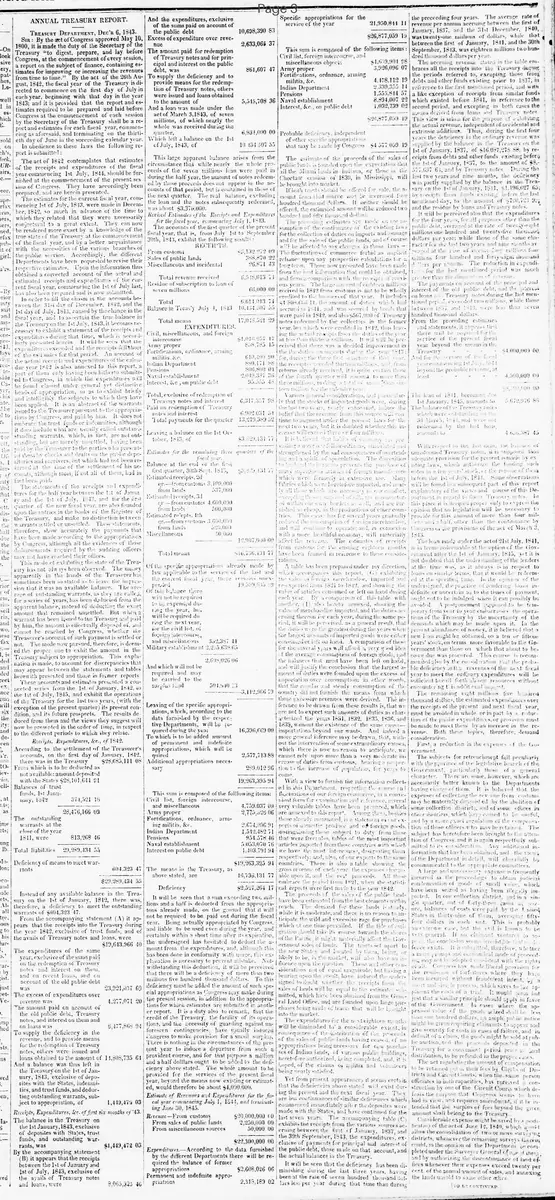
And the expenditures, exclusive Specific appropriations for the service of the year $31,950,811 11
$26,877,059 19
This sum is composed of the following items:
Civil list, foreign intercourse, and miscellaneous objects $4,659,901 98
Army proper 3,926,096 07
Fortifications, ordnance, arming militia, &c. 4,178,112 19
Indian Department 2,330,355 14
Pensions 1,555,814 57
Naval establishment 8,894,007 22
Interest, &c., on public debt 1,032,739 02
$24,377,059 19
Probable deficiency, independent of other special appropriations that may be made by Congress $2,377,039 19
The estimate of the proceeds of the sales of public lands is founded upon the expectation that all the Miami Lands in Indiana, or those in the Choctaw cession of 1830, in Mississippi, will be brought into market.
If both tracts should be offered for sale, the amount from that source may be increased four hundred thousand dollars. If neither should be offered, the estimated amount will be reduced two hundred and fifty thousand dollars.
The preceding estimates are made on the assumption of the continuance of the existing laws for the collection of duties on imports and tonnage and for the sale of the public lands, and of course will be affected by any changes in those laws.
The fluctuations of commerce forbid an implicit reliance upon any prospective calculations for a long term. Those now presented have been made from the best information that could be obtained, and from comparison with the receipts of previous years. The large amount eighteen millions received in 1842 from customs is not to be wholly credited to the business of that year. It includes $8,805,000, the amount of duties which had accrued in 1841, and was secured by bond, that were paid in 1842, and also $567,000 of Treasury notes redeemed by the collectors, in the former year, but which were credited in 1842, thus lessening the actual receipts from the duties of the year at less than thirteen millions. It will be perceived that there was a decided improvement in the duties on imports during the year 1843: During the three first quarters of that year, the receipts exceeded thirteen and a half millions, and from returns already received, it is quite certain those of the fourth quarter will amount to more than three millions, making in all nearly sixteen millions for the calendar year.
Various speculations are to be added, and particularly that the stocks of imported goods were, during the last two years, nearly exhausted, induce the belief that the revenue from this source will continue to augment under the present laws for the next two years, but it is doubted whether this increase will exceed three or four millions.
It is believed that habits of economy in purchasing goods for consumption, stimulated by the sad consequences of overtrading and a spirit of speculation. The disposition to rely less on foreign fabrics, and to encourage home manufactures, which were formerly in extensive use. many fabrics which were heretofore imported, and nearly all those which are now so, can be obtained within our own borders nearly as cheap, as the productions of other countries. This cause has for several years gradually reduced the consumption of foreign articles, and will continue to operate: and, in connexion with a more healthful economy, will materially affect the revenue. The estimates of receipts from customs in the ensuing eighteen months have been framed in reference to these considerations.
A table has been prepared under my direction, which accompanies this report, exhibiting the value of foreign merchandise, imported and re-exported from 1821 to 1842, and showing the value of articles consumed or left on hand during each year. By a comparison of this table with another, (1) also hereto appended, showing the value of merchandise imported, and the duties accruing thereon for each year, during the same period, it will be perceived, as a general result, that the duties were the greatest during the years when the largest amounts of imported goods were either consumed or left on hand. A comparison of these for the several years will afford a very good idea of the average consumption of foreign goods, and the balances that must have been left on hand, and will justify the conclusion that the largest amount of duties were founded upon the excess of importation over consumption; in other words, that the regular and steady consumption of the country did not furnish the means from which those excessive revenues were derived. The inference to be drawn from these results is, that we are not to expect such amounts of duties as characterized the years 1836, 1837, 1835, 1836, and 1839, without the existence of the same cause—importations beyond our wants. And indeed a more general inference may be drawn, that, without the intervention of some extraordinary causes, which there is now no reason to anticipate, we cannot rely upon more than a very moderate increase of duties from customs, bearing a proportion to the increase of population, for years to come.
With a view to furnish the information collected in this Department, respecting the course and fluctuations of our foreign commerce, in a convenient form for examination and reference, several very valuable tables have been prepared, which are annexed to this report. Among them, besides those already mentioned, is a statement of our exports of domestic produce and of foreign goods, distinguishing those subject to duty from those that were free; also, tables of the most important articles imported from those countries with which we have the most intercourse, designating them respectively, and, also, of our exports to the same countries. There is also a table showing the gross revenue of each year, the expenses chargeable upon it, and the net proceeds. All these embrace the period from 1821, when the statistical reports were first made to the year 1842.
The proceeds of the sales of the public lands have been estimated from the best elements within reach. The demand for these lands is steady, while it is moderate, and there is no reason to anticipate the wild and excessive rage for purchases which at one time prevailed. If the tide of emigration, should take its course towards the shores of the Pacific it might materially affect the Government sales of lands. The tracts set apart to the new States and located by them, being, or likely to be, in the market, will also have an influence upon the question. These and other considerations not of equal magnitude, but having a bearing upon the result, have induced the undersigned to doubt whether the receipts from the sales of lands will be equal to the estimate submitted, which have been obtained from the General Land Office, and are founded upon large purchases being made of tracts that will be brought into the market.
The expenditures for the next eighteen months, will be diminished to a considerable extent, in consequence of the distribution of the proceeds of the sales of public lands having ceased, of no appropriations being necessary for new purchases of Indian lands, of various public buildings, heretofore authorized, being completed, and, it is hoped, of the claims of militia and volunteers being nearly satisfied.
Yet from present appearances it seems certain that the deficiencies above stated will exist during the present and the next fiscal year. They are but continuations of similar deficiencies which commenced immediately after the deposits were made with the States, and have continued for the last seven years. The accompanying table (C) exhibits the receipts from the various sources accruing between the first of January, 1837, and the 30th September, 1843, the expenditures, exclusive of payments for principal and interest of the public debt, those made on that account, and the actual balances in the Treasury.
It will be seen that the deficiency has been diminishing during the last three years, having been at the rate of seven hundred thousand dollars less per year during that time than during the preceding four years. The average rate of revenue per annum accruing between the first of January, 1837, and the 31st December, 1840, was twenty-one millions of dollars, while that between the first of January, 1841, and the 30th September, 1843, was eighteen millions two hundred thousand dollars per year.
The accruing revenue stated in the table embraces all the receipts into the Treasury during the periods referred to, excepting those from debts and other funds existing prior to 1837, in reference to the first mentioned period, and with a like exception of receipts from similar funds which existed before 1841, in reference to the second period, and excepting in both cases the means derived from loans and Treasury notes This view is taken for the purpose of exhibiting the actual revenue, independent of accidental and extrinsic additions. Thus, during the first four years the deficiency in the ordinary revenue was supplied by the balance in the Treasury on the 1st of January, 1837, of $16,087,278 88; by receipts from debts and other funds existing before the 1st of January, 1837, to the amount of $3,577,697 63, and by Treasury notes During the last two years and nine months, the deficiency was partly supplied by the balance in the Treasury on the 1st of January, 1841, $1,196,627 65; by receipts from funds existing before the last mentioned day, to the amount of $780,723 93; and the residue by loans and Treasury notes.
It will be perceived also that the expenditures for the four years, for all purposes other than the public debt, averaged at the rate of twenty-eight millions one hundred and twenty-five thousand dollars per year; while those of the same character for the last two years and nine months averaged at the rate of twenty millions four hundred and forty-eight thousand dollars per annum. The reduction in expenditures for the last mentioned period was much greater than the diminution in revenue.
The payments on account of the principal and interest of the old public debt, and the stereas on loans : Treasury notes during the last mentioned period, exceeded two millions, while those between 1837 and 1840 were less than seven hundred thousand dollars.
From the preceding estimates and statements, it appears that there will be required for the service of the present fiscal year beyond the means in the Treasury $4,000,000 00
And for part of next year estimated beyond the probable revenue, at least 500,000 00
The loan of 1841, becoming due 1st January, 1845, amounts to $5,672,976 88
The balance of Treasury notes which were outstanding on the 3d March, 1840, and were not redeemed by the last loan, amounts to $656,387 45
With respect to the loan, the balance of unredeemed Treasury notes, it is supposed that adequate provision for the present stage by existing laws, which authorize the funding such notes in a 5 per cent. stock, either option of the lender before the 1st of July, 1845. Some observations will be found in a subsequent part of this report explanatory of the views and course of this Department in regard to these Treasury notes. In this place it is deemed proper only to express the opinion that no legislation will be necessary to provide for this amount of more than four millions and a half, other than the continuance by Congress of the provisions of the act of March 3, 1843.
The loan made under the act of 21st July, 1841, is in terms redeemable at the option of the Government after the 1st of January, 1845, yet it is not doubted that the understanding of the lenders at the time was, as it always is in respect to loans on simple terms, that it would be redeemed at the specified time. In the opinion of the undersigned, dependence on extending loans indefinite or uncertain as to the times of payment, ought not to be indulged when it can possibly be avoided. A postponement supposed to be temporary from year to year embarrasses the operations of the Treasury by the uncertainty of the demand, which may be made upon it. In the present abundance of money, it is believed that a new loan might be obtained, on a ten or fifteen years' stock, on terms more favorable to the Government than those on which that about to become due was procured. This course is recommended also by the consideration that the probable deficiency in the revenues of the next fiscal year to meet the ordinary expenditures will be sufficient to call forth all our resources without encountering an additional amount.
The remaining eight millions five hundred thousand dollars, the estimated expenditures over the receipts of the present and next fiscal year, must be avoided in whole or in part by a reduction of the public expenditures, or provision must be made to meet them by an increase in the revenue. Both these topics, therefore, demand consideration.
First, a reduction in the expenses of the Government.
The subjects for retrenchment fall peculiarly within the province of the legislative branch of the Government, particularly those of a general character. There are some, however, which are necessarily better known to the Departments having charge of them. It is believed that the expenses of collecting the revenue from customs may be materially diminished by the abolition of some collection districts, and of some offices in other districts, which have ceased to be useful, and by a more exact regulation of the compensation of those officers who may be retained. The subject has heretofore been brought to the attention of Congress, and it is again respectfully submitted to its consideration. Any additional information that has been obtained, and the views of the Department in detail, will cheerfully be communicated to the appropriate committees.
A large and unnecessary expense is frequently incurred in the proceedings to obtain judicial condemnation of goods of small value, which have been seized as having been illegally imported. In one collection district, and in a single quarter, out of forty-three cases of seizure, balances of costs were paid by the United States in thirty-nine of them, averaging fifty-four dollars. in each suit. This is probably an extreme case, but the evil is known to be very general. If no claimant ventures to oppose the conclusion seems worse injustice exists. it is submitted, therefore, whether a more prompt and economical mode of proceeding may not be adopted consistent with the rights of all. Congress has made liberal provision for the remission of forfeitures where they have been incurred without fraudulent intent, a short and summary process, which saves to the applicant the costs of a trial. It would seem but just that a similar principle should apply in favor of the Government. In cases where the appraised value of the goods seized shall be less than one hundred dollars, an ample public notice might be given requiring claimants to appear and give security for costs in cases of failure, and in default of a claim, the goods might be sold at public auction, and the proceeds deposited in the Treasury for a convenient period previous to sure distribution, to be refunded in the proper cases.
The act regulating the amount of compensation to be retained out of their fees by Clerks of Districts and Circuit Courts, when the same person officiates in both capacities, has received a construction by one of the Circuit Courts which defeats the purpose that Congress seems to have had in view, and requires amendment, if it be intended that the surplus of fees beyond the given amount shall belong to the Treasury.
Considerable expense might be saved by a modification of the act of June 12, 1840, which would allow the consolidation of two or more surveying districts, whenever the remaining surveys therein could, in the opinion of the Department be completed under the Surveyor General of one of them, and by authorizing the discontinuance of land offices whenever their expenses exceed twenty per cent of the annual amount of sales, and annexing the lands unsold to some other office.
What sub-type of article is it?
What keywords are associated?
Domestic News Details
Event Date
1843
Outcome
estimated expenditures $26,877,059; probable deficiency $2,377,039; recommendations for expense reductions in customs collection and judicial proceedings.
Event Details
Annual Treasury Report outlines expenditures by category, revenue estimates from customs and public land sales, historical revenue trends from 1821-1843, factors affecting commerce and consumption, and suggestions for government expense reductions including abolishing collection districts and modifying seizure procedures.