Thank you for visiting SNEWPapers!
Sign up free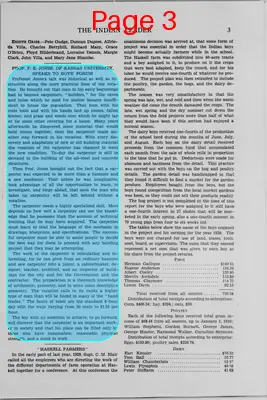
The Indian Leader
Lawrence, Douglas County, Kansas
What is this article about?
Prof. F. E. Jones of Kansas University addresses Boys' Forum on the historical evolution of carpentry from primitive shelters to modern steel structures, stressing the need for imagination, specialized skills, and continuous learning to advance in the vocation, with opportunities for growth and standard wages.
Clipping
OCR Quality
Full Text
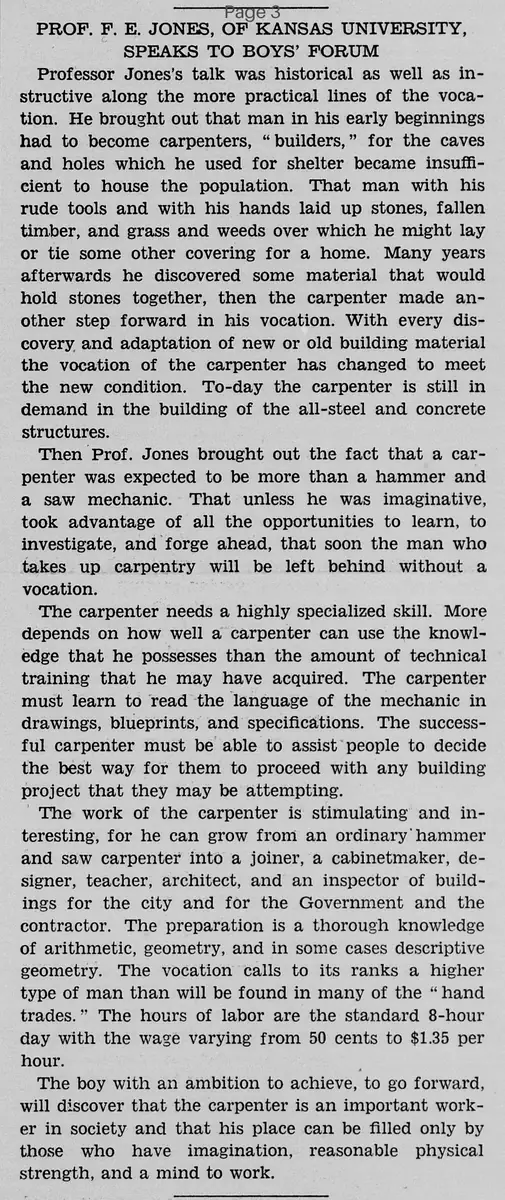
SPEAKS TO BOYS' FORUM
Professor Jones's talk was historical as well as instructive along the more practical lines of the vocation. He brought out that man in his early beginnings had to become carpenters, "builders," for the caves and holes which he used for shelter became insufficient to house the population. That man with his rude tools and with his hands laid up stones, fallen timber, and grass and weeds over which he might lay or tie some other covering for a home. Many years afterwards he discovered some material that would hold stones together, then the carpenter made another step forward in his vocation. With every discovery and adaptation of new or old building material the vocation of the carpenter has changed to meet the new condition. To-day the carpenter is still in demand in the building of the all-steel and concrete structures.
Then Prof. Jones brought out the fact that a carpenter was expected to be more than a hammer and a saw mechanic. That unless he was imaginative, took advantage of all the opportunities to learn, to investigate, and forge ahead, that soon the man who takes up carpentry will be left behind without a vocation.
The carpenter needs a highly specialized skill. More depends on how well a carpenter can use the knowledge that he possesses than the amount of technical training that he may have acquired. The carpenter must learn to read the language of the mechanic in drawings, blueprints, and specifications. The successful carpenter must be able to assist people to decide the best way for them to proceed with any building project that they may be attempting.
The work of the carpenter is stimulating and interesting, for he can grow from an ordinary hammer and saw carpenter into a joiner, a cabinetmaker, designer, teacher, architect, and an inspector of buildings for the city and for the Government and the contractor. The preparation is a thorough knowledge of arithmetic, geometry, and in some cases descriptive geometry. The vocation calls to its ranks a higher type of man than will be found in many of the "hand trades." The hours of labor are the standard 8-hour day with the wage varying from 50 cents to $1.35 per hour.
The boy with an ambition to achieve, to go forward, will discover that the carpenter is an important worker in society and that his place can be filled only by those who have imagination, reasonable physical strength, and a mind to work.
What sub-type of article is it?
What themes does it cover?
What keywords are associated?
What entities or persons were involved?
Where did it happen?
Story Details
Key Persons
Location
Kansas University
Story Details
Prof. Jones discusses the historical development of carpentry from primitive times to modern era, emphasizing the need for imagination, learning, specialized skills like reading blueprints, and opportunities for advancement to roles like architect or inspector, with standard 8-hour days and wages from 50 cents to $1.35 per hour.