Thank you for visiting SNEWPapers!
Sign up free
Gazette Of The United States
New York, New York County, New York
What is this article about?
Agricultural report from Wilmington on July 18 detailing successful crop rotation and manuring techniques at Prospect Hill estate, yielding good wheat and rye harvests over six years with minimal manure. Includes a 1760 quote criticizing overuse of dung in favor of natural soil amendments, signed by William Geddes.
Clipping
OCR Quality
Full Text
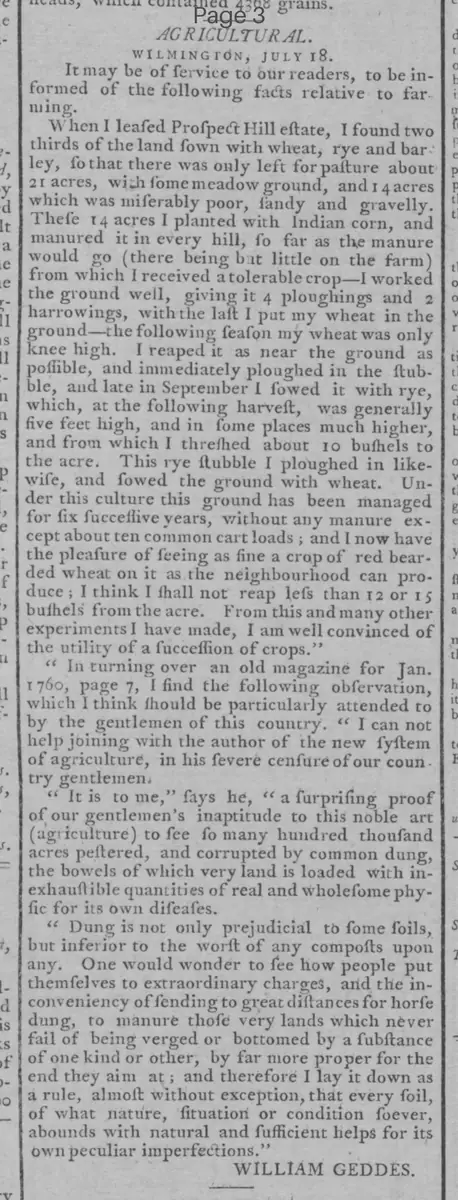
WILMINGTON, JULY 18.
It may be of service to our readers, to be informed of the following facts relative to farming.
When I leased Prospect Hill estate, I found two thirds of the land sown with wheat, rye and barley, so that there was only left for pasture about 21 acres, with some meadow ground, and 14 acres which was miserably poor, sandy and gravelly. These 14 acres I planted with Indian corn, and manured it in every hill, so far as the manure would go (there being but little on the farm) from which I received a tolerable crop—I worked the ground well, giving it 4 ploughings and 2 harrowings, with the last I put my wheat in the ground—the following season my wheat was only knee high. I reaped it as near the ground as possible, and immediately ploughed in the stubble, and late in September I sowed it with rye, which, at the following harvest, was generally five feet high, and in some places much higher, and from which I threshed about 10 bushels to the acre. This rye stubble I ploughed in likewise, and sowed the ground with wheat. Under this culture this ground has been managed for six successive years, without any manure except about ten common cart loads; and I now have the pleasure of seeing as fine a crop of red bearded wheat on it as the neighbourhood can produce; I think I shall not reap less than 12 or 15 bushels from the acre. From this and many other experiments I have made, I am well convinced of the utility of a succession of crops."
"In turning over an old magazine for Jan. 1760, page 7, I find the following observation, which I think should be particularly attended to by the gentlemen of this country. I cannot help joining with the author of the new system of agriculture, in his severe censure of our country gentlemen.
"It is to me," says he, "a surprising proof of our gentlemen's inaptitude to this noble art (agriculture) to see so many hundred thousand acres pestered, and corrupted by common dung, the bowels of which very land is loaded with inexhaustible quantities of real and wholesome physic for its own diseases.
"Dung is not only prejudicial to some soils, but inferior to the worst of any composts upon any. One would wonder to see how people put themselves to extraordinary charges, and the inconvenience of sending to great distances for horse dung, to manure those very lands which never fail of being veered or bottomed by a substance of one kind or other, by far more proper for the end they aim at; and therefore I lay it down as a rule, almost without exception, that every soil, of what nature, situation or condition soever, abounds with natural and sufficient helps for its own peculiar imperfections."
WILLIAM GEDDES.
What sub-type of article is it?
What keywords are associated?
What entities or persons were involved?
Where did it happen?
Domestic News Details
Primary Location
Wilmington
Event Date
July 18
Key Persons
Outcome
produced tolerable corn crop initially; rye yielded about 10 bushels per acre; current wheat crop expected 12-15 bushels per acre after six years with minimal manure.
Event Details
Description of farming practices on 14 acres of poor sandy gravelly land at Prospect Hill estate: planted Indian corn with hill manuring, multiple ploughings and harrowings, followed by succession of wheat, rye, and wheat crops, emphasizing utility of crop rotation. Includes quote from 1760 magazine advocating natural soil amendments over dung.