Thank you for visiting SNEWPapers!
Sign up free
Letter to Editor
September 15, 1845
The Daily Union
Washington, District Of Columbia
What is this article about?
Report from Philadelphia correspondent on Sept. 13, 1845, discussing potential railroad projects to connect to Pittsburgh, need for reduced rail fares, Ex-President Tyler's visit, new steamboat James Cage trials, firemen's riots, Pennsylvania canal tolls, and actor Hackett's theater benefit.
Clipping
OCR Quality
98%
Excellent
Full Text
[From our regular correspondent.]
Philadelphia, Sept. 13, 1845.
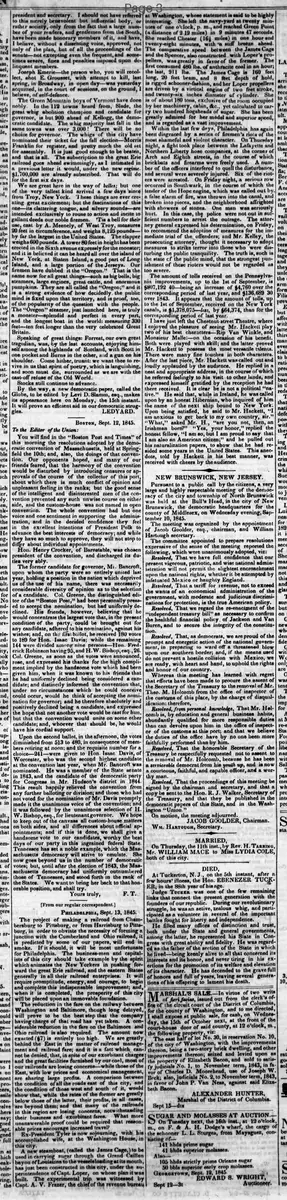
The project of making a railroad from Chambersburg to Pittsburg, or from Harrisburg to Pittsburg, in order to obviate the necessity of forming a junction with the Cumberland and Ohio railroad, it is predicted by some of our papers, will end in smoke. If it should, it will be most unfortunate for Philadelphia. The business-men and capitalists of this city should take example by the spirit which animates the New Yorkers in pushing forward the great Erie railroad, and the eastern States generally in all their railroad enterprises. It will require promptitude, energy, and courage, to begin and complete this indispensable improvement; and, when it is completed, the prosperity of this city will be placed upon an immovable foundation.
The reduction in the fare on the railway between Washington and Baltimore, though long delayed, will prove to be the best step that the company having charge of that road has yet taken. A considerable reduction in the fare on the Baltimore and Ohio railroad is also required. The amount now exacted ($7) is entirely too high. We are greatly behind the East in the matter of railroad management and railroad fare; and it is a fact which cannot be denied, that, in spite of our exorbitant charges and the great facilities furnished by our coal, most of our railroads are losing concerns while those of the East, with low prices and economical management, are sharing large profits. A comparison between the condition of all the roads east of this city, and the condition of those west and south of it, would show that, while the rates of the former are greatly below those of the latter, their profits, in all cases, are beyond them; and that many of the railroads in this region are losing concerns, notwithstanding their business and exorbitant fares. What more unanswerable proof could be required that reasonable prices encourage increased travel?
Ex-President Tyler is now sojourning, with his accomplished wife, at the Washington House, in this city.
A new steamboat, (called the James Cage,) to be used in carrying sugar through the Grand Caillou bayou of Louisiana to the vessels loading at its mouth, has just been constructed in this city, under the superintendence of Capt. Loper, on whose plan it was built. The experimental trip was witnessed by Capt. A. V. Frazer, the chief of the revenue bureau at Washington, whose statement is said to be highly interesting. She left the navy-yard at twenty minutes of one o'clock, p. m., and reached Green Point (a distance of 2 1/9 miles) in 9 minutes 47 seconds. She reached Chester (164 miles) in one hour and twenty-eight minutes, with a stiff breeze ahead.
The comparative speed between the James Cage and the Spencer, also constructed with Loper's propellers, was greatly in favor of the former. The first consumed 480 lbs. of anthracite coal in an hour; the last, 911 lbs. The James Cage is 160 feet long, 20 feet beam, and 8 feet depth of hold, is rigged schooner-fashion, and her Loper propellers are driven by a vertical engine of two feet stroke, and twenty-six inches diameter of cylinder. She is of about 180 tons, exclusive of the room occupied by her machinery, cabin, &c., yet calculated to carry two hundred hogsheads of sugar. She has been greatly admired for her model and superior speed, and is regarded as a vast improvement.
Within the last few days, Philadelphia has again been disgraced by a series of firemen's riots of the most shameful and violent character. On Thursday night, a fight took place between the Lafayette and Northern Liberty hose companies, at the corner of Arch and Eighth streets, in the course of which brickbats and firearms were freely used. A number of the officers interfered to quell the disturbance, and several were severely injured. Six of the rioters were arrested.
On Friday night, a serious row occurred in Southwark, in the course of which the tender of the Hope engine, which was called out by a false alarm of fire, was thrown into the canal, and broken into pieces, and the neighborhood affrighted with showers of stones. One man was seriously hurt. In this case, the police were not out in sufficient numbers to arrest the outrage. The attorney general expressed his determination, on Friday, to recommend the adoption of measures for the immediate trial of the offenders; and Mr. Kelley, the prosecuting attorney, thought it necessary to adopt measures to strike terror into those who were disturbing the public tranquility. The truth is, such is the state of the public mind, that the strongest punishment of these rioters would not be regarded as too severe.
The amount of tolls received on the Pennsylvania improvements, up to the 1st of September, is $807,192 40—being an increase of $4,760 over the corresponding period of last year, and $136,689 30 over 1843. It appears that the amount of tolls, up to the 1st of September, received on the New York canals, is $1,378,075—less, by $64,374, than for the corresponding period of last year.
I have just left the Chestnut-street Theatre, where I enjoyed the pleasure of seeing Mr. Hackett play two of his best characters—Rip Van Winkle, and Monsieur Mallet—on the occasion of his benefit. Both were played with skill; and the latter proved Mr. Hackett to possess the most versatile talents. There were many fine touches in both characters.
After the last piece, Mr. Hackett was called out and loudly applauded by the audience. He replied in a neat and appropriate address, in the course of which he referred feelingly to his visit to other lands, and expressed himself gratified by the reception he had there received. It is clear he is not a political "native." He said that, while in Ireland, he was called upon by an honest Hibernian, who inquired of him the name of the next ship bound to New York: Upon being satisfied, he said to Mr. Hackett, "I am anxious to get back to my own country, sir." "What," asked Mr. H., "are you not, then, an Irishman born?" "Yes, your honor," replied the honest fellow, "I am so, but I am proud to say that I am also an American citizen;" and he pulled out his naturalization papers, to show that he had resided some years in the United States. This anecdote, told by Hackett in his best manner, was received with cheers by the audience.
Philadelphia, Sept. 13, 1845.
The project of making a railroad from Chambersburg to Pittsburg, or from Harrisburg to Pittsburg, in order to obviate the necessity of forming a junction with the Cumberland and Ohio railroad, it is predicted by some of our papers, will end in smoke. If it should, it will be most unfortunate for Philadelphia. The business-men and capitalists of this city should take example by the spirit which animates the New Yorkers in pushing forward the great Erie railroad, and the eastern States generally in all their railroad enterprises. It will require promptitude, energy, and courage, to begin and complete this indispensable improvement; and, when it is completed, the prosperity of this city will be placed upon an immovable foundation.
The reduction in the fare on the railway between Washington and Baltimore, though long delayed, will prove to be the best step that the company having charge of that road has yet taken. A considerable reduction in the fare on the Baltimore and Ohio railroad is also required. The amount now exacted ($7) is entirely too high. We are greatly behind the East in the matter of railroad management and railroad fare; and it is a fact which cannot be denied, that, in spite of our exorbitant charges and the great facilities furnished by our coal, most of our railroads are losing concerns while those of the East, with low prices and economical management, are sharing large profits. A comparison between the condition of all the roads east of this city, and the condition of those west and south of it, would show that, while the rates of the former are greatly below those of the latter, their profits, in all cases, are beyond them; and that many of the railroads in this region are losing concerns, notwithstanding their business and exorbitant fares. What more unanswerable proof could be required that reasonable prices encourage increased travel?
Ex-President Tyler is now sojourning, with his accomplished wife, at the Washington House, in this city.
A new steamboat, (called the James Cage,) to be used in carrying sugar through the Grand Caillou bayou of Louisiana to the vessels loading at its mouth, has just been constructed in this city, under the superintendence of Capt. Loper, on whose plan it was built. The experimental trip was witnessed by Capt. A. V. Frazer, the chief of the revenue bureau at Washington, whose statement is said to be highly interesting. She left the navy-yard at twenty minutes of one o'clock, p. m., and reached Green Point (a distance of 2 1/9 miles) in 9 minutes 47 seconds. She reached Chester (164 miles) in one hour and twenty-eight minutes, with a stiff breeze ahead.
The comparative speed between the James Cage and the Spencer, also constructed with Loper's propellers, was greatly in favor of the former. The first consumed 480 lbs. of anthracite coal in an hour; the last, 911 lbs. The James Cage is 160 feet long, 20 feet beam, and 8 feet depth of hold, is rigged schooner-fashion, and her Loper propellers are driven by a vertical engine of two feet stroke, and twenty-six inches diameter of cylinder. She is of about 180 tons, exclusive of the room occupied by her machinery, cabin, &c., yet calculated to carry two hundred hogsheads of sugar. She has been greatly admired for her model and superior speed, and is regarded as a vast improvement.
Within the last few days, Philadelphia has again been disgraced by a series of firemen's riots of the most shameful and violent character. On Thursday night, a fight took place between the Lafayette and Northern Liberty hose companies, at the corner of Arch and Eighth streets, in the course of which brickbats and firearms were freely used. A number of the officers interfered to quell the disturbance, and several were severely injured. Six of the rioters were arrested.
On Friday night, a serious row occurred in Southwark, in the course of which the tender of the Hope engine, which was called out by a false alarm of fire, was thrown into the canal, and broken into pieces, and the neighborhood affrighted with showers of stones. One man was seriously hurt. In this case, the police were not out in sufficient numbers to arrest the outrage. The attorney general expressed his determination, on Friday, to recommend the adoption of measures for the immediate trial of the offenders; and Mr. Kelley, the prosecuting attorney, thought it necessary to adopt measures to strike terror into those who were disturbing the public tranquility. The truth is, such is the state of the public mind, that the strongest punishment of these rioters would not be regarded as too severe.
The amount of tolls received on the Pennsylvania improvements, up to the 1st of September, is $807,192 40—being an increase of $4,760 over the corresponding period of last year, and $136,689 30 over 1843. It appears that the amount of tolls, up to the 1st of September, received on the New York canals, is $1,378,075—less, by $64,374, than for the corresponding period of last year.
I have just left the Chestnut-street Theatre, where I enjoyed the pleasure of seeing Mr. Hackett play two of his best characters—Rip Van Winkle, and Monsieur Mallet—on the occasion of his benefit. Both were played with skill; and the latter proved Mr. Hackett to possess the most versatile talents. There were many fine touches in both characters.
After the last piece, Mr. Hackett was called out and loudly applauded by the audience. He replied in a neat and appropriate address, in the course of which he referred feelingly to his visit to other lands, and expressed himself gratified by the reception he had there received. It is clear he is not a political "native." He said that, while in Ireland, he was called upon by an honest Hibernian, who inquired of him the name of the next ship bound to New York: Upon being satisfied, he said to Mr. Hackett, "I am anxious to get back to my own country, sir." "What," asked Mr. H., "are you not, then, an Irishman born?" "Yes, your honor," replied the honest fellow, "I am so, but I am proud to say that I am also an American citizen;" and he pulled out his naturalization papers, to show that he had resided some years in the United States. This anecdote, told by Hackett in his best manner, was received with cheers by the audience.
What sub-type of article is it?
Informative
Persuasive
What themes does it cover?
Infrastructure
Economic Policy
Social Issues
What keywords are associated?
Railroad Projects
Phila Economy
Rail Fares
John Tyler Visit
James Cage Steamboat
Firemen Riots
Pennsylvania Tolls
Hackett Theater
What entities or persons were involved?
Our Regular Correspondent
Letter to Editor Details
Author
Our Regular Correspondent
Main Argument
urges philadelphia's business leaders to energetically pursue railroad connections to pittsburgh for economic prosperity, criticizes high rail fares, reports local news including riots and innovations, and praises theater performance.
Notable Details
Predicted Failure Of Chambersburg Pittsburgh Or Harrisburg Pittsburgh Railroad
Ex President Tyler At Washington House
James Cage Steamboat Specs And Trial Run
Firemen's Riots Involving Lafayette And Northern Liberty Companies
Pennsylvania Tolls $807,192.40 Up To Sept 1
Hackett's Benefit Performance Of Rip Van Winkle And Monsieur Mallet
Anecdote About Irish American Citizen