Thank you for visiting SNEWPapers!
Sign up free
Editorial
August 7, 1894
The Yellowstone Journal
Miles City, Custer County, Montana
What is this article about?
The editorial mocks the American Railway Union's organizational structure, where leader Eugene Debs and the convention that ordered the strike lack authority to end it, leaving local unions to decide, stranding strikers after defeat.
Clipping
OCR Quality
98%
Excellent
Full Text
A QUEER SITUATION.
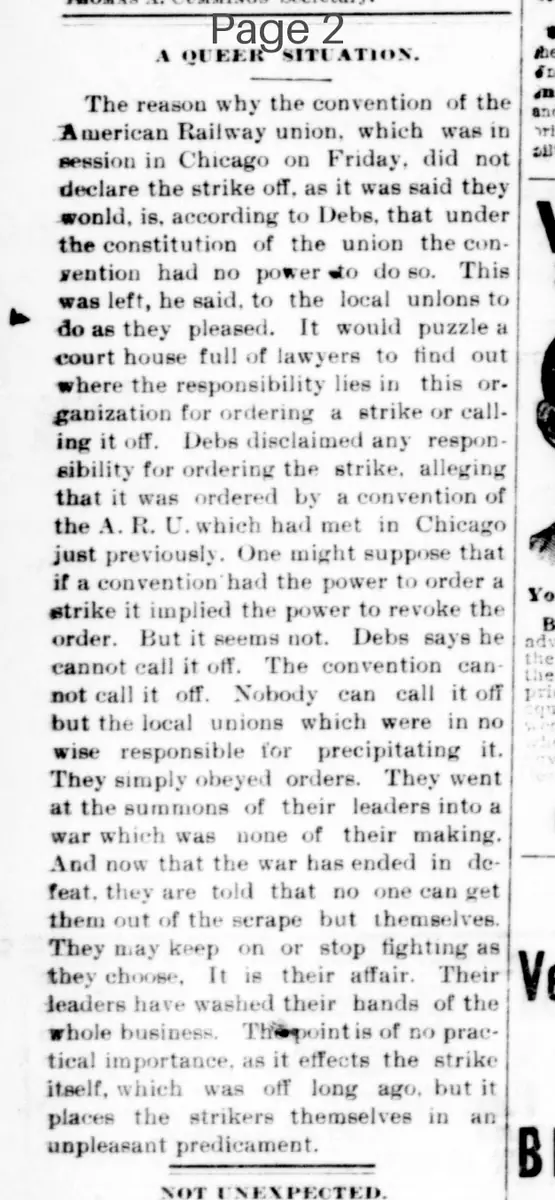
The reason why the convention of the American Railway union, which was in session in Chicago on Friday, did not declare the strike off, as it was said they would, is, according to Debs, that under the constitution of the union the convention had no power to do so. This was left, he said, to the local unions to do as they pleased. It would puzzle a court house full of lawyers to find out where the responsibility lies in this organization for ordering a strike or calling it off. Debs disclaimed any responsibility for ordering the strike, alleging that it was ordered by a convention of the A. R. U. which had met in Chicago just previously. One might suppose that if a convention had the power to order a strike it implied the power to revoke the order. But it seems not. Debs says he cannot call it off. The convention cannot call it off. Nobody can call it off but the local unions which were in no wise responsible for precipitating it. They simply obeyed orders. They went at the summons of their leaders into a war which was none of their making. And now that the war has ended in defeat, they are told that no one can get them out of the scrape but themselves. They may keep on or stop fighting as they choose. It is their affair. Their leaders have washed their hands of the whole business. The point is of no practical importance, as it affects the strike itself, which was off long ago, but it places the strikers themselves in an unpleasant predicament.
The reason why the convention of the American Railway union, which was in session in Chicago on Friday, did not declare the strike off, as it was said they would, is, according to Debs, that under the constitution of the union the convention had no power to do so. This was left, he said, to the local unions to do as they pleased. It would puzzle a court house full of lawyers to find out where the responsibility lies in this organization for ordering a strike or calling it off. Debs disclaimed any responsibility for ordering the strike, alleging that it was ordered by a convention of the A. R. U. which had met in Chicago just previously. One might suppose that if a convention had the power to order a strike it implied the power to revoke the order. But it seems not. Debs says he cannot call it off. The convention cannot call it off. Nobody can call it off but the local unions which were in no wise responsible for precipitating it. They simply obeyed orders. They went at the summons of their leaders into a war which was none of their making. And now that the war has ended in defeat, they are told that no one can get them out of the scrape but themselves. They may keep on or stop fighting as they choose. It is their affair. Their leaders have washed their hands of the whole business. The point is of no practical importance, as it affects the strike itself, which was off long ago, but it places the strikers themselves in an unpleasant predicament.
What sub-type of article is it?
Labor
What keywords are associated?
Railway Strike
Eugene Deb S
Union Constitution
Strike Responsibility
Local Unions
Chicago Convention
What entities or persons were involved?
Eugene Debs
American Railway Union
A. R. U. Convention
Local Unions
Editorial Details
Primary Topic
Responsibility For Ending The American Railway Union Strike
Stance / Tone
Critical And Sarcastic Of Union Leadership
Key Figures
Eugene Debs
American Railway Union
A. R. U. Convention
Local Unions
Key Arguments
Convention Lacks Power To End Strike Per Union Constitution
Debs Disclaims Responsibility For Ordering Or Ending Strike
Local Unions Must Decide To Continue Or Stop Independently
Irony That Convention Can Order But Not Revoke Strike
Strikers Left In Predicament After Obeying Leaders