Thank you for visiting SNEWPapers!
Sign up free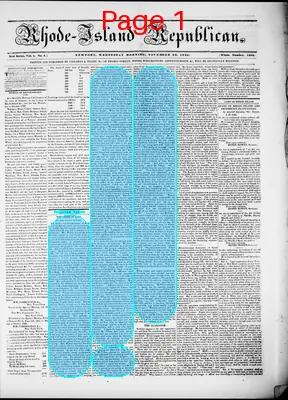
Literary
November 23, 1836
The Rhode Island Republican
Newport, Newport County, Rhode Island
What is this article about?
At young Henry Audley's funeral, his grieving father Mr. Audley remains despondent despite clergyman Mr. Villars's comforting words. Focus shifts to Evelyn, Henry's pious orphan niece, who tends his grave and reveals her own sorrows and faith in conversations with Villars, highlighting themes of loss, resilience, and divine support.
Clipping
OCR Quality
95%
Excellent
Full Text
SELECTED TALES.
THE ORPHAN GIRL.
BY MRS. JULIA L. DUMONT.
The family reached the house of death just as the funeral service was commencing. Mr. Audley had but recently arrived in the neighborhood & was still a stranger to its inhabitants. Mrs. Walton was struck with the improvements he had already made in his newly purchased seat and the palpable marks of wealth exhibited by the interior of the mansion house. A sepulchral gloom, however, pervaded every apartment and she sighed over the grandeur that surrounded her. The wretched father arrested her attention. He was sitting at the head of the coffin, and his eye, tearless, sunken and bloodshot, was fixed on the lid with an expression of endless despair. There was nothing of benignity in his features—they were clouded with the darkness of an irreconciled spirit, wounded indeed and writhing with agony, but altogether unsubdued and still wresting with the decrees of the Most High. Mr. Villars addressed his audience in the most touching and impressive manner: the character of the good old man fitted him peculiarly for the service of the dead. Mild and apostolic in his demeanor, practical in his benevolence, fervid in his piety—with a heart expanding to all mankind—participating in their sorrows—bleeding for their crimes—mourning over their follies. Simple and unostentatious in his language, he bestowed no adventitious ornaments on the sublime truths he inculcated and they fell from his lips with a power the eloquence of earth cannot reach. Still the unhappy Audley seemed not to hear him. In a voice tremulous with emotion, the venerable man breathed forth a prayer for the bereaved parent, but the subject of his solicitude was evidently unconscious of the earnest supplication.
The anthems of death rose deep and solemn on the attentive ear of the wrapt audience, awakening a momentary glow of devotion—a transient perception of the glories of immortality, even in the soul of youth and of thoughtless folly, but the motionless Audley remained with his eye still fixed upon the coffin, as if that were the boundary of hope and beyond it he had no interest.—The sister of the deceased, an elegant and beautiful girl, arrayed in all the pomp of woe, wept convulsively. Mrs. Walton regarded her with pity and concern, but her attention was at length exclusively drawn to an object of yet deeper interest. At the foot of the coffin, sat a young female, whose countenance, though composed, was touched with a grief that passes show. She seemed not more than fourteen, yet her fine features, notwithstanding their perfect regularity, were instinct with character.—Her dark hair lay in shining and shadowy masses round her high pale forehead, and her long rich lashes rested heavily on a cheek that was polished and colored as marble. The simplicity of her sable vestments was in keeping with the cast of her calm and settled countenance, which though strongly expressive of unutterable bereavement, was legibly impressed with the seal of unearthly communion.
She seemed to listen to the voice of the preacher with an intensity of interest: he spoke of the evils incident to man in a state when guilt prevailed and death triumphed; when the parent was robbed of his last surviving hope, and the friendless orphan wept over the grave of the parent. As he drew the picture, the interesting mourner leaned her head on the coffin and seemed to weep, but it was in silence, and only for a moment. Mr. Villars reverted to the joys that lie beyond the precincts of the grave—the rest of the weary—the triumphs of immortality—she lifted her dark eye to his face and returning serenity again passed over her features. When the service was closed and the corpse removed for interment a slight convulsion wrought the countenance of the agonized father and he groaned aloud. Mr. Villars approached him with an instinctive wish to offer sympathy and consolation, but the miserable man turned abruptly away.—'We must leave him to his God,' said the old man, mentally—'he alone can still the tempest and bind the billows that are now overwhelming him.'
And who,' inquired Mrs. Walton, as returning homewards, accompanied by Mr. Villars, their conversation turned on the scene they had just left, 'who is the pale girl that looks as if she were consecrated to heaven?' 'I am told she is a niece of Mr. Audley.' 'And do you know her? have you not formed any acquaintance with the family?' 'None, except that I have occasionally met the youth now gone, and who once seen, could not be forgotten. Do you not recollect, that in passing a group of boys but a few days since, there was one who had just purchased from his companions a cage of birds for the purpose of setting them at liberty? Did you not mark the animation of his fine face as he looked after the little captives soaring away thro' the free air? It was Henry Audley—he was taken ill soon after, but I knew it not till called by his request, to attend his dying moments. I then saw, for the first time, the interesting niece. She was sitting by Henry, and regardless of every other object, with the most watchful tenderness, moistening his parched lips and waiting the release of the struggling spirit. The attending physician requested her several times to retire, but she shook her head mournfully, and kept her station till the scene was closed—then clasping her hands in silence and kissing the bloodless cheek she rose voluntarily and left the room. I then learned she had been his constant attendant and had scarcely slept since his illness. His father, said the physician, seems driven to despair, and the sister is vehement in her grief, but she alone has smoothed his dying pillow with ceaseless care, and administered consolation to his passing spirit. I hope,' continued Mr. Villars, 'to see more of this extraordinary girl. I purpose ere long to call again on Mr. Audley—his countenance is indeed repelling, but he is our neighbor and is in affliction; he is therefore entitled to our commiseration.'
A few days after this, the old man walked to the house of mourning. He found Mr. Audley alone and wrapt up in gloomy meditations. He evinced something like surprise at seeing Mr. Villars, and received him with much coldness. 'I came not,' said the old man, mildly, 'to intrude on your sorrows, nor to insult the feeling of the parent by the dispassionate arguments of a mind at ease. Accept, my dear sir, of my deepest sympathy, and suffer me to sit with you as a friend, feeling sensible of your affliction, and prepared to listen to its unrestrained utterance.' 'My affliction,' said Audley, haughtily, 'is certainly incapable of alleviation—but I am not in the habit of taxing the sympathy of my neighbors, or of giving way to unavailing complaint. Man was born to suffer, but 'tis only the feeble that deplore.' 'Affliction indeed is the lot of frail humanity,' replied Mr. Villars, 'but there is mercy still mingled with the bitterest cup, and through clouds and darkness the light of a father's countenance is yet visible.—When the ties of friendship or affection are severed—when the blossoms of love are withered & the branches of hope are lopped off, the spirit then rises above this scene of desolation & seeks communion with imperishable things. The glories of heaven break on the mental eye—the soul no longer travels in darkness—earth is no longer the boundary of our wishes—misfortune is robbed of its power—the spoiler of his triumph.' Mr. Audley had risen and now walked the floor with an impatient step. 'Your language,' said he, at length, 'is that of enthusiasm, and it suits your sacred function.' 'I speak the language of truth,' rejoined Mr. Villars, with calm dignity 'would that you could feel it as such—but the time must come when the meteors of life shall have all vanished, as assuredly they will—then, my friend, you will seek and find consolation in that religion which you now regard as an idle dream.'
A long pause succeeded. Audley continued pacing the floor with long strides, and Mr. Villars, pitying his emotions, at length addressed him on more general subjects. He inquired for his daughter, and learned that, she had already returned to a boarding school, from which she had been merely called to attend her brother. 'You must make a painful sacrifice,' said Mr. Villars, 'in giving up her society at this time, but our duties often require the sacrifice of selfish feelings—you have still a niece with you, who seems tender and amiable.' 'The niece of my deceased wife, sir;' returned Audley coldly, 'and a mere child: her character has yet to discover itself.' Mr. Villars felt something like disappointment, and again changed the subject. An hour wore heavily away, and he took his leave. 'I have performed a duty,' he said, as he returned pensively homeward—'somewhat unpleasant, indeed, and certainly unavailing, but nevertheless incumbent.' The beauties of the hour gradually changed the tone of his feelings and awakened all the energies of devotion. Willing to prolong a walk, thus favorable to contemplation, he took a circuitous path that led by the cemetery where Henry Audley now slumbered. A lad, with a spade and basket, opened the gate as Mr. Villars approached it. Somewhat surprised, he inquired of the boy what had brought him hither? 'I come,' he replied, 'to assist Miss Evelyn,' and he pointed to the new made grave, where the niece of Audley stood with a pitcher of water, which she now poured at the foot of a rose tree, just planted at its head. The shades of twilight were deepening into gloom, but the moon, which had just risen, threw a pale uncertain light on the grassy mounds and sculptured marbles of the consecrated spot. Evelyn finished her task and advanced towards the gate of the cemetery. Mr. Villars approached her. 'Ah, my daughter, do I meet you at an hour like this, among the inhabitants of death? What motive has imbued your young spirit with such firmness?'—'The shades of evening,' replied Evelyn, in a voice of thrilling melody, 'will prevent this little bush from withering; had it been brought hither earlier, the beams of the sun would have faded its fresh leaves,' and she looked at the rose tree, which was covered with a profusion of white flowers already in bloom. 'And will it not wither to-morrow,' asked Mr. Villars. 'Oh, it must be shaded from the sun till it has taken root.' 'Tis a lovely plant,' replied the old man, gazing with admiration at the snowy blossoms, which glittered in the pale moon-beams, and contrasted finely with the dark green leaves that embosomed them. 'It was the flower he best loved,' said Evelyn, 'and 'tis emblematic of his character.' 'Why, then, my daughter, should you mourn over these mouldering ashes? Henry, I trust, has already burst the bonds of the grave—corruption has put on incorruption, and mortality immortality.' 'Mourn,' repeated Evelyn, with inexpressible emphasis, 'mourn for him I loved, because he is thus early called to rest! Oh, no no; left as I am, desolate and alone in this cold world, I rejoice that his happiness is consummated, God has strengthened me through all my afflictions and will support me still.' 'Amazing girl,' said Mr. Villars, 'are you so young and yet so rich in piety!—so young, and yet so deeply acquainted with sorrow? Tell me, my child, what have been these sorrows, and who has led you to seek the healing balm of Gilead.' 'Ah, sir, what language can describe the negative sorrows of the orphan?—the grave has shut me out from the fountain of paternal love, and I have striven vainly to purchase the affection of those who afford me a home. I look vainly round me for the glance of tenderness—the voice of blessing never comes over my heart.'—'Alas, poor girl, and have you then been long an orphan?' 'Oh, many bitter years. I have only a dim recollection of my parents, like that of a soft dream. I felt not the blow that severed them from me at the time, but my heart soon became cold, and the world that was once bright grew dark and joyless. Oh, Henry, Henry,' she continued, turning suddenly back to the grave, 'from you alone have I ever heard the accents of kindness. When cruelty and neglect weighed me to the earth, you alone soothed and comforted me—you alone thought of the destitute Evelyn with interest.—Oh, my brother, my brother! for such you taught me to call you, I still call on your name but you no longer answer me.' Mr. Villars attempted to speak, but his emotion impeded utterance. He would have soothed the lovely mourner, but ere he could address her, Evelyn was again calm as the scenes around them. 'I must return,' she said, glancing her eyes to the gate, where the boy was yet standing, 'my little companion waits.' She then plucked a rose from the newly planted bush, and held it timidly towards the old man—'Will you accept it, sir? and keep it as a memorial of one who begs an interest in your prayers?' 'I cannot forget you, Evelyn,' said Mr. Villars, with fervor, 'may God shield you from the contaminating breath of the world, and preserve the light that now dwelleth in your soul.'
THE ORPHAN GIRL.
BY MRS. JULIA L. DUMONT.
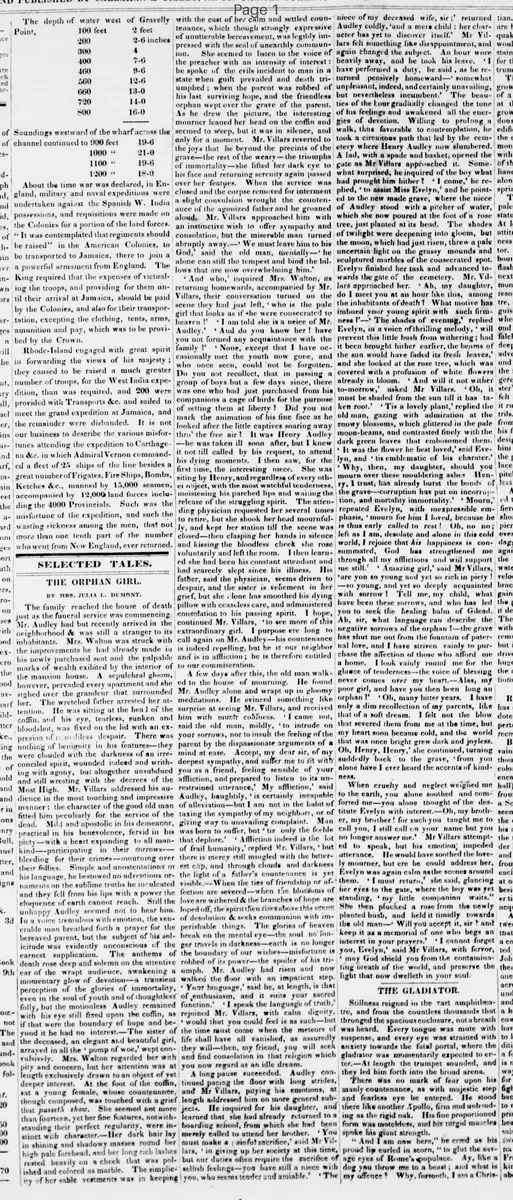
The family reached the house of death just as the funeral service was commencing. Mr. Audley had but recently arrived in the neighborhood & was still a stranger to its inhabitants. Mrs. Walton was struck with the improvements he had already made in his newly purchased seat and the palpable marks of wealth exhibited by the interior of the mansion house. A sepulchral gloom, however, pervaded every apartment and she sighed over the grandeur that surrounded her. The wretched father arrested her attention. He was sitting at the head of the coffin, and his eye, tearless, sunken and bloodshot, was fixed on the lid with an expression of endless despair. There was nothing of benignity in his features—they were clouded with the darkness of an irreconciled spirit, wounded indeed and writhing with agony, but altogether unsubdued and still wresting with the decrees of the Most High. Mr. Villars addressed his audience in the most touching and impressive manner: the character of the good old man fitted him peculiarly for the service of the dead. Mild and apostolic in his demeanor, practical in his benevolence, fervid in his piety—with a heart expanding to all mankind—participating in their sorrows—bleeding for their crimes—mourning over their follies. Simple and unostentatious in his language, he bestowed no adventitious ornaments on the sublime truths he inculcated and they fell from his lips with a power the eloquence of earth cannot reach. Still the unhappy Audley seemed not to hear him. In a voice tremulous with emotion, the venerable man breathed forth a prayer for the bereaved parent, but the subject of his solicitude was evidently unconscious of the earnest supplication.
The anthems of death rose deep and solemn on the attentive ear of the wrapt audience, awakening a momentary glow of devotion—a transient perception of the glories of immortality, even in the soul of youth and of thoughtless folly, but the motionless Audley remained with his eye still fixed upon the coffin, as if that were the boundary of hope and beyond it he had no interest.—The sister of the deceased, an elegant and beautiful girl, arrayed in all the pomp of woe, wept convulsively. Mrs. Walton regarded her with pity and concern, but her attention was at length exclusively drawn to an object of yet deeper interest. At the foot of the coffin, sat a young female, whose countenance, though composed, was touched with a grief that passes show. She seemed not more than fourteen, yet her fine features, notwithstanding their perfect regularity, were instinct with character.—Her dark hair lay in shining and shadowy masses round her high pale forehead, and her long rich lashes rested heavily on a cheek that was polished and colored as marble. The simplicity of her sable vestments was in keeping with the cast of her calm and settled countenance, which though strongly expressive of unutterable bereavement, was legibly impressed with the seal of unearthly communion.
She seemed to listen to the voice of the preacher with an intensity of interest: he spoke of the evils incident to man in a state when guilt prevailed and death triumphed; when the parent was robbed of his last surviving hope, and the friendless orphan wept over the grave of the parent. As he drew the picture, the interesting mourner leaned her head on the coffin and seemed to weep, but it was in silence, and only for a moment. Mr. Villars reverted to the joys that lie beyond the precincts of the grave—the rest of the weary—the triumphs of immortality—she lifted her dark eye to his face and returning serenity again passed over her features. When the service was closed and the corpse removed for interment a slight convulsion wrought the countenance of the agonized father and he groaned aloud. Mr. Villars approached him with an instinctive wish to offer sympathy and consolation, but the miserable man turned abruptly away.—'We must leave him to his God,' said the old man, mentally—'he alone can still the tempest and bind the billows that are now overwhelming him.'
And who,' inquired Mrs. Walton, as returning homewards, accompanied by Mr. Villars, their conversation turned on the scene they had just left, 'who is the pale girl that looks as if she were consecrated to heaven?' 'I am told she is a niece of Mr. Audley.' 'And do you know her? have you not formed any acquaintance with the family?' 'None, except that I have occasionally met the youth now gone, and who once seen, could not be forgotten. Do you not recollect, that in passing a group of boys but a few days since, there was one who had just purchased from his companions a cage of birds for the purpose of setting them at liberty? Did you not mark the animation of his fine face as he looked after the little captives soaring away thro' the free air? It was Henry Audley—he was taken ill soon after, but I knew it not till called by his request, to attend his dying moments. I then saw, for the first time, the interesting niece. She was sitting by Henry, and regardless of every other object, with the most watchful tenderness, moistening his parched lips and waiting the release of the struggling spirit. The attending physician requested her several times to retire, but she shook her head mournfully, and kept her station till the scene was closed—then clasping her hands in silence and kissing the bloodless cheek she rose voluntarily and left the room. I then learned she had been his constant attendant and had scarcely slept since his illness. His father, said the physician, seems driven to despair, and the sister is vehement in her grief, but she alone has smoothed his dying pillow with ceaseless care, and administered consolation to his passing spirit. I hope,' continued Mr. Villars, 'to see more of this extraordinary girl. I purpose ere long to call again on Mr. Audley—his countenance is indeed repelling, but he is our neighbor and is in affliction; he is therefore entitled to our commiseration.'
A few days after this, the old man walked to the house of mourning. He found Mr. Audley alone and wrapt up in gloomy meditations. He evinced something like surprise at seeing Mr. Villars, and received him with much coldness. 'I came not,' said the old man, mildly, 'to intrude on your sorrows, nor to insult the feeling of the parent by the dispassionate arguments of a mind at ease. Accept, my dear sir, of my deepest sympathy, and suffer me to sit with you as a friend, feeling sensible of your affliction, and prepared to listen to its unrestrained utterance.' 'My affliction,' said Audley, haughtily, 'is certainly incapable of alleviation—but I am not in the habit of taxing the sympathy of my neighbors, or of giving way to unavailing complaint. Man was born to suffer, but 'tis only the feeble that deplore.' 'Affliction indeed is the lot of frail humanity,' replied Mr. Villars, 'but there is mercy still mingled with the bitterest cup, and through clouds and darkness the light of a father's countenance is yet visible.—When the ties of friendship or affection are severed—when the blossoms of love are withered & the branches of hope are lopped off, the spirit then rises above this scene of desolation & seeks communion with imperishable things. The glories of heaven break on the mental eye—the soul no longer travels in darkness—earth is no longer the boundary of our wishes—misfortune is robbed of its power—the spoiler of his triumph.' Mr. Audley had risen and now walked the floor with an impatient step. 'Your language,' said he, at length, 'is that of enthusiasm, and it suits your sacred function.' 'I speak the language of truth,' rejoined Mr. Villars, with calm dignity 'would that you could feel it as such—but the time must come when the meteors of life shall have all vanished, as assuredly they will—then, my friend, you will seek and find consolation in that religion which you now regard as an idle dream.'
A long pause succeeded. Audley continued pacing the floor with long strides, and Mr. Villars, pitying his emotions, at length addressed him on more general subjects. He inquired for his daughter, and learned that, she had already returned to a boarding school, from which she had been merely called to attend her brother. 'You must make a painful sacrifice,' said Mr. Villars, 'in giving up her society at this time, but our duties often require the sacrifice of selfish feelings—you have still a niece with you, who seems tender and amiable.' 'The niece of my deceased wife, sir;' returned Audley coldly, 'and a mere child: her character has yet to discover itself.' Mr. Villars felt something like disappointment, and again changed the subject. An hour wore heavily away, and he took his leave. 'I have performed a duty,' he said, as he returned pensively homeward—'somewhat unpleasant, indeed, and certainly unavailing, but nevertheless incumbent.' The beauties of the hour gradually changed the tone of his feelings and awakened all the energies of devotion. Willing to prolong a walk, thus favorable to contemplation, he took a circuitous path that led by the cemetery where Henry Audley now slumbered. A lad, with a spade and basket, opened the gate as Mr. Villars approached it. Somewhat surprised, he inquired of the boy what had brought him hither? 'I come,' he replied, 'to assist Miss Evelyn,' and he pointed to the new made grave, where the niece of Audley stood with a pitcher of water, which she now poured at the foot of a rose tree, just planted at its head. The shades of twilight were deepening into gloom, but the moon, which had just risen, threw a pale uncertain light on the grassy mounds and sculptured marbles of the consecrated spot. Evelyn finished her task and advanced towards the gate of the cemetery. Mr. Villars approached her. 'Ah, my daughter, do I meet you at an hour like this, among the inhabitants of death? What motive has imbued your young spirit with such firmness?'—'The shades of evening,' replied Evelyn, in a voice of thrilling melody, 'will prevent this little bush from withering; had it been brought hither earlier, the beams of the sun would have faded its fresh leaves,' and she looked at the rose tree, which was covered with a profusion of white flowers already in bloom. 'And will it not wither to-morrow,' asked Mr. Villars. 'Oh, it must be shaded from the sun till it has taken root.' 'Tis a lovely plant,' replied the old man, gazing with admiration at the snowy blossoms, which glittered in the pale moon-beams, and contrasted finely with the dark green leaves that embosomed them. 'It was the flower he best loved,' said Evelyn, 'and 'tis emblematic of his character.' 'Why, then, my daughter, should you mourn over these mouldering ashes? Henry, I trust, has already burst the bonds of the grave—corruption has put on incorruption, and mortality immortality.' 'Mourn,' repeated Evelyn, with inexpressible emphasis, 'mourn for him I loved, because he is thus early called to rest! Oh, no no; left as I am, desolate and alone in this cold world, I rejoice that his happiness is consummated, God has strengthened me through all my afflictions and will support me still.' 'Amazing girl,' said Mr. Villars, 'are you so young and yet so rich in piety!—so young, and yet so deeply acquainted with sorrow? Tell me, my child, what have been these sorrows, and who has led you to seek the healing balm of Gilead.' 'Ah, sir, what language can describe the negative sorrows of the orphan?—the grave has shut me out from the fountain of paternal love, and I have striven vainly to purchase the affection of those who afford me a home. I look vainly round me for the glance of tenderness—the voice of blessing never comes over my heart.'—'Alas, poor girl, and have you then been long an orphan?' 'Oh, many bitter years. I have only a dim recollection of my parents, like that of a soft dream. I felt not the blow that severed them from me at the time, but my heart soon became cold, and the world that was once bright grew dark and joyless. Oh, Henry, Henry,' she continued, turning suddenly back to the grave, 'from you alone have I ever heard the accents of kindness. When cruelty and neglect weighed me to the earth, you alone soothed and comforted me—you alone thought of the destitute Evelyn with interest.—Oh, my brother, my brother! for such you taught me to call you, I still call on your name but you no longer answer me.' Mr. Villars attempted to speak, but his emotion impeded utterance. He would have soothed the lovely mourner, but ere he could address her, Evelyn was again calm as the scenes around them. 'I must return,' she said, glancing her eyes to the gate, where the boy was yet standing, 'my little companion waits.' She then plucked a rose from the newly planted bush, and held it timidly towards the old man—'Will you accept it, sir? and keep it as a memorial of one who begs an interest in your prayers?' 'I cannot forget you, Evelyn,' said Mr. Villars, with fervor, 'may God shield you from the contaminating breath of the world, and preserve the light that now dwelleth in your soul.'
What sub-type of article is it?
Prose Fiction
What themes does it cover?
Death Mortality
Religious
Moral Virtue
What keywords are associated?
Orphan Girl
Funeral Grief
Piety
Consolation
Family Loss
What entities or persons were involved?
By Mrs. Julia L. Dumont.
Literary Details
Title
The Orphan Girl.
Author
By Mrs. Julia L. Dumont.
Key Lines
She Seemed To Listen To The Voice Of The Preacher With An Intensity Of Interest: He Spoke Of The Evils Incident To Man In A State When Guilt Prevailed And Death Triumphed; When The Parent Was Robbed Of His Last Surviving Hope, And The Friendless Orphan Wept Over The Grave Of The Parent.
'Mourn,' Repeated Evelyn, With Inexpressible Emphasis, 'Mourn For Him I Loved, Because He Is Thus Early Called To Rest! Oh, No No; Left As I Am, Desolate And Alone In This Cold World, I Rejoice That His Happiness Is Consummated, God Has Strengthened Me Through All My Afflictions And Will Support Me Still.'
'Ah, Sir, What Language Can Describe The Negative Sorrows Of The Orphan?—The Grave Has Shut Me Out From The Fountain Of Paternal Love, And I Have Striven Vainly To Purchase The Affection Of Those Who Afford Me A Home.'
Oh, Henry, Henry,' She Continued, Turning Suddenly Back To The Grave, 'From You Alone Have I Ever Heard The Accents Of Kindness. When Cruelty And Neglect Weighed Me To The Earth, You Alone Soothed And Comforted Me—You Alone Thought Of The Destitute Evelyn With Interest.—Oh, My Brother, My Brother! For Such You Taught Me To Call You, I Still Call On Your Name But You No Longer Answer Me.'