Thank you for visiting SNEWPapers!
Sign up free
Fowle's New Hampshire Gazette And General Advertiser
Portsmouth, Rockingham County, New Hampshire
What is this article about?
Bryan Edwards continues his essay advocating for renewed trade between British West Indies and the United States post-Revolution. He refutes claims of insignificant exports/imports, impossibility of alternative supplies from Canada/Nova Scotia or Britain due to cost and logistics, and argues that restricting sugar exports harms British interests by benefiting rivals like France, while boosting overall prosperity.
Merged-components note: This is a continuation of the serialized essay 'Thoughts on the Trade between America and the West-India Islands' by Bryan Edwards, as indicated by '(Continued from our last.)' in the first part and the thematic and textual flow connecting to the second part ending with '(To be concluded in our next.)'. The second part's original 'editorial' label is corrected to 'literary' to match the overall essay nature.
Clippings
1 of 2
OCR Quality
Full Text
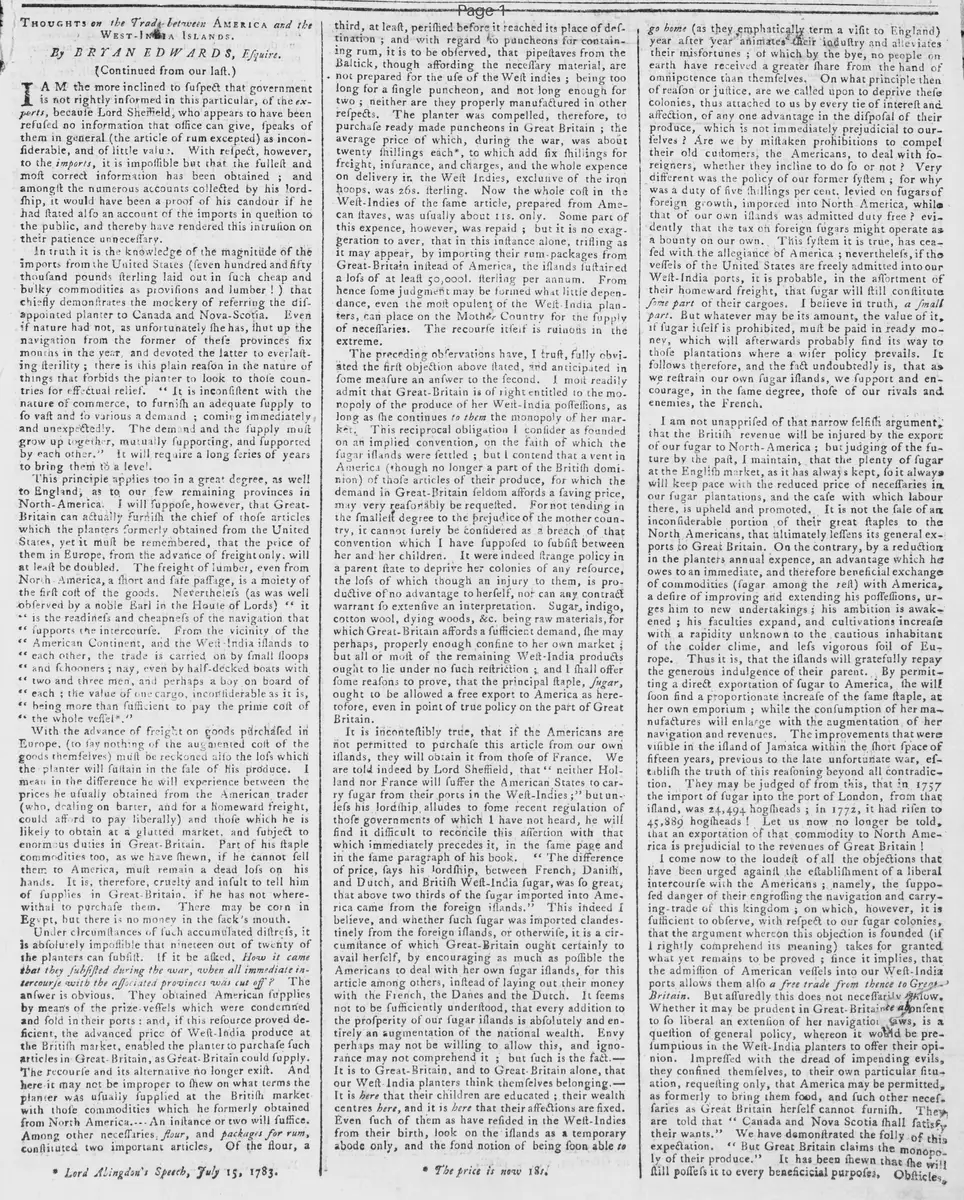
By BRYAN EDWARDS, Esquire.
(Continued from our last.)
I am the more inclined to suspect that government is not rightly informed in this particular, of the exports, because Lord Sheffield, who appears to have been refused no information that office can give, speaks of them in general (the article of rum excepted) as inconsiderable, and of little value. With respect, however, to the imports, it is impossible but that the fullest and most correct information has been obtained; and amongst the numerous accounts collected by his lordship, it would have been a proof of his candour if he had stated also an account of the imports in question to the public, and thereby have rendered this intrusion on their patience unnecessary.
In truth it is the knowledge of the magnitude of the imports from the United States (seven hundred and fifty thousand pounds sterling laid out in such cheap and bulky commodities as provisions and lumber!) that chiefly demonstrates the mockery of referring the disappointed planter to Canada and Nova-Scotia. Even if nature had not, as unfortunately she has, shut up the navigation from the former of these provinces six months in the year, and devoted the latter to everlasting sterility; there is this plain reason in the nature of things that forbids the planter to look to those countries for effectual relief. "It is inconsistent with the nature of commerce, to furnish an adequate supply to so vast and so various a demand; coming immediately and unexpectedly. The demand and the supply must grow up together, mutually supporting, and supported by each other." It will require a long series of years to bring them to a level.
This principle applies too in a great degree, as well to England, as to our few remaining provinces in North-America. I will suppose, however, that Great-Britain can actually furnish the chief of those articles which the planters formerly obtained from the United States, yet it must be remembered, that the price of them in Europe, from the advance of freight only, will at least be doubled. The freight of lumber, even from North America, a short and safe passage, is a moiety of the first cost of the goods. Nevertheless (as was well observed by a noble Earl in the House of Lords) "it is the readiness and cheapness of the navigation that supports the intercourse. From the vicinity of the American Continent, and the West-India islands to each other, the trade is carried on by small sloops and schooners; nay, even by half-decked boats with two and three men, and perhaps a boy on board of each; the value of one cargo, inconsiderable as it is, being more than sufficient to pay the prime cost of the whole vessel."
With the advance of freight on goods purchased in Europe, (to say nothing of the augmented cost of the goods themselves) must be reckoned also the loss which the planter will sustain in the sale of his produce. I mean in the difference he will experience between the prices he usually obtained from the American trader (who, dealing on barter, and for a homeward freight, could afford to pay liberally) and those which he is likely to obtain at a glutted market, and subject to enormous duties in Great-Britain. Part of his staple commodities too, as we have shown, if he cannot sell them to America, must remain a dead loss on his hands. It is, therefore, cruelty and insult to tell him of supplies in Great-Britain, if he has not wherewithal to purchase them.
There may be corn in Egypt, but there is no money in the sack's mouth.
Under circumstances of such accumulated distress, it is absolutely impossible that nineteen out of twenty of the planters can subsist. If it be asked, How it came that they subsisted during the war, when all immediate intercourse with the associated provinces was cut off? The answer is obvious. They obtained American supplies by means of the prize-vessels which were condemned and sold in their ports: and, if this resource proved deficient, the advanced price of West-India produce at the British market, enabled the planter to purchase such articles in Great-Britain, as Great-Britain could supply. The resource and its alternative no longer exist. And here it may not be improper to show on what terms the planter was usually supplied at the British market with those commodities which he formerly obtained from North America.-- An instance or two will suffice.
Among other necessaries, flour, and packages for rum, constituted two important articles, Of the flour, a third, at least, perished before it reached its place of destination; and with regard to puncheons for containing rum, it is to be observed, that pipe-staves from the Baltick, though affording the necessary material, are not prepared for the use of the West Indies; being too long for a single puncheon, and not long enough for two; neither are they properly manufactured in other respects. The planter was compelled, therefore, to purchase ready made puncheons in Great Britain; the average price of which, during the war, was about twenty shillings each*, to which add six shillings for freight, insurance, and charges, and the whole expence on delivery in the West Indies, exclusive of the iron hoops, was 26s. sterling. Now the whole cost in the West-Indies of the same article, prepared from American staves, was usually about 11s. only. Some part of this expence, however, was repaid; but it is no exaggeration to aver, that in this instance alone, trifling as it may appear, by importing their rum-packages from Great-Britain instead of America, the islands sustained a loss of at least 20,000l. sterling per annum. From hence some judgment may be formed what little dependence, even the most opulent of the West-India planters, can place on the Mother Country for the supply of necessaries. The resource itself is ruinous in the extreme.
The preceding observations have, I trust, fully obviated the first objection above stated, and anticipated in some measure an answer to the second. I most readily admit that Great-Britain is of right entitled to the monopoly of the produce of her West-India possessions, as long as she continues to them the monopoly of her market. This reciprocal obligation I consider as founded on an implied convention, on the faith of which the sugar islands were settled; but I contend that a vent in America (though no longer a part of the British dominion) of those articles of their produce, for which the demand in Great-Britain seldom affords a saving price, may very reasonably be requested. For not tending in the smallest degree to the prejudice of the mother country, it cannot surely be considered as a breach of that convention which I have supposed to subsist between her and her children. It were indeed strange policy in a parent state to deprive her colonies of any resource, the loss of which though an injury to them, is productive of no advantage to herself, nor can any contract warrant so extensive an interpretation. Sugar, indigo, cotton wool, dying woods, &c. being raw materials, for which Great-Britain affords a sufficient demand, she may perhaps, properly enough confine to her own market but all or most of the remaining West-India products ought to lie under no such restriction; and I shall offer some reasons to prove, that the principal staple, Sugar, ought to be allowed a free export to America as heretofore, even in point of true policy on the part of Great Britain.
It is incontestibly true, that if the Americans are not permitted to purchase this article from our own islands, they will obtain it from those of France. We are told indeed by Lord Sheffield, that "neither Holland nor France will suffer the American States to carry sugar from their ports in the West-Indies:" but unless his lordship alludes to some recent regulation of those governments of which I have not heard, he will find it difficult to reconcile this assertion with that which immediately precedes it, in the same page and in the same paragraph of his book. "The difference of price, says his lordship, between French, Danish, and Dutch, and British West-India sugar, was so great, that above two thirds of the sugar imported into America came from the foreign islands." This indeed I believe, and whether such sugar was imported clandestinely from the foreign islands, or otherwise, it is a circumstance of which Great-Britain ought certainly to avail herself, by encouraging as much as possible the Americans to deal with her own sugar islands, for this article among others, instead of laying out their money with the French, the Danes and the Dutch. It seems not to be sufficiently understood, that every addition to the prosperity of our sugar islands is absolutely and entirely an augmentation of the national wealth. Envy perhaps may not be willing to allow this, and ignorance may not comprehend it; but such is the fact.--
It is to Great-Britain, and to Great-Britain alone, that our West-India planters think themselves belonging.-- It is here that their children are educated: their wealth centres here, and it is here that their affections are fixed. Even such of them as have resided in the West-Indies from their birth, look on the islands as a temporary abode only, and the fond notion of being soon able to go home (as they emphatically term a visit to England) year after year animates their industry and alleviates their misfortunes; of which by the bye, no people on earth have received a greater share from the hand of omnipotence than themselves. On what principle then of reason or justice, are we called upon to deprive these colonies, thus attached to us by every tie of interest and affection, of any one advantage in the disposal of their produce, which is not immediately prejudicial to ourselves? Are we by mistaken prohibitions to compel their old customers, the Americans, to deal with foreigners, whether they incline to do so or not? Very different was the policy of our former system; for why was a duty of five shillings per cent. levied on sugars of foreign growth, imported into North America, while that of our own islands was admitted duty free? evidently that the tax on foreign sugars might operate as a bounty on our own.. This system it is true, has ceased with the allegiance of America; nevertheless, if the vessels of the United States are freely admitted into our West-India ports, it is probable, in the assortment of their homeward freight, that sugar will still constitute some part of their cargoes. I believe in truth, a small part. But whatever may be its amount, the value of it, if sugar itself is prohibited, must be paid in ready money, which will afterwards probably find its way to those plantations where a wiser policy prevails. It follows therefore, and the fact undoubtedly is, that as we restrain our own sugar islands, we support and encourage, in the same degree, those of our rivals and enemies, the French.
I am not unapprised of that narrow selfish argument, that the British revenue will be injured by the export of our sugar to North-America; but judging of the future by the past, I maintain, that the plenty of sugar at the English market, as it has always kept, so it always will keep pace with the reduced price of necessaries in our sugar plantations, and the ease with which labour there, is upheld and promoted. It is not the sale of an inconsiderable portion of their great staples to the North Americans, that ultimately lessens its general exports to Great Britain. On the contrary, by a reduction in the planters annual expence, an advantage which he owes to an immediate, and therefore beneficial exchange of commodities (sugar among the rest) with America, a desire of improving and extending his possessions, urges him to new undertakings: his ambition is awakened; his faculties expand, and cultivations increase with a rapidity unknown to the cautious inhabitant of the colder clime, and less vigorous soil of Europe. Thus it is, that the islands will gratefully repay the generous indulgence of their parent.. By permitting a direct exportation of sugar to America, she will soon find a proportionate increase of the same staple, at her own emporium; while the consumption of her manufactures will enlarge with the augmentation of her navigation and revenues. The improvements that were visible in the island of Jamaica within the short space of fifteen years, previous to the late unfortunate war, establish the truth of this reasoning beyond all contradiction. They may be judged of from this, that in 1757 the import of sugar into the port of London, from that island, was 24,494 hogsheads; in 1772, it had risen to 45,889 hogsheads! Let us now no longer be told, that an exportation of that commodity to North America is prejudicial to the revenues of Great Britain!
I come now to the loudest of all the objections that have been urged against the establishment of a liberal intercourse with the Americans; namely, the supposed danger of their engrossing the navigation and carrying-trade of this kingdom; on which, however, it is sufficient to observe, with respect to our sugar colonies, that the argument whereon this objection is founded (if I rightly comprehend its meaning) takes for granted what yet remains to be proved; since it implies, that the admission of American vessels into our West-India ports allows them also a free trade from thence to Great-Britain. But assuredly this does not necessarily follow. Whether it may be prudent in Great-Britain at present to so liberal an extension of her navigation laws, is a question of general policy, whereon it would be presumptuous in the West-India planters to offer their opinion. Impressed with the dread of impending evils, they confined themselves to their own particular situation, requesting only, that America may be permitted, as formerly to bring them food, and such other necessaries as Great Britain herself cannot furnish. They are told that "Canada and Nova Scotia shall satisfy their wants." We have demonstrated the folly of this expectation. "But Great Britain claims the monopoly of their produce." It has been shown that they will still possess it to every beneficial purpose. Obstacles in reality that I really believe many will maintain an idea of its meaning to this hour. If the sense of it be thus, who have grown hoarse in repeating it, have no ideas that American ships will supply foreign markets with British plantation sugar, to the prejudice of the British refinery; the noble author of whom I have made frequent mention, and who has clearly given it this interpretation has himself furnished an answer; for he repeatedly affirms, that the French islands can supply, not only the American consumption, but that of all Europe besides, on far cheaper terms than our own. Does the noble Lord suppose, that America will buy dearer, with a view to sell cheaper, than the French? Their past conduct has afforded no proof of such egregious folly. I must observe too, that our islands have already permission (by 12 Geo. III.) to send sugar to the southward of Cape Finistere; yet, during a residence of 15 years in the West Indies, I never heard of but two vessels that tried the experiment, and the owners had no encouragement to repeat it. If the objection signifies, what I believe it was meant to signify, on the debate of Mr. Pitt's provisional bill; namely, that American ships, having discharged their cargoes in the West India islands, will enter into a Competition with British vessels loading there, for freight to Great Britain; it is, I confess, a matter deserving consideration; but Great Britain surely may administer a preventive less dangerous in its effects than the project of starving her sugar colonies, by interdicting all intercourse whatever between them and the United States. The disease, in this case, is, indeed, by far the lesser evil.
(To be concluded in our next.)
What sub-type of article is it?
What themes does it cover?
What keywords are associated?
What entities or persons were involved?
Literary Details
Title
Thoughts On The Trade Between America And The West India Islands.
Author
By Bryan Edwards, Esquire.
Subject
On Trade Policies Between The British West Indies, United States, And Great Britain
Key Lines