Thank you for visiting SNEWPapers!
Sign up free
Domestic News
March 12, 1832
Phenix Gazette
Alexandria, Virginia
What is this article about?
Extract from a recent speech by Mr. Adams in the House of Representatives on the Apportionment Bill, advocating for a larger representation to maximize the educational and moral benefits of congressional deliberations as a 'school of wisdom and virtue' for members and the public.
Clipping
OCR Quality
98%
Excellent
Full Text
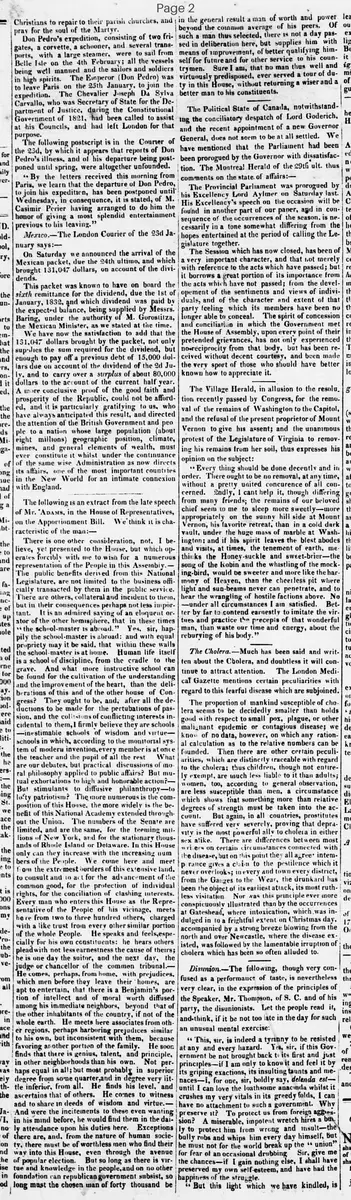
The following is an extract from the late speech of Mr. Adams, in the House of Representatives, on the Apportionment Bill. We think it is characteristic of the man:—
There is one other consideration, not, I believe, yet presented to the House, but which operates forcibly with me to wish for a numerous representation of the People in this Assembly.—The public benefits derived from this National Legislature, are not limited to the business officially transacted by them in the public service. There are others, collateral and incident to them, but in their consequences perhaps not less important. It is an admired saying of an eloquent orator of the other hemisphere, that in these times "the school-master is abroad." Yes, sir, happily the school-master is abroad: and with equal propriety may it be said, that within these walls the school-master is at home. Human life itself is a school of discipline, from the cradle to the grave. And what more instructive school can be found for the cultivation of the understanding and the improvement of the heart, than the deliberations of this and of the other house of Congress? They ought to be, and, after all the deductions to be made for the perturbations of passion, and the collisions of conflicting interests incidental to them, I firmly believe they are schools—inestimable schools of wisdom and virtue—schools in which, according to the monitorial system of modern invention, every member is at once the teacher and the pupil of all the rest. What are our debates, but practical discussions of moral philosophy applied to public affairs? But mutual exhortations to high and honorable action?—But stimulants to diffusive philanthropy—to lofty patriotism? The more numerous is the composition of this House, the more widely is the benefit of this National Academy extended through out the Union. The numbers of the Senate are limited, and are the same, for the teeming millions of New York, and for the stationary thousands of Rhode Island or Delaware. In this House only can they increase with the increasing numbers of the People. We come here and meet from the extremest borders of this extensive land, to consult and to act for the advancement of the common good, for the protection of individual rights, for the conciliation of clashing interests. Every man who enters this House as the Representative of the People of his vicinage, meets here from two to three hundred others, charged with a like trust from every other similar portion of the whole People. He speaks and feels, especially for his own constituents: he hears others plead with not less earnestness the cause of theirs; he is one day the suitor, and the next day, the judge or chancellor of the common tribunal.—He comes, perhaps, from home, with prejudices, which men before they leave their homes, are apt to entertain, that there is a Benjamin's portion of intellect and of moral worth diffused among his immediate neighbors, beyond that of the other inhabitants of the country, if not of the whole earth. He meets here associates from other regions, perhaps harboring prejudices similar to his own, but inconsistent with them, because favoring another portion of the family. He soon finds that there is genius, talent, and principle, in other neighborhoods than his own. Not perhaps equal in all; but most probably in superior degree from some quarter, and in degree very little inferior, from all. He finds his level, and ascertains that of others. He comes to witness and to share in deeds of wisdom and virtue.—And were the incitements to these even wanting in his mind before, he would find them in the daily attendance upon his duties here. Exceptions there are, and, from the nature of human society, there must be of worthless men who find their way into this House, even through the avenue of popular election. But so long as there is virtue and knowledge in the people, and on no other foundation can republican government subsist, so long must the chosen man of forty thousand be in the general result a man of worth and power beyond the common average of his peers. Of such a man thus selected, there is not a day passed in deliberation here, but supplies him with means of improvement, of better qualifying himself for future and for other service to his countrymen. Sure I am, that no man thus well and virtuously predisposed, ever served a tour of duty in this House, without returning a wiser and a better man to his constituents.
There is one other consideration, not, I believe, yet presented to the House, but which operates forcibly with me to wish for a numerous representation of the People in this Assembly.—The public benefits derived from this National Legislature, are not limited to the business officially transacted by them in the public service. There are others, collateral and incident to them, but in their consequences perhaps not less important. It is an admired saying of an eloquent orator of the other hemisphere, that in these times "the school-master is abroad." Yes, sir, happily the school-master is abroad: and with equal propriety may it be said, that within these walls the school-master is at home. Human life itself is a school of discipline, from the cradle to the grave. And what more instructive school can be found for the cultivation of the understanding and the improvement of the heart, than the deliberations of this and of the other house of Congress? They ought to be, and, after all the deductions to be made for the perturbations of passion, and the collisions of conflicting interests incidental to them, I firmly believe they are schools—inestimable schools of wisdom and virtue—schools in which, according to the monitorial system of modern invention, every member is at once the teacher and the pupil of all the rest. What are our debates, but practical discussions of moral philosophy applied to public affairs? But mutual exhortations to high and honorable action?—But stimulants to diffusive philanthropy—to lofty patriotism? The more numerous is the composition of this House, the more widely is the benefit of this National Academy extended through out the Union. The numbers of the Senate are limited, and are the same, for the teeming millions of New York, and for the stationary thousands of Rhode Island or Delaware. In this House only can they increase with the increasing numbers of the People. We come here and meet from the extremest borders of this extensive land, to consult and to act for the advancement of the common good, for the protection of individual rights, for the conciliation of clashing interests. Every man who enters this House as the Representative of the People of his vicinage, meets here from two to three hundred others, charged with a like trust from every other similar portion of the whole People. He speaks and feels, especially for his own constituents: he hears others plead with not less earnestness the cause of theirs; he is one day the suitor, and the next day, the judge or chancellor of the common tribunal.—He comes, perhaps, from home, with prejudices, which men before they leave their homes, are apt to entertain, that there is a Benjamin's portion of intellect and of moral worth diffused among his immediate neighbors, beyond that of the other inhabitants of the country, if not of the whole earth. He meets here associates from other regions, perhaps harboring prejudices similar to his own, but inconsistent with them, because favoring another portion of the family. He soon finds that there is genius, talent, and principle, in other neighborhoods than his own. Not perhaps equal in all; but most probably in superior degree from some quarter, and in degree very little inferior, from all. He finds his level, and ascertains that of others. He comes to witness and to share in deeds of wisdom and virtue.—And were the incitements to these even wanting in his mind before, he would find them in the daily attendance upon his duties here. Exceptions there are, and, from the nature of human society, there must be of worthless men who find their way into this House, even through the avenue of popular election. But so long as there is virtue and knowledge in the people, and on no other foundation can republican government subsist, so long must the chosen man of forty thousand be in the general result a man of worth and power beyond the common average of his peers. Of such a man thus selected, there is not a day passed in deliberation here, but supplies him with means of improvement, of better qualifying himself for future and for other service to his countrymen. Sure I am, that no man thus well and virtuously predisposed, ever served a tour of duty in this House, without returning a wiser and a better man to his constituents.
What sub-type of article is it?
Politics
What keywords are associated?
Adams Speech
Apportionment Bill
House Of Representatives
Representation
Congressional Debates
What entities or persons were involved?
Mr. Adams
Domestic News Details
Event Date
Late Speech
Key Persons
Mr. Adams
Event Details
Mr. Adams delivered a speech in the House of Representatives on the Apportionment Bill, arguing for a more numerous representation to extend the educational benefits of congressional deliberations, describing them as schools of wisdom and virtue that improve members' understanding and morals through debates and interactions.