Thank you for visiting SNEWPapers!
Sign up free
Editorial
February 21, 1844
The Whig Standard
Washington, District Of Columbia
What is this article about?
This editorial critiques a Globe article defending Martin Van Buren and accusing Henry Clay of restless ambition for the presidency since 1816. It refutes claims about Clay's actions in Seminole campaign debates and Monroe's administration, portraying Van Buren's 1840 defeat as public rejection of his eagerness for power. The piece defends Clay's patriotism and plans further analysis.
Clipping
OCR Quality
98%
Excellent
Full Text
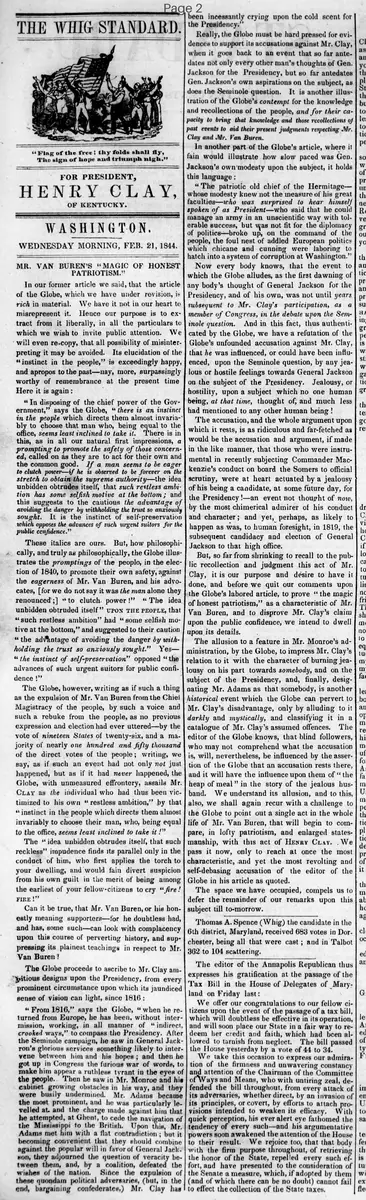
MR. VAN BUREN'S "MAGIC OF HONEST PATRIOTISM."
In our former article we said, that the article of the Globe, which we have under revision, is rich in material. We have it not in our heart to misrepresent it. Hence our purpose is to extract from it liberally, in all the particulars to which we wish to invite public attention. We will even re-copy, that all possibility of misinterpreting it may be avoided. Its elucidation of the "instinct in the people," is exceedingly happy, and apropos to the past—nay, more, surpassingly worthy of remembrance at the present time. Here it is again:
"In disposing of the chief power of the Government," says the Globe, "there is an instinct in the people which directs them almost invariably to choose that man who, being equal to the office, seems least inclined to take it. There is in this, as in all our natural first impressions, a prompting to promote the safety of those concerned, called on as they are to act for their own and the common good. If a man seems to be eager to clutch power; if he is observed to be forever on the stretch to obtain the supreme authority—the idea unbidden obtrudes itself, that such restless ambition has some selfish motive at the bottom; and this suggests to the cautious the advantage of avoiding the danger by withholding the trust so anxiously sought. It is the instinct of self-preservation which opposes the advances of such urgent suitors for the public confidence."
These italics are ours. But, how philosophically, and truly as philosophically, the Globe illustrates the promptings of the people, in the election of 1840, to promote their own safety, against the eagerness of Mr. Van Buren, and his advocates, [for we do not say it was the man alone they renounced;] "to clutch power!" "The idea unbidden obtruded itself" upon the people, that "such restless ambition" had "some selfish motive at the bottom," and suggested to their caution "the advantage of avoiding the danger by withholding the trust so anxiously sought." Yes—"the instinct of self-preservation" opposed "the advances of such urgent suitors for public confidence!"
The Globe, however, writing as if such a thing as the expulsion of Mr. Van Buren from the Chief Magistracy of the people, by such a voice and such a rebuke from the people, as no previous expression and election had ever uttered—by the vote of nineteen States of twenty-six, and a majority of nearly one hundred and fifty thousand of the direct votes of the people; writing, we say, as if such an event had not only not just happened, but as if it had never happened, the Globe, with unmeasured effrontery, assails Mr. Clay as the individual who had thus been victimized to his own "restless ambition," by that "instinct in the people which directs them almost invariably to choose their man, who, being equal to the office, seems least inclined to take it!"
The "idea unbidden obtrudes itself, that such reckless" impudence finds its parallel only in the conduct of him, who first applies the torch to your dwelling, and would fain divert suspicion from his own guilt in the merit of being among the earliest of your fellow-citizens to cry "fire! FIRE!"
Can it be true, that Mr. Van Buren, or his honestly meaning supporters—for he doubtless had, and has, some such—can look with complacency upon this course of perverting history, and suppressing its plainest teachings in respect to Mr. Van Buren?
The Globe proceeds to ascribe to Mr. Clay ambitious designs upon the Presidency, from every prominent circumstance upon which its jaundiced sense of vision can light, since 1816:
"From 1816," says the Globe, "when he returned from Europe, he has been, without intermission, working, in all manner of "indirect, crooked ways," to compass the Presidency. After the Seminole campaign, he saw in General Jackson's glorious services something likely to intervene between him and his hopes; and then he got up in Congress the furious war of words, to make him appear a ruthless tyrant in the eyes of the people. Then he saw in Mr. Monroe and his cabinet growing obstacles in his way, and they were busily undermined. Mr. Adams became the most prominent, and he was particularly levelled at and the charge made against him that he attempted, at Ghent, to cede the navigation of the Mississippi to the British. Upon this, Mr. Adams met him with a flat contradiction; but it becoming convenient that they should combine against the popular will in favor of General Jackson, they adjourned the question of veracity between them, and, by a coalition, defeated the wishes of the nation. Since the expulsion of these quondam political adversaries, (but, in the end, bargaining confederates,) Mr. Clay has been incessantly crying upon the cold scent for the Presidency."
Really, the Globe must be hard pressed for evidences to support its accusations against Mr. Clay, when it goes back to an event that so far antedates not only every other man's thoughts of Gen. Jackson for the Presidency, but so far antedates Gen. Jackson's own aspirations on the subject, as does the Seminole question. It is another illustration of the Globe's contempt for the knowledge and recollections of the people, and for their capacity to bring that knowledge and those recollections of past events to aid their present judgments respecting Mr. Clay and Mr. Van Buren.
In another part of the Globe's article, where it fain would illustrate how slow paced was Gen. Jackson's own modesty upon the subject, it holds this language:
"The patriotic old chief of the Hermitage—whose modesty knew not the measure of his great faculties—who was surprised to hear himself spoken of as President—who said that he could manage an army in an unscientific way with tolerable success, but was not fit for the diplomacy of politics—broke up, on the command of the people, the foul nest of addled European politics which chicane and cunning were laboring to hatch into a system of corruption at Washington."
Now every body knows, that the event to which the Globe alludes, as the first dawning of any body's thought of General Jackson for the Presidency, and of his own, was not until years subsequent to Mr. Clay's participation, as a member of Congress, in the debate upon the Seminole question. And in this fact, thus authenticated by the Globe, we have a refutation of the Globe's unfounded accusation against Mr. Clay, that he was influenced, or could have been influenced, upon the Seminole question, by any jealousy or hostile feelings towards General Jackson on the subject of the Presidency. Jealousy, or hostility, upon a subject which no one human being, at that time, thought of, and much less had mentioned to any other human being!
The accusation, and the whole argument upon which it rests, is as ridiculous and far-fetched as would be the accusation and argument, if made in the like manner, that those who were instrumental in recently subjecting Commander Mackenzie's conduct on board the Somers to official scrutiny, were at heart actuated by a jealousy of his being a candidate, at some future day, for the Presidency!—an event not thought of now, by the most chimerical admirer of his conduct and character; and yet, perhaps, as likely to happen as was, to human foresight, in 1819, the subsequent candidacy and election of General Jackson to that high office.
But, so far from shrinking to recall to the public recollection and judgment this act of Mr. Clay, it is our purpose and desire to have it done, and before we quit our comments upon the Globe's labored article, to prove "the magic of honest patriotism," as a characteristic of Mr. Van Buren, and to disprove Mr. Clay's claim upon the public confidence, we intend to dwell upon its details.
The allusion to a feature in Mr. Monroe's administration, by the Globe, to impress Mr. Clay's relation to it with the character of burning jealousy on his part towards somebody, and on the subject of the Presidency, and, finally, designating Mr. Adams as that somebody, is another historical event which the Globe can pervert to Mr. Clay's disadvantage, only by alluding to it darkly and mystically, and classifying it in a catalogue of Mr. Clay's assumed offences. The editor of the Globe knows, that blind followers, who may not comprehend what the accusation is, will, nevertheless, be influenced by the assertion of the Globe that an accusation rests there, and it will have the influence upon them of "the heap of meal" in the story of the jealous husband. We understand its allusion, and to this, also, we shall again recur with a challenge to the Globe to point out a single act in the whole life of Mr. Van Buren, that will begin to compare, in lofty patriotism, and enlarged statesmanship, with this act of Henry Clay. We pass it now, only to reach at once the most characteristic, and yet the most revolting and self-debasing accusation of the editor of the Globe in his article as quoted.
The space we have occupied, compels us to defer the remainder of our remarks upon this subject till to-morrow.
In our former article we said, that the article of the Globe, which we have under revision, is rich in material. We have it not in our heart to misrepresent it. Hence our purpose is to extract from it liberally, in all the particulars to which we wish to invite public attention. We will even re-copy, that all possibility of misinterpreting it may be avoided. Its elucidation of the "instinct in the people," is exceedingly happy, and apropos to the past—nay, more, surpassingly worthy of remembrance at the present time. Here it is again:
"In disposing of the chief power of the Government," says the Globe, "there is an instinct in the people which directs them almost invariably to choose that man who, being equal to the office, seems least inclined to take it. There is in this, as in all our natural first impressions, a prompting to promote the safety of those concerned, called on as they are to act for their own and the common good. If a man seems to be eager to clutch power; if he is observed to be forever on the stretch to obtain the supreme authority—the idea unbidden obtrudes itself, that such restless ambition has some selfish motive at the bottom; and this suggests to the cautious the advantage of avoiding the danger by withholding the trust so anxiously sought. It is the instinct of self-preservation which opposes the advances of such urgent suitors for the public confidence."
These italics are ours. But, how philosophically, and truly as philosophically, the Globe illustrates the promptings of the people, in the election of 1840, to promote their own safety, against the eagerness of Mr. Van Buren, and his advocates, [for we do not say it was the man alone they renounced;] "to clutch power!" "The idea unbidden obtruded itself" upon the people, that "such restless ambition" had "some selfish motive at the bottom," and suggested to their caution "the advantage of avoiding the danger by withholding the trust so anxiously sought." Yes—"the instinct of self-preservation" opposed "the advances of such urgent suitors for public confidence!"
The Globe, however, writing as if such a thing as the expulsion of Mr. Van Buren from the Chief Magistracy of the people, by such a voice and such a rebuke from the people, as no previous expression and election had ever uttered—by the vote of nineteen States of twenty-six, and a majority of nearly one hundred and fifty thousand of the direct votes of the people; writing, we say, as if such an event had not only not just happened, but as if it had never happened, the Globe, with unmeasured effrontery, assails Mr. Clay as the individual who had thus been victimized to his own "restless ambition," by that "instinct in the people which directs them almost invariably to choose their man, who, being equal to the office, seems least inclined to take it!"
The "idea unbidden obtrudes itself, that such reckless" impudence finds its parallel only in the conduct of him, who first applies the torch to your dwelling, and would fain divert suspicion from his own guilt in the merit of being among the earliest of your fellow-citizens to cry "fire! FIRE!"
Can it be true, that Mr. Van Buren, or his honestly meaning supporters—for he doubtless had, and has, some such—can look with complacency upon this course of perverting history, and suppressing its plainest teachings in respect to Mr. Van Buren?
The Globe proceeds to ascribe to Mr. Clay ambitious designs upon the Presidency, from every prominent circumstance upon which its jaundiced sense of vision can light, since 1816:
"From 1816," says the Globe, "when he returned from Europe, he has been, without intermission, working, in all manner of "indirect, crooked ways," to compass the Presidency. After the Seminole campaign, he saw in General Jackson's glorious services something likely to intervene between him and his hopes; and then he got up in Congress the furious war of words, to make him appear a ruthless tyrant in the eyes of the people. Then he saw in Mr. Monroe and his cabinet growing obstacles in his way, and they were busily undermined. Mr. Adams became the most prominent, and he was particularly levelled at and the charge made against him that he attempted, at Ghent, to cede the navigation of the Mississippi to the British. Upon this, Mr. Adams met him with a flat contradiction; but it becoming convenient that they should combine against the popular will in favor of General Jackson, they adjourned the question of veracity between them, and, by a coalition, defeated the wishes of the nation. Since the expulsion of these quondam political adversaries, (but, in the end, bargaining confederates,) Mr. Clay has been incessantly crying upon the cold scent for the Presidency."
Really, the Globe must be hard pressed for evidences to support its accusations against Mr. Clay, when it goes back to an event that so far antedates not only every other man's thoughts of Gen. Jackson for the Presidency, but so far antedates Gen. Jackson's own aspirations on the subject, as does the Seminole question. It is another illustration of the Globe's contempt for the knowledge and recollections of the people, and for their capacity to bring that knowledge and those recollections of past events to aid their present judgments respecting Mr. Clay and Mr. Van Buren.
In another part of the Globe's article, where it fain would illustrate how slow paced was Gen. Jackson's own modesty upon the subject, it holds this language:
"The patriotic old chief of the Hermitage—whose modesty knew not the measure of his great faculties—who was surprised to hear himself spoken of as President—who said that he could manage an army in an unscientific way with tolerable success, but was not fit for the diplomacy of politics—broke up, on the command of the people, the foul nest of addled European politics which chicane and cunning were laboring to hatch into a system of corruption at Washington."
Now every body knows, that the event to which the Globe alludes, as the first dawning of any body's thought of General Jackson for the Presidency, and of his own, was not until years subsequent to Mr. Clay's participation, as a member of Congress, in the debate upon the Seminole question. And in this fact, thus authenticated by the Globe, we have a refutation of the Globe's unfounded accusation against Mr. Clay, that he was influenced, or could have been influenced, upon the Seminole question, by any jealousy or hostile feelings towards General Jackson on the subject of the Presidency. Jealousy, or hostility, upon a subject which no one human being, at that time, thought of, and much less had mentioned to any other human being!
The accusation, and the whole argument upon which it rests, is as ridiculous and far-fetched as would be the accusation and argument, if made in the like manner, that those who were instrumental in recently subjecting Commander Mackenzie's conduct on board the Somers to official scrutiny, were at heart actuated by a jealousy of his being a candidate, at some future day, for the Presidency!—an event not thought of now, by the most chimerical admirer of his conduct and character; and yet, perhaps, as likely to happen as was, to human foresight, in 1819, the subsequent candidacy and election of General Jackson to that high office.
But, so far from shrinking to recall to the public recollection and judgment this act of Mr. Clay, it is our purpose and desire to have it done, and before we quit our comments upon the Globe's labored article, to prove "the magic of honest patriotism," as a characteristic of Mr. Van Buren, and to disprove Mr. Clay's claim upon the public confidence, we intend to dwell upon its details.
The allusion to a feature in Mr. Monroe's administration, by the Globe, to impress Mr. Clay's relation to it with the character of burning jealousy on his part towards somebody, and on the subject of the Presidency, and, finally, designating Mr. Adams as that somebody, is another historical event which the Globe can pervert to Mr. Clay's disadvantage, only by alluding to it darkly and mystically, and classifying it in a catalogue of Mr. Clay's assumed offences. The editor of the Globe knows, that blind followers, who may not comprehend what the accusation is, will, nevertheless, be influenced by the assertion of the Globe that an accusation rests there, and it will have the influence upon them of "the heap of meal" in the story of the jealous husband. We understand its allusion, and to this, also, we shall again recur with a challenge to the Globe to point out a single act in the whole life of Mr. Van Buren, that will begin to compare, in lofty patriotism, and enlarged statesmanship, with this act of Henry Clay. We pass it now, only to reach at once the most characteristic, and yet the most revolting and self-debasing accusation of the editor of the Globe in his article as quoted.
The space we have occupied, compels us to defer the remainder of our remarks upon this subject till to-morrow.
What sub-type of article is it?
Partisan Politics
What keywords are associated?
Van Buren
Henry Clay
Election 1840
Political Ambition
Globe Newspaper
Seminole Campaign
Jackson Modesty
What entities or persons were involved?
Mr. Van Buren
Mr. Clay
General Jackson
The Globe
Mr. Monroe
Mr. Adams
Editorial Details
Primary Topic
Critique Of Globe's Accusations Against Henry Clay's Ambition And Defense Of Van Buren's 1840 Defeat
Stance / Tone
Strongly Pro Clay And Anti Van Buren, Refuting Historical Perversions
Key Figures
Mr. Van Buren
Mr. Clay
General Jackson
The Globe
Mr. Monroe
Mr. Adams
Key Arguments
People's Instinct Rejects Eager Power Seekers Like Van Buren In 1840 Election
Globe Ignores Van Buren's Expulsion By Overwhelming Vote
Clay's Seminole Debate Predates Jackson's Presidential Aspirations, Refuting Jealousy Claims
Globe's Accusations Against Clay Since 1816 Are Far Fetched And Contemptuous Of Public Knowledge
Clay's Actions Show Honest Patriotism Superior To Van Buren's