Thank you for visiting SNEWPapers!
Sign up free
Henderson Daily Dispatch
Henderson, Vance County, North Carolina
What is this article about?
On July 30, 1914, amid rising tensions, leaders like Kaiser Wilhelm, Czar Nicholas II, and King George V attempted to avert World War I through telegrams and appeals, but lies from Russian officials, hesitation by British Foreign Secretary Sir Edward Grey, and unstoppable mobilization efforts led to war's inevitability across European capitals.
Merged-components note: World War 20 years ago article merged with continuation text.
Clipping
OCR Quality
Full Text
July 30th, 1914—Along the Champs Elysees, Paris; at Brandenburg Gate, Berlin; in Trafalgar Square, London; around the Burggring, Vienna, there are people who realize that a flood is rising and soon must burst the dam of common sense, and they raise their voices in protest. Beside the Winter Palace, St. Petersburg, Cossacks mercilessly still murmurs that might become angry shouts.
Soon vox populi will drown out the protests with cheers.
The Wein Arbeiterzeitung is crying "—the blood that is to be shed in a cause which could perfectly well be settled in honorable and peaceful fashion."
The Berliner Vorwarts is warning, "a mad crime is to be capped by a crime still madder."
In Paris, 12 dailies are expressing alarm and demanding peace.
These newspapers will be suppressed.
In Paris a trades union congress issues an appeal for a European-wide general strike, "to prevent war and bring governments to arbitration"
Jean Jaures will be assassinated.
The Juggernaut Berchtold started rolling cannot be stopped.
Not even by kings.
Wilhelm telegraphs his cousin Nicholas at 1 a. m.:
"My Ambassador has been instructed to call your Government's attention to the dangers and serious consequences of mobilization. Austria-Hungary mobilized only against Servia, and at that she mobilized only part of her army. If Russia, as she appears from what you and your government say, is mobilizing only against Austria-Hungary, the position of Mediator, which you intrusted to me in a friendly manner and which I accepted at your urgent request, is jeopardized if not rendered untenable.
The whole weight of the decision now rests on your shoulders; they must bear the responsibility of war or peace"
The Czar knows only what he is told.
When he telephones his minister of war, Suchomlinov, to reduce the mobilization to a partial one, he is told the machinery of mobilization cannot be stopped! The chief of the general staff, Yanushkevich, confirms this.
The Czar is dissuaded.
The machine has been in motion for five days, all the while Russia has been denying it to the world.
Another king who does not want war cannot prevent it. George, Defender of the Faith, etc., telegraphs his cousin Prince Henry of Prussia, brother of Wilhelm:
"I am earnestly desirous that such an irreparable disaster as a European war should be averted. My Government is doing its utmost, suggesting to Russia and France to suspend further military preparations if Austria will consent to be satisfied with occupation of Belgrade ... as a hostage for satisfactory settlement of her demands ... Trust William will use his great influence ..."
That day George's Government was not doing its utmost, authorities were to agree later. George's cousin, Grand Duke Alexander, tells us:
"The British government could have averted the catastrophe, had it declared its readiness to stand by France and Russia"
Germany and Austria-Hungary still hoped, that day, Britain would remain neutral. France asked, that day, for a declaration from London that would leave no doubts in Berlin or Vienna.
But Sir Edward Grey hesitated, and Europe was lost.
The juggernaut would not be stopped.
(To be continued)
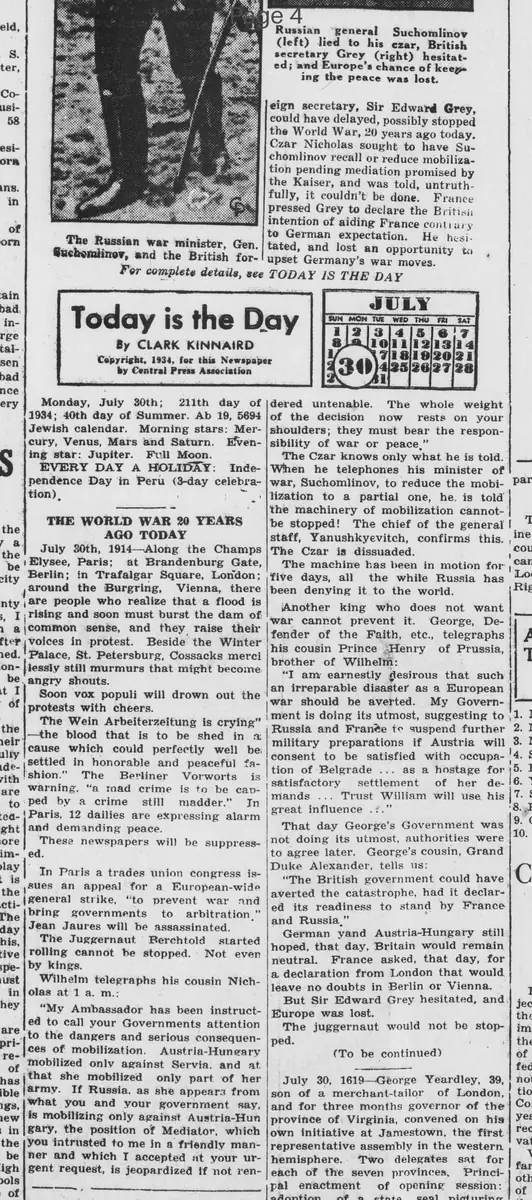
Russian general Suchomlinov (left) lied to his czar, British foreign secretary, Sir Edward Grey, (right) hesitated; and Europe's chance of keeping the peace was lost.
Foreign secretary, Sir Edward Grey, could have delayed, possibly stopped the World War, 20 years ago today.
Czar Nicholas sought to have Suchomlinov recall or reduce mobilization pending mediation promised by the Kaiser, and was told, untruthfully, it couldn't be done. France pressed Grey to declare the British intention of aiding France contrary to German expectation. He hesitated, and lost an opportunity to upset Germany's war moves.
What sub-type of article is it?
What themes does it cover?
What keywords are associated?
What entities or persons were involved?
Where did it happen?
Story Details
Key Persons
Location
Paris, Berlin, London, Vienna, St. Petersburg
Event Date
July 30th, 1914
Story Details
On July 30, 1914, protests against impending war occur in European capitals, but are overshadowed by cheers. Newspapers warn of madness, but are suppressed. A general strike is called in Paris. Jean Jaures is assassinated. Diplomatic telegrams from Wilhelm to Nicholas and George to Prince Henry seek to halt mobilization, but Russian officials lie to the Czar, and Grey hesitates, sealing Europe's fate.