Thank you for visiting SNEWPapers!
Sign up free
Daily National Intelligencer
Washington, District Of Columbia
What is this article about?
Overview of European political affairs: proposed sovereigns' council on army occupation in conquered countries; Russian Emperor's expedition to southern provinces with military readiness; unclear European policy on South America; varying conditions in Spain, Germany, England, and France emphasizing commerce, revolution principles, and press freedom.
Clipping
OCR Quality
Full Text
FROM THE ESSEX REGISTER.
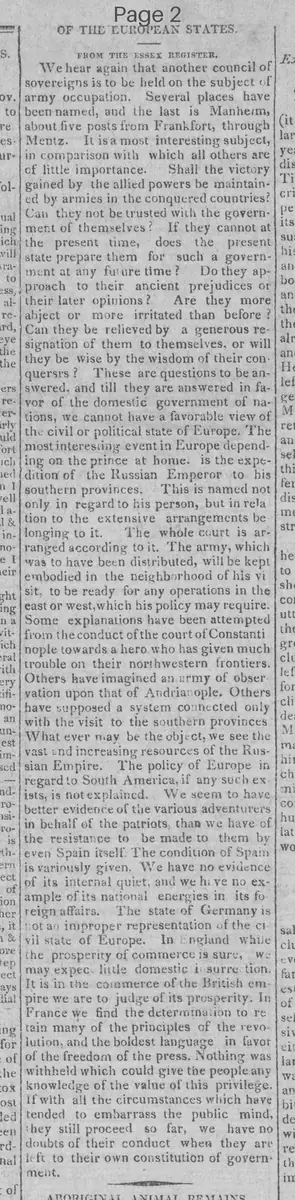
We hear again that another council of sovereigns is to be held on the subject of army occupation. Several places have been named, and the last is Manheim, about five posts from Frankfort, through Mentz. It is a most interesting subject, in comparison with which all others are of little importance. Shall the victory gained by the allied powers be maintained by armies in the conquered countries? Can they not be trusted with the government of themselves? If they cannot at the present time, does the present state prepare them for such a government at any future time? Do they approach to their ancient prejudices or their later opinions? Are they more abject or more irritated than before? Can they be relieved by a generous resignation of them to themselves, or will they be wise by the wisdom of their conquerors? These are questions to be answered, and till they are answered in favor of the domestic government of nations, we cannot have a favorable view of the civil or political state of Europe. The most interesting event in Europe depending on the prince at home, is the expedition of the Russian Emperor to his southern provinces. This is named not only in regard to his person, but in relation to the extensive arrangements belonging to it. The whole court is arranged according to it. The army, which was to have been distributed, will be kept embodied in the neighborhood of his visit, to be ready for any operations in the east or west, which his policy may require. Some explanations have been attempted from the conduct of the court of Constantinople towards a hero who has given much trouble on their northwestern frontiers. Others have imagined an army of observation upon that of Adrianople. Others have supposed a system connected only with the visit to the southern provinces. Whatever may be the object, we see the vast and increasing resources of the Russian Empire. The policy of Europe in regard to South America, if any such exists, is not explained. We seem to have better evidence of the various adventurers in behalf of the patriots, than we have of the resistance to be made to them by even Spain itself. The condition of Spain is variously given. We have no evidence of its internal quiet, and we have no example of its national energies in its foreign affairs. The state of Germany is not an improper representation of the civil state of Europe. In England while the prosperity of commerce is sure, we may expect little domestic insurrection. It is in the commerce of the British empire we are to judge of its prosperity. In France we find the determination to retain many of the principles of the revolution, and the boldest language in favor of the freedom of the press. Nothing was withheld which could give the people any knowledge of the value of this privilege. If with all the circumstances which have tended to embarrass the public mind, they still proceed so far, we have no doubts of their conduct when they are left to their own constitution of government.
What sub-type of article is it?
What keywords are associated?
What entities or persons were involved?
Where did it happen?
Foreign News Details
Primary Location
Europe
Key Persons
Event Details
Report on proposed council of sovereigns at Manheim on army occupation in conquered countries post-allied victory; questions on self-government; Russian Emperor's expedition to southern provinces with court and army arrangements for potential operations; speculations on relations with Constantinople and resources of Russian Empire; unclear European policy on South America and Spanish resistance; conditions in Spain lacking internal quiet and energies; Germany representing Europe's civil state; England's commerce prosperity reducing insurrection risk; France retaining revolution principles and advocating press freedom.