Thank you for visiting SNEWPapers!
Sign up free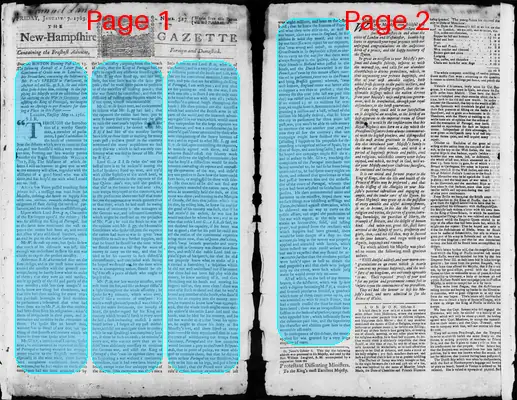
The New Hampshire Gazette
Portsmouth, Rockingham County, New Hampshire
What is this article about?
Extract from a letter describing William Pitt's speech in the British House of Commons on May 12, 1762, defending continued funding for the war in Germany and aid to Portugal amid debate on war expenses. Pitt advocated vigor in prosecution for honorable peace; funds were granted by large majority.
Merged-components note: Merging image and text components that form a single article reporting on Mr. Pitt's speech in Parliament. The text continues directly from page 1 to page 2, and the image overlaps spatially with the article text on page 1.
Clippings
1 of 2
OCR Quality
Full Text
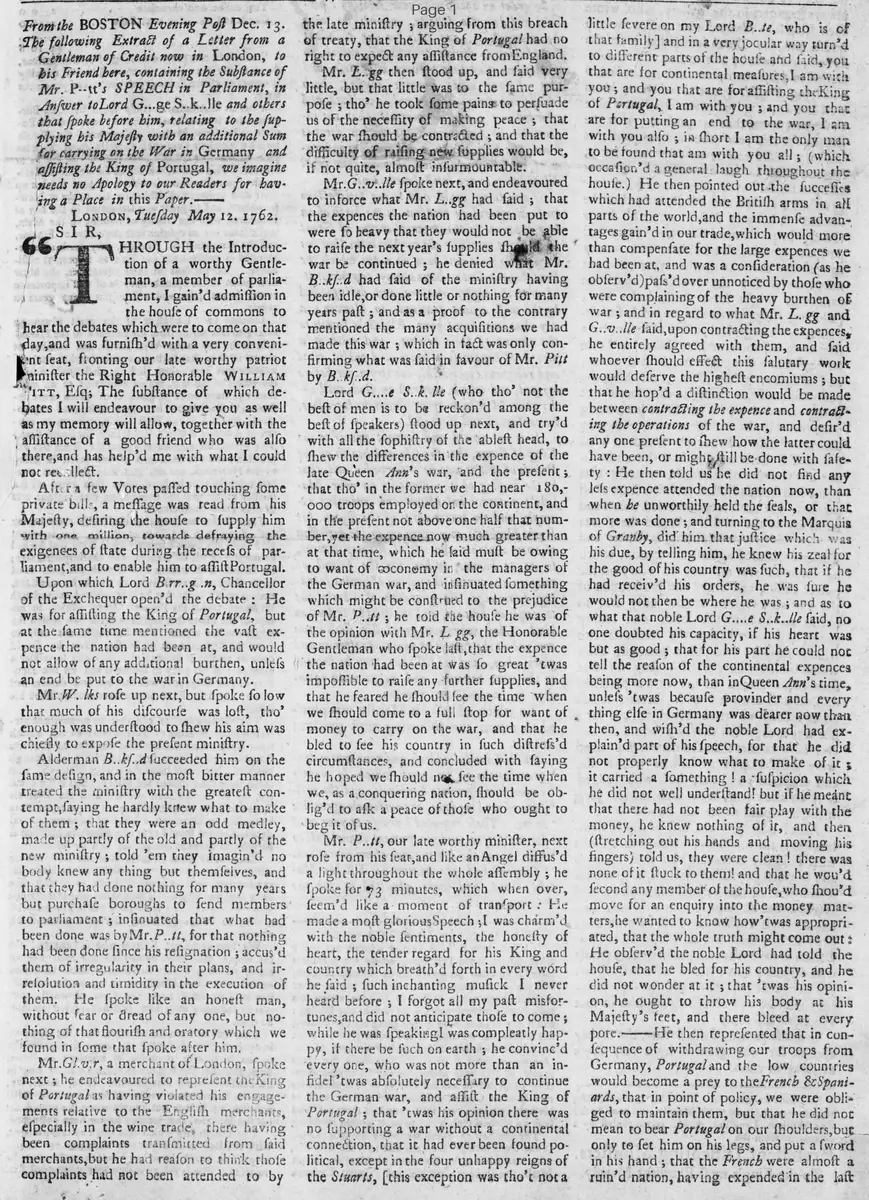
The following Extract of a Letter from a Gentleman of Credit now in London, to his Friend here, containing the Substance of Mr. Pitt's SPEECH in Parliament, in Answer to Lord George Sackville and others that spoke before him, relating to the supplying his Majesty with an additional Sum for carrying on the War in Germany and assisting the King of Portugal, we imagine needs no Apology to our Readers for having a Place in this Paper.
LONDON, Tuesday May 12. 1762.
Through the Introduction of a worthy Gentleman, a member of parliament, I gain'd admission in the house of commons to hear the debates which were to come on that day, and was furnish'd with a very convenient seat, fronting our late worthy patriot minister the Right Honorable WILLIAM PITT, Esq; The substance of which debates I will endeavour to give you as well as my memory will allow, together with the assistance of a good friend who was also there, and has help'd me with what I could not recollect.
After a few Votes passed touching some private bills, a message was read from his Majesty, desiring the house to supply him with one million, towards defraying the exigencies of state during the recess of parliament, and to enable him to assist Portugal.
Upon which Lord Brr..g..n, Chancellor of the Exchequer open'd the debate: He was for assisting the King of Portugal, but at the same time mentioned the vast expence the nation had been at, and would not allow of any additional burthen, unless an end be put to the war in Germany.
Mr. W..lks rose up next, but spoke so low that much of his discourse was lost, tho' enough was understood to shew his aim was chiefly to expose the present ministry.
Alderman B..kf..d succeeded him on the same design, and in the most bitter manner treated the ministry with the greatest contempt, saying he hardly knew what to make of them; that they were an odd medley, made up partly of the old and partly of the new ministry; told 'em they imagin'd no body knew any thing but themselves, and that they had done nothing for many years but purchase boroughs to send members to parliament; insinuated that what had been done was by Mr. Pitt, for that nothing had been done since his resignation; accus'd them of irregularity in their plans, and irresolution and timidity in the execution of them. He spoke like an honest man, without fear or dread of any one, but nothing of that flourish and oratory which we found in some that spoke after him.
Mr. Gl..v..r, a merchant of London, spoke next; he endeavoured to represent the King of Portugal as having violated his engagements relative to the English merchants, especially in the wine trade, there having been complaints transmitted from said merchants. but he had reason to think those complaints had not been attended to by the late ministry: arguing from this breach of treaty, that the King of Portugal had no right to expect any assistance from England.
Mr. L..gg then stood up, and said very little, but that little was to the same purpose; tho' he took some pains to persuade us of the necessity of making peace; that the war should be contracted; and that the difficulty of raising new supplies would be, if not quite, almost insurmountable.
Mr. G..v..lle spoke next, and endeavoured to enforce what Mr. L..gg had said; that the expences the nation had been put to were so heavy that they would not be able to raise the next year's supplies should the war be continued: he denied what Mr. B..kf..d had said of the ministry having been idle, or done little or nothing for many years past; and as a proof to the contrary mentioned the many acquisitions we had made this war; which in fact was only confirming what was said in favour of Mr. Pitt by B..kf..d.
Lord G....e S..k..lle (who tho' not the best of men is to be reckon'd among the best of speakers) stood up next, and try'd with all the sophistry of the ablest head, to shew the differences in the expence of the late Queen Ann's war, and the present; that tho' in the former we had near 180,000 troops employed on the continent, and in the present not above one half that number, yet the expence now much greater than at that time, which he laid must be owing to want of oeconomy in the managers of the German war, and insinuated something which might be construed to the prejudice of Mr. Pitt: he told the house he was of the opinion with Mr. L..gg, the Honorable Gentleman who spoke last, that the expence the nation had been at was so great 'twas impossible to raise any further supplies, and that he feared he should see the time when we should come to a full stop for want of money to carry on the war, and that he bled to see his country in such distress'd circumstances, and concluded with saying he hoped we should not see the time when we, as a conquering nation, should be oblig'd to ask a peace of those who ought to beg it of us.
Mr. Pitt, our late worthy minister, next rose from his seat, and like an Angel diffus'd a light throughout the whole assembly; he spoke for 3/4 minutes, which when over, seem'd like a moment of transport: He made a most glorious Speech: I was charm'd with the noble sentiments, the honesty of heart, the tender regard for his King and country which breath'd forth in every word he said; such enchanting musick I never heard before; I forgot all my past misfortunes, and did not anticipate those to come; while he was speaking I was compleatly happy, if there be such on earth; he convinc'd every one, who was not more than an infidel 'twas absolutely necessary to continue the German war, and assist the King of Portugal: that 'twas his opinion there was no supporting a war without a continental connection, that it had ever been found political, except in the four unhappy reigns of the Stuarts, [this exception was tho't not a little severe on my Lord B..te, who is of that family] and in a very jocular way turn'd to different parts of the house and said, you that are for continental measures, I am with you; and you that are for assisting the King of Portugal, I am with you; and you that are for putting an end to the war, I am with you also; in short I am the only man to be found that am with you all; (which occasion'd a general laugh throughout the house.) He then pointed out the success which had attended the British arms in all parts of the world, and the immense advantages gain'd in our trade, which would more than compensate for the large expences we had been at. and was a consideration (as he observ'd) pass'd over unnoticed by those who were complaining of the heavy burthen of war; and in regard to what Mr. L..gg and G..v..lle said, upon contracting the expences. he entirely agreed with them, and said whoever should effect this salutary work would deserve the highest encomiums; but that he hop'd a distinction would be made between contracting the expence and contracting the operations of the war, and desir'd any one present to shew how the latter could have been, or might still be done with safety: He then told us he did not find any less expence attended the nation now, than when he unworthily held the seals, or that more was done; and turning to the Marquis of Granby, did him that justice which was his due, by telling him, he knew his zeal for the good of his country was such, that if he had receiv'd his orders, he was sure he would not then be where he was; and as to what that noble Lord G....e S..k..lle said, no one doubted his capacity, if his heart was but as good; that for his part he could not tell the reason of the continental expences being more now, than in Queen Ann's time, unless 'twas because provinder and every thing else in Germany was dearer now than then, and wish'd the noble Lord had explain'd part of his speech, for that he did not properly know what to make of it; it carried a something! a suspicion which he did not well understand! but if he meant that there had not been fair play with the money, he knew nothing of it, and then (stretching out his hands and moving his fingers) told us, they were clean! there was none of it stuck to them! and that he wou'd second any member of the house, who shou'd move for an enquiry into the money matters, he wanted to know how 'twas appropriated. that the whole truth might come out: He observ'd the noble Lord had told the house, that he bled for his country, and he did not wonder at it; that twas his opinion, he ought to throw his body at his Majesty's feet, and there bleed at every pore.--He then represented that in consequence of withdrawing our troops from Germany, Portugal and the low countries would become a prey to the French & Spaniards, that in point of policy, we were obliged to maintain them, but that he did not mean to bear Portugal on our shoulders, but only to set him on his legs. and put a sword in his hand; that the French were almost a ruin'd nation. having expended in the last
year eight millions, and been on the losing hand; that he knew the finances of France. and what they were able to do, as well if not better, than any man in England. let his abilities be what they would, and that we by our successes were repaid for our expence; that 'twas wrong and unjust, to represent Great Britain in so deplorable a state, as unable to carry on the war (for that there were always strangers in the gallery, who wrote their friends in Holland what passed in the house, and the Dutch forwarded it to the French, and 'twas by this means affairs mentioned in parliament, came out in the French and lying Brussels gazette) whereas, 'twas well known, England never was better able to support a war than at present; that the money for this year (the last was paid this day) was raised and he would answer for it, if we wanted 15 or 20 millions for next year, we might have it, & recommended their granting a million and a half, instead of the million his Majesty desired; that he knew the cry in parliament for three years last past, was, you won't be able to raise money to continue the war another year; and yet now they all saw the contrary; that one campaign might have finished the war; [alluding to his proposals for demanding a categorical answer of Spain, by a fleet of ships, and attacking Cadiz,] and that he hoped one campaign might still do it; and in answer to Mr. Glynr, touching the complaints of the Portugal merchants not being attended to, he said so far from being unattended to, he had spent many nights on them, and referred that gentleman to what had passed between him and the ambassador of the court of Portugal, wherein that point had been adjusted to satisfaction of all persons. He then recommended union and harmony to the ministry, hoped there was no such things now subsisting as Whigs and Tories, declaimed against altercation, which he observed was no way to carry on the public affairs, and urged the prosecution of the war with vigour, as the only way to obtain an honourable, solid, and lasting peace, and proved from the readiness with which supplies had been granted, there would be little danger of a stop on that account, so long as the money was properly applied and attended with success, which latter indeed no man could answer for; nor was it expected that any should be accountable, farther than the measures pursued were looked upon as best to obtain the end proposed; and that those who judged only by the event, were such whose judgment he would never rely on.
All of which, to the best of my remembrance, is the substance, which was spoken with a dignity becoming an M.P., a coolness and firmness peculiar to himself, a goodness which none of them could come up to, and was attended to with so much silence, that had a mouse crossed the floor he must have been heard; there was an inexpressible satisfaction in the looks of all present, except those who opposed him; which sufficiently shows the deference paid him, and the superiority his character and abilities gave him in that venerable assembly.
In consequence of this debate, the money applied for was granted by a very large majority of votes.
What sub-type of article is it?
What keywords are associated?
What entities or persons were involved?
Where did it happen?
Foreign News Details
Primary Location
London
Event Date
May 12, 1762
Key Persons
Outcome
the money applied for was granted by a very large majority of votes; pitt recommended granting a million and a half instead of one million.
Event Details
In the House of Commons, a debate ensued on a royal message requesting one million pounds for state exigencies and aid to Portugal. Speakers including Lord Brr..g..n, Mr. W..lks, Alderman B..kf..d, Mr. Gl..v..r, Mr. L..gg, Mr. G..v..lle, and Lord George Sackville criticized war expenses, ministry performance, and the need for peace or economy. William Pitt delivered a compelling speech defending the continuation of the German war and assistance to Portugal, emphasizing continental connections, British successes, financial capability, and the need for vigorous prosecution to achieve honorable peace. He addressed criticisms, advocated union, and suggested inquiring into money appropriation if needed.