Thank you for visiting SNEWPapers!
Sign up free
Alexandria Advertiser And Commercial Intelligencer
Alexandria, Virginia
What is this article about?
This editorial from the Charleston Courier critiques radical democrats' misuse of John Locke's and Richard Hooker's philosophies on natural rights, arguing they apply only to a state of nature, not civil society. It defends property accumulation, marriage as societal foundations, and God-ordained inequality against egalitarian excesses.
Merged-components note: Merged three sequential components that continue the same editorial article 'NATURAL RIGHTS. No. II.' across the page.
Clipping
OCR Quality
Full Text
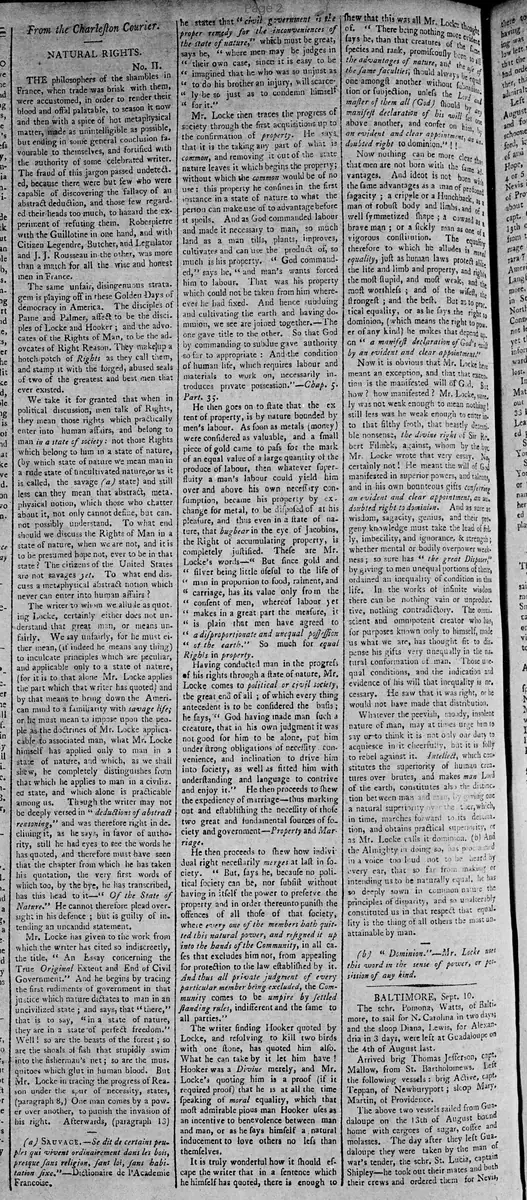
NATURAL RIGHTS.
No. II.
THE philosophers of the shambles in France, when trade was brisk with them, were accustomed, in order to render their blood and offal palatable, to season it now and then with a spice of hot metaphysical matter, made as unintelligible as possible, but ending in some general conclusion favourable to themselves, and fortified with the authority of some celebrated writer.
The fraud of this jargon passed undetected, because there were but few who were capable of discovering the fallacy of an abstract deduction, and those few regarded their heads too much, to hazard the experiment of refuting them. Robespierre with the Guillotine in one hand, and with Citizen Legendre, Slaughter, and Legislator and J. J. Rousseau in the other, was more than a match for all the wise and honest men in France.
The same unfair, disingenuous stratagem is playing off in these Golden Days of democracy in America. The disciples of Paine and Palmer, affect to be the disciples of Locke and Hooker: and the advocates of the Rights of Man, to be the advocates of Right Reason. They make up a hotchpotch of Rights as they call them, and stamp it with the forged, abused seals of two of the greatest and best men that ever existed.
We take it for granted that when in political discussion, men talk of Rights, they mean those rights which practically enter into human affairs, and belong to man in a state of society: not those Rights which belong to him in a state of nature, (by which state of nature we mean man in a rude state of uncultivated nature, or as it is called, the savage (a) state) and still less can they mean that abstract, metaphysical notion, which those who chatter about it, not only cannot define, but cannot possibly understand. To what end should we discuss the Rights of Man in a state of nature, when we are not, and it is to be presumed hope not, ever to be in that state? The citizens of the United States are not savages yet. To what end discuss a metaphysical abstract notion which never can enter into human affairs?
The writer to whom we allude as quoting Locke, certainly either does not understand that great man, or means unfairly. We say unfairly, for he must either mean, (if indeed he means any thing) to inculcate principles which are peculiar, and applicable only to a state of nature, (for it is to that alone Mr. Locke applies the part which that writer has quoted) and by that means to bring down the American mind to a familiarity with savage life; or he must mean to impose upon the people as the doctrines of Mr. Locke applicable to associated man, what Mr. Locke himself has applied only to man in a state of nature, and which, as we shall shew, he completely distinguishes from that which he applies to man in a civilized state, and which alone is practicable among us. Though the writer may not be deeply versed in deductions of abstract reasoning, and was therefore right in declining it, as he says, in favor of authority, still he had eyes to see the words he has quoted, and therefore must have seen that the chapter from which he has taken his quotation, the very first words of which too, by the bye, he has transcribed, has this title to it—'Of the State of Nature.' He cannot therefore plead oversight in his defence; but is guilty of intending an uncandid statement.
Mr. Locke has given to the work from which the writer has cited so indiscreetly, the title, 'An Essay concerning the True Original Extent and End of Civil Government.' And he begins by tracing the first rudiments of government in that justice which nature dictates to man in an uncivilized state; and says, that 'there,' that is to say, 'in a state of nature, they are in a state of perfect freedom.' Well! so are the beasts of the forest; so are the shoals of fish that stupidly swim into the fisherman's net; so are the mosquitoes which glut in human blood. But Mr. Locke in tracing the progress of Reason under the spur of necessity, states, (paragraph 8,) One man comes by a power over another, to punish the invasion of his right. Afterwards, (paragraph 13)
(a) SAVAGE.—Se dit de certains peuples qui vivent ordinairement dans les bois, presque sans religion, sans loi, sans habitation fixe. Dictionnaire de l'Académie Françoise.
he states that 'civil government is the proper remedy for the inconveniences of the state of nature,' which must be great, says he, 'where men may be judges in their own case, since it is easy to be imagined that he who was so unjust as to do his brother an injury, will scarcely be so just as to condemn himself for it.'
Mr. Locke then traces the progress of society through the first acquisitions up to the confirmation of property. He says that it is the taking any part of what is common, and removing it out of the state nature leaves it which begins the property; without which the common would be of no use: this property he confines in the first instance in a state of nature to what the person can make use of to advantage before it spoils. And as God commanded labour and made it necessary to man, so much land as a man tills, plants, improves, cultivates and can use the product of, so much is his property. 'God commanded,' says he, 'and man's wants forced him to labour. That was his property which could not be taken from him wherever he had fixed. And hence subduing and cultivating the earth and having dominion, we see are joined together.—The one gave title to the other. So that God by commanding to subdue gave authority so far to appropriate: And the condition of human life, which requires labour and materials to work on, necessarily introduces private possession.'—Chap. 5. Part. 35.
He then goes on to state that the extent of property, is by nature bounded by men's labour. As soon as metals (money) were considered as valuable, and a small piece of gold came to pass for the mark of an equal value of a large quantity of the produce of labour, then whatever superfluity a man's labour could yield him over and above his own necessary consumption, became his property by exchange for metal, to be disposed of at his pleasure, and thus even in a state of nature, that bugbear in the eye of Jacobins, the Right of accumulating property, is completely justified. These are Mr. Locke's words—'But since gold and silver being little useful to the life of man in proportion to food, raiment, and carriage, has its value only from the consent of men, whereof labour yet makes in a great part the measure, it is plain that men have agreed to a disproportionate and unequal possession of the earth.' So much for equal Rights in property.
Having conducted man in the progress of his rights through a state of nature, Mr. Locke comes to political or civil society the great end of all; of which every thing antecedent is to be considered the basis; he says, 'God having made man such a creature, that in his own judgment it was not good for him to be alone, put him under strong obligations of necessity, convenience, and inclination to drive him into society, as well as fitted him with understanding and language to contrive and enjoy it.' He then proceeds to shew the expediency of marriage—thus marking out and establishing the necessity of those two great and fundamental sources of society and government—Property and Marriage.
He then proceeds to shew how individual right necessarily merges at last in society. 'But,' says he, 'because no political society can be, nor subsist without having in itself the power to preserve the property and in order thereunto punish the offences of all those of that society, where every one of the members hath quitted this natural power, and resigned it up into the hands of the Community, in all cases that excludes him not, from appealing for protection to the law established by it. And thus all private judgment of every particular member being excluded, the Community comes to be umpire by settled standing rules, indifferent and the same to all parties.'
The writer finding Hooker quoted by Locke, and resolving to kill two birds with one stone, has quoted him also. What he can take by it let him have! Hooker was a Divine merely, and Mr. Locke's quoting him is a proof (if it required proof) that he is at all the time speaking of moral equality, which that most admirable pious man Hooker uses as an incentive to benevolence between man and man, or as he says himself a natural inducement to love others no less than themselves.
It is truly wonderful how it should escape the writer that in a sentence which he himself has quoted, there is enough to
there show that this was much says he, than that creatures species and rank, promiscuously the advantages of nature, and of the lame born to all the use of having had order that the low letting was the one amongst another without subordination or subjection, unless the Lord and absolute master of them all (God) should by any manifest declaration of his will set one above another, and confer by an evident and clear appointment, an undoubted right to dominion.
Now nothing can be more clear than from Hooker, is scheme that men are not born with the same advantages. And idiot is not born with the same advantages as a man of profound sagacity; a cripple or a Hunchback, man of robust body and limbs, and of well symmetrized shape; a Coward as a captain vigorous constitution. The equality from J3th brave man; or a sickly man as one of a therefore to which he alludes is moral equality, not as human laws protect alike the life and limb and property, and right the most stupid, and most weak, and the most worthless; and of the wisest, the strongest; and the best. But as to practical equality, or as he says the right to come "a manifest declaration of God's will yet by an evident and clear appointment" information, ward lost. tion is the manifested will of God. But how? how manifested? Mr. Locke, surely was not weak enough to mean nothing! still less was he weak enough to enter into that filthy froth, that beastly detestable nonsense, the divine right of Sir Robert Filmer, against whom by the bye Mr. Locke wrote that very essay. No, certainly not! He meant the will of God as manifested in superior powers, and talents, and in his own bounteous gifts conferring an evident and clear appointment, an undoubted right to dominion. And as sure as her wisdom, sagacity, genius, and their progeny knowledge must take the lead of folly, imbecility, and ignorance, & strength; whether mental or bodily overpower weakness; so sure has "the great Disposer," by giving to men unequal portions of these, ordained an inequality of condition in this life. In the works of infinite wisdom my there can be nothing vain or unproductive, nothing contradictory. The omniscient and omnipotent creator who has, for purposes known only to himself, made us what we are, has thought fit to dispense his gifts very unequally in the natural conformation of man. Those unequal conditions, and the indication and evidence of his will that inequality is necessary. He saw that it was right, or he would not have made that distribution. Whatever the peevish, moody, insolent nature of man, may at times urge him to say or to think it is not only our duty to acquiesce in it cheerfully, but it is folly to rebel against it. Intellect, which constitutes the superiority of human creatures over brutes, and makes man Lord of the earth, constitutes also the distinction between man and man, by giving one a natural superiority over the other, which, in time, marches forward to its destination, and obtains practical superiority, or as Mr. Locke calls it dominion. (b) And the Almighty in doing so, has proclaimed in a voice too loud not to be heard by every ear, that so far from making or intending us to be naturally equal, he has so deeply sown in common nature the principles of disparity, and so unalterably constituted us in that respect that equality is the thing of all others the most unattainable by man.
(b) "Dominion." Mr. Locke uses this word in the sense of power, or possession of any kind.
What sub-type of article is it?
What keywords are associated?
What entities or persons were involved?
Editorial Details
Primary Topic
Critique Of Misapplying Locke's Natural Rights To Civil Society
Stance / Tone
Defense Of Property Rights And Natural Inequality Against Radical Democracy
Key Figures
Key Arguments