Thank you for visiting SNEWPapers!
Sign up free
Daily Globe
Saint Paul, Ramsey County, Minnesota
What is this article about?
Investigation into abuses at Minnesota Hospital for Insane in St. Peter reveals testimony alleging supervisor John Betts caused patient McDonald's death by choking during forced feeding; includes asylum visit, food quality complaints, scalding incident, and defensive letters from Dr. Bartlett amid committee scrutiny.
Clipping
OCR Quality
Full Text
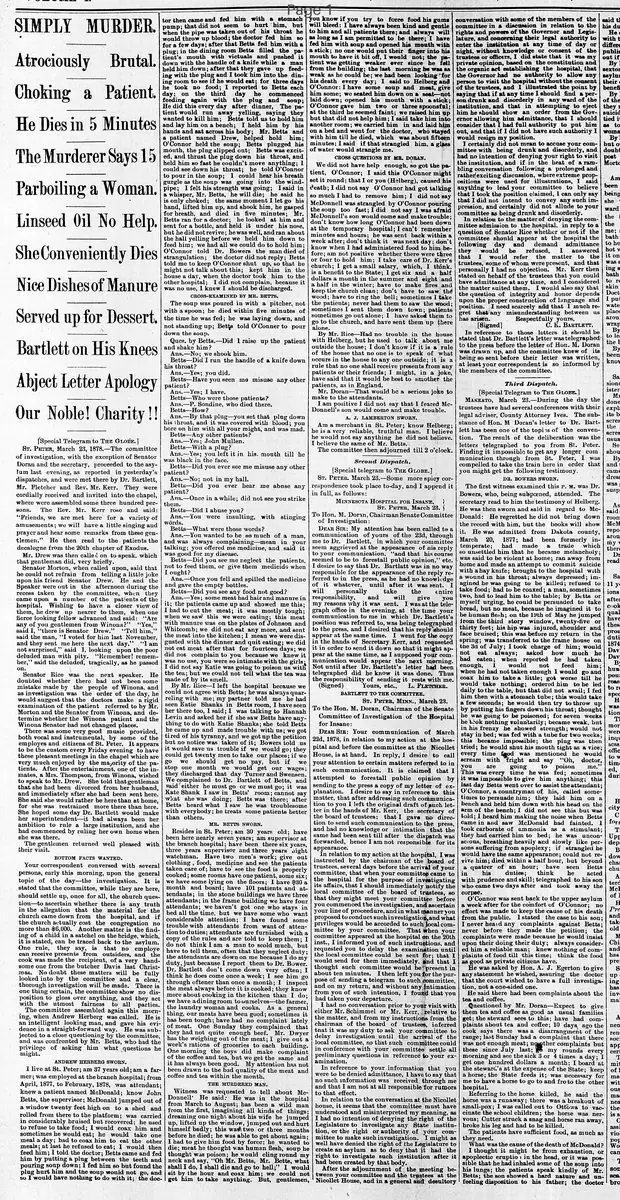
Atrociously Brutal.
Choking a Patient. He Dies in 5 Minutes.
The Murderer Says 15 Parboiling a Woman.
Linseed Oil No Help.
She Conveniently Dies.
Nice Dishes of Manure Served up for Dessert.
Bartlett on His Knees. Abject Letter Apology.
Our Noble! Charity !!
Special Telegram to The Globe.
ST. PETER, March 23, 1878.--The committee of investigation, with the exception of Senator Doran and the secretary, proceeded to the asylum last evening, as reported in yesterday's dispatches, and were met thereby Dr. Bartlett. Mr. Fletcher and Rev. Mr. Kerr. They were cordially received and invited into the chapel, where were assembled some three hundred persons.
The Rev. Mr. Kerr rose and said: "Friends, we are met here for a variety of amusements; we will have a little singing and prayer and hear some remarks from these gentlemen." He then read to the patients the decalogue from the 20th chapter of Exodus.
Mr. Drew was then called on to speak. which that gentleman did, very briefly.
Senator Morton, when called upon, said that he could not refrain from telling a little joke upon his friend Senator Drew. He and the Speaker were out in the afternoon during the recess taken by the committee, when they came upon a number of the patients of the hospital. Wishing to have a closer view of them, he drew up nearer to them, when one fierce looking fellow advanced and said: "Are any of you gentlemen from Winona?" "Yes." said I, "there is Senator Drew." "Tell him," said the man, "I voted for him last November, and they sent me here the next day." "I am not surprised," said I. looking upon the poor deluded man with pity. "Remember! remember," said the deluded, tragically, as he passed on.
Senator Rice was the next speaker. He doubted whether there had not been some mistake made by the people of Winona. and as investigation was the order of the day, he would suggest that the doctors make a rigid examination of the patient referred to by Mr. Morton and the Senator from Winona. and determine whether the Winona patient and the Winona Senator had not changed places.
There was some very good music provided. both vocal and instrumental, by some of the employes and citizens of St. Peter. It appears to be the custom every Friday evening to have these pleasant meetings in the chapel which are very much enjoyed by the majority of the patients. After the entertainment, one of the inmates, a Mrs. Thompson, from Winona, wished to speak to Mr. Drew. She told that gentleman that she had been divorced from her husband. and immediately after she had been sent here. She said she would rather be here than at home, for she was restrained more there than here. She hoped some day Dr. Bartlett would make her superintendent-it had always been her ambition to rule a large institution, and she had commenced by ruling her own home when she was there.
The gentlemen returned well pleased with their visit.
BOTTOM FACTS WANTED.
Your correspondent conversed with several persons, early this morning, upon the general topic of the day-the investigation. It is stated that the committee, while they are here, should settle up, once for all, the church question-to ascertain whether there is any truth in the allegation that the material for the church came down from the hospital, and if the church actually cost the congregation no more than $6,000. Another matter is the finding of a child in a satchel on the bridge, which. it is stated, can be traced back to the asylum. One rule, they say, is that no employe can receive presents from outsiders, and the cook was made the recipient, of a very handsome one from the butcher Davis last Christmas. No doubt these matters will be fully looked into by the committee and a clear, thorough investigation will be made. There is one thing certain, the committee show no disposition to gloss over anything, and they act with the utmost fairness to all parties.
The committee assembled again this morning. when Andrew Herberg was called. He is an intelligent looking man, and gave his evidence in a straight-forward way. He was subjected to a close questioning by the committee, and was confronted by Mr. Betts, who had the privilege of asking him what questions he might.
ANDREW HERBERG SWORN.
I live at St. Peter; am 37 years old; am a farmer; was employed at the branch hospital; from April, 1877, to February, 1878, was attendant; knew a patient named McDonald; know John Betts, the supervisor; McDonald jumped out of a window twenty feet high on to a shed and rolled from there to the platform; was carried in considerably bruised but recovered: he used to refuse to take food; I would coax him and sometimes he would eat; he would take one meal a day; had to coax him to eat the other meals; at last he refused to eat; I would then feed him; I told the doctor; Betts came and fed him by putting a plug between the teeth and pouring soup down; I fed him so but found the plug hurt him and the soup would not go, and so I would have nothing to do with it; the doctor then came and fed him with a stomach pump; that did not seem to hurt him, but when the pipe was taken out of his throat he would throw up blood; the doctor fed him so for a few days; after that Betts fed him with a plug; in the dining room Betts filled the patient's mouth with victuals and pushed it down with the handle of a knife while a man held him down; after that they gave up feeding with the plug and I took him into the dining room to see if he would eat; for three days he took no food; I reported to Betts each day; on the third day he commenced feeding again with the plug and soup; He did this every day after dinner, The patient would run away yelling, saying they wanted to kill him; Betts told us to hold him and lay him on a bench; I held him by his hands and sat across his body; Mr. Betts and a patient named Drew, helped hold him; O'Connor held the soup; Betts plugged his mouth, the plug slipped out; Betts was excited, and thrust the plug down his throat, and held him so fast he couldn't move anything; I could see down his throat: he told O'Connor to pour in the soup; I could hear his breath gurgle as the soup was going into the wind-pipe; I felt his strength was going; I said in a whisper, Mr. Betts, he will die; he said he is only choked; the same moment I let go his hand, lifted him up, and shook him, he gasped for breath. and died in five minutes; Mr. Betts ran for a doctor; he looked at him and sent for a bottle, and held it under his nose, but he did not revive; he was well, and ran about the hall yelling before we held him down to feed him; we had all we could do to hold him; O'Connor told Dr. Bowers the man died of strangulation; the doctor did not reply: Betts told me to keep O'Connor shut up, so that he might not talk about this; kept him in the house a day, when the doctor took him to the other hospital: I did not complain. because it was no use, I knew I should be discharged.
CROSS-EXAMINED BY MR. BETTS.
The soup was poured in with a pitcher, not with a spoon; he died within five minutes of the time he was fed; he was laying down, and not standing up; Betts told O'Connor to pour down the soup.
Quee. by Betts.—Did I raise up the patient and shake him?
Ans.—No; we shook him.
Betts—Did I run the handle of a knife down his throat?
Ans.—Yes; you did.
Betts—Have you seen me misuse any other patient?
Ans.—Yes; I have.
Betts—Who were those patients?
Ans.—P. Sondine, who died there.
Betts—How?
Ans.—By that plug—you set that plug down his throat, and it was covered with blood; you bore on him with all your might, and was mad.
Betts—Any other patient?
Ans.—Yes; John Mullen.
Betts—With a plug?
Ans.—Yes; you left it in his mouth till he was black in the face.
Betts—Did you ever see me misuse any other patient?
Ans.—No; not in my hall.
Betts—Did you ever hear me abuse any patient?
Ans.—Once in a while; did not see you strike them.
Betts—Did I abuse you?
Ans.—You were insulting, with stinging words.
Betts—What were those words?
Ans.—You wanted to be so much of a man, and was always complaining—mean in your talking; you offered me medicine, and said it was good for my disease.
Betts—Did you see me neglect the patients, not to feed them, or give them medicine when I ought?
Ans.—Once you fell and spilled the medicine and gave the empty bottles.
Betts—Did you see any food not good?
Ans.—Yes; some meat had hair and manure in it; the patients came up and showed me this; I had to cut the meat; it was mostly tough; when we saw this we were eating; this meat with manure was on the plates of Johnson and Whitcomb; we did not eat any more, and sent the meat into the kitchen; I mean we were disgusted with the dinner and quit eating; we did not eat meat after that for fourteen days; we did not complain to you because we knew it was no use, you were so intimate with the girls; I did not say Katie was going to poison us with the tea; but we could not tell what the tea was made of by its smell.
By Mr. Rice—I left the hospital because we could not agree with Betts; he was always quarreling with me; my partner told me he had seen Katie Shanks in Betts room, I have seen her there too, I said; I was talking to Hannah Levin and asked her if she saw Betts have anything to do with Katie Shanks; she told Betts he came up and made trouble with us; we got tired of his tyranny, and we got up the petition but no notice was taken of it; Bowers told us it would save us trouble if we would go; they could get twenty men to take our places; if we go we should get no pay, but if we stop one month we would get our wages; they discharged that day Turner and Swensen. We complained to Dr. Bartlett of Betts, and said either he must go or we must go; it was Kate Shank I saw in Betts' room; cannot say what she was doing; Betts was there; after Betts heard what I saw he was troublesome with everybody; he treats some patients better than others.
MR. BETTS SWORN.
Resides in St. Peter: am 30 years old; have been here nearly seven years; am supervisor at the branch hospital; have been there six years, three years supervisor and three years night watchman. Have two men's work; give out clothing, food, medicine and see the patients taken care of; have to see the food is properly cooked; some rooms have one patient, some six; we have some lying on the floors; I have $30 a month and board; have 101 patients and attendants; in the stone buildings we have three attendants; in the frame building we have four attendants; we haven't got one who stays in bed all the time, but we have some who want considerable attention; I have found some trouble with attendants from want of attention to duties; attendants are furnished with a copy of the rules and are told to keep them; I do not think I am a man to scold much, but have to tell them, often that they neglect duty; the attendants are down on me because I do my duty, just because I report them to Dr. Bower. Dr. Bartlett don't come down very often; I think he does come once a week; I see him go through oftener than once a month; I inspect the meat always before it is cooked; they know more about cooking in the kitchen than I do; we have a dining room to ourselves—the farmer, the laundry woman and cooks. As a general thing, our meats have been good; sometimes it has been tough; have had no complaint lately of meat. One Sunday they complained that they had not quite enough beef. Mr. Dwyer has the weighing out of the meat; I give out a week's rations of groceries to each building. One morning the boys did make complaint of the coffee and tea, but we get the same and it has always been good. My attention has not been drawn to the bad quality of the meat and coffee and tea within the month.
THE MURDERED MAN.
Witness was requested to tell about McDonnell. He said: He was in the hospital from March to August; has been a wild man from the first, imagining all kinds of things; dreaming one night about his wife he jumped up, lifted up the window, jumped out and hurt himself badly; this was two or three months before he died; he was able to get about again; I had to give him food by force; he wanted to die; meat he thought was human flesh, soup he thought was poison; he would cling round my neck and say, "Oh Mr. Betts, Mr. Betts, what shall I do, I shall die and go to hell;" I would sit by the hour and coax him; we could not get him to take anything. But, gentlemen, you know if you try to force food his gums will bleed: I have always been kind and gentle to him and all patients there; and always will as long as I am permitted to be there; I have fed him with soup and opened his mouth with a stick; no one would put their finger into his mouth to have it bit off, I would not; the patient was getting weaker ever since he fell from the building; the last morning he was as weak as he could be; we had been looking for his death every day; I said to Herberg and O'Connor: I have some soup and meat, give him some; we seated him down on a seat—not laid down; opened his mouth with a stick; O'Connor gave him two or three spoonsful; at the third he seemed faint; we raised him up but that did not help him; I said take him into another room; we carried him in and laid him on a bed and went for the doctor, who stayed with him till he died, which was about fifteen minutes; I said if that strangled him, a glass of water would strangle me.
CROSS QUESTIONS BY MR. DORAN.
We did not have help enough, so got the patient, O'Connor; I said this O'Connor might set it round; that I or you (Herberg), caused his death; I did not say O'Connor had got talking so much I had to remove him; I did not say McDonnell was strangled by O'Connor pouring the soup too fast; I did not say I was afraid McDonnell's son would come and make trouble; don't know how long O'Connor had been down at the temporary hospital; I can't remember minutes and hours; he was sent back within a week after: don't think it was next day; don't know when I had administered food to him before; am not positive whether there were three or four to hold him; I take care of Dr. Kerr's church; I get a small salary, which, I think. is a benefit to the State; I get six and a half dollars a month in the summer and eight and a half in the winter; have to make fires and keep the church clean; don't have to saw the wood; have to ring the bell; sometimes I take the patients; never had them to saw the wood; sometimes I sent them down town; patients sometimes go out alone; I have asked them to go to the church, and have sent them up there alone.
By Mr. Rice—Had no trouble in the house with Herberg, but he used to talk about me outside the house; I don't know if it is a rule of the house that no one is to speak of what occurs in the house to any one outside; it is a rule that no one shall receive presents from any patients or their friends; I might, in a joke, have said that it would be best to smother the patients, as in England.
Mr. Doran—That would be a serious joke to make to the attendants.
I am positive I did not say that I feared McDonnell's son would come and make trouble.
A. J. LAMBERTON SWORN.
Am a merchant in St. Peter; know Herberg; he is a very reliable, truthful man. I believe he would not say anything he did not believe. I believe the same of Mr. Betts.
The committee then adjourned till 2 o'clock.
Second Dispatch.
Special telegram to The Globe.
ST. PETER, March 23.—Some more spicy correspondence took place to-day, and I append it in full, as follows:
Minnesota Hospital for Insane,
ST. PETER, March 23.
To Hon. M. Doran, Chairman Senate Committee of Investigation:
DEAR SIR: My attention has been called to a communication of yours of the 23d, through me to Dr. Bartlett, in which your committee seem aggrieved at the appearance of his reply to your communication, "and that his course seemed to be to forestall public opinion," etc.
I desire to say that Dr. Bartlett was in no way responsible for the appearance of the reply referred to in the press, as he had no knowledge of it whatever, until after it was sent. I will personally take the entire responsibility, and will give you my reasons why it was sent. I was at the telegraph office in the evening, at the time your communication to me in which Dr. Bartlett's position was referred to, was being telegraphed to the press, and I desired that his reply should appear at the same time. I went for the copy in the hands of Secretary Kerr, and requested it in order to send it down so that it might appear at the same time, as I supposed your communication would appear the next morning. Not until after Dr. Bartlett's letter had been telegraphed did he know it was done. Thus the responsibility of sending it rests with me.
(Signed) Yours, etc., L. FLETCHER.
BARTLETT TO THE COMMITTEE.
ST. PETER, MINN., March 23.
To the Hon. M. Doran, Chairman of the Senate Committee of Investigation of the Hospital for Insane:
Dear Sir: Your communication of March 22d, 1878, in relation to my action at the hospital and before the committee at the Nicollet House, is at hand. In reply, I desire to call your attention to certain matters referred to in such communication. It is claimed that I attempted to forestall public opinion by sending to the press a copy of my letter of explanation. I desire to say in reference to this matter. that after addressing such communication to you I left the original draft of such letter in the hands of Mr. Kerr, the secretary of the board of trustees; that I gave no direction to send such communication to the press, and had no knowledge or intimation that the same had been sent till after the dispatch was forwarded, hence I am not responsible for its appearance.
In relation to my action at the hospital, I was instructed by the chairman of the board of trustees. several days before the arrival of your committee, that when your committee came to the hospital for the purpose of investigating its affairs, that I should immediately notify the local committee of the board of trustees, so that they might meet your committee before you commenced the investigation, and ascertain your line of procedure, and in what manner you proposed to conduct such investigation, and what privileges would be accorded to such local committee by your committee. That when your committee appeared at the hospital on the 20th inst., I informed you of such instructions, and requested you to delay the examination until the local committee could be sent for; that I would send for them immediately, and that I thought such committee would be present in about ten minutes. I then left you for the purpose of sending a telegram to such committee, and on my return, and without any intimation from you of such intention, I found that you had taken your departure.
I had no conversation prior to your visit with either Mr. Schimmel or Mr. Kerr, relative to the matter, and from my instructions from the chairman of the board of trustees, inferred that it was my duty to ask your committee to delay investigation until the arrival of the local committee, so that such committee could in conference with your committee settle all preliminary questions in reference to your examination.
In reference to your information that you were to be denied admittance, I have to say that no such information was received through me and that I am not at all responsible for rumors to that effect.
In relation to the conversation at the Nicollet house, it seems that the committee must have understood and misinterpreted my meaning, as I had no intention of denying the right of the Legislature to investigate any State institution, or the right or authority of your committee to make such investigation. I might as well have denied the right of the Legislature to create an asylum as to deny that it had the right to investigate such institution after it had been created by that body.
After the adjournment of the meeting between your committee and the trustees at the Nicollet House, and in a general and desultory conversation with some of the members of the committee in a discussion in relation to the rights and powers of the Governor and Legislature, and concerning their legal authority to enter the institution at any time of day or night, without knowledge or consent of the trustees or officers, I did state that it was my private opinion, based on the constitution and the organic act establishing the hospital, that the Governor had no authority to allow any person to visit the hospital without the consent of the trustees, and I illustrated the point by saying that if at any time I should find a person drunk and disorderly in any ward of the institution, and that in attempting to eject him he should show an order from the Governor allowing him admittance, that I should consider that I had full authority to put him out, and that if I did not have such authority I would resign my position.
I certainly did not mean to accuse your committee with being drunk and disorderly, and had no intention of denying your right to visit the institution, and if in the heat of a rambling conversation following a prolonged and rather exciting discussion, where extreme propositions were used for illustrations, I said anything to lead your committee to believe that I took the position claimed, I can only say that I did not intend to convey any such impression, and certainly did not allude to your committee as being drunk and disorderly.
In relation to the matter of denying the committee admission to the hospital, in reply to a question of Senator Rice whether or not if the committee should appear at the hospital the following day and demand admittance they would be refused, I answered that I would refer the matter to the trustees, some of whom were present, and that personally I had no objection. Mr. Kerr then stated on behalf of the trustees that you could have admittance at any time, and I considered the matter settled. I would also say that the question of integrity and honor depends upon the proper construction of language and position. I need scarcely add that I much regret that any misunderstanding between us has arisen.
Respectfully yours,
[Signed] C. K. BARTLETT.
In reference to those letters it should be stated that Dr. Bartlett's letter was telegraphed to the press before the letter of Hon. M. Doran was drawn up, and the committee knew of its being so sent before their letter was written, at least your correspondent is so informed by the members of the committee.
Third Dispatch.
[Special Telegram to The Globe.]
MANKATO, March 23.—During the day the trustees have had several conferences with their legal adviser, County Attorney Ives. The substance of Hon. M Doran's letter to Dr. Bartlett has been one of the topics of the convention. The result of the deliberation was the letters telegraphed to you from St. Peter. Finding it impossible to get any longer communication through from St. Peter, I was compelled to take the train here in order that you might get the following testimony
DR. BOWERS SWORN.
The first witness examined this P. M. was Dr. Bowers, who, being subpoenaed, attended. The secretary read to him the testimony of Herberg. He was then sworn and said in regard to McDonald: He regretted he did not bring down the record with him, but the books will show it. He was admitted from Dakota county, March 20, 1877; had been formerly intemperate; had made a trade which so unsettled him that he became melancholy; was said to be violent at home; ran away from home and made an attempt to commit suicide with a hay knife; brought to the hospital with a wound in his throat; always depressed; imagined he was going to be killed; refused to take food; had to be coaxed; a man, sometimes two, had to lead him to the table; by Betts or myself urging, he could be persuaded to take bread, but no meat. because he imagined it to be human flesh; on the 19th of May he jumped from the third story window, twenty-five or thirty feet; his hip was injured, shoulder and face bruised; this was before my return in the spring; was transferred to the frame house on the 3d of July; I took charge of him; would not eat always; asked how much he had eaten; when reported he had taken enough, I would not feed him; when he had not taken enough I would go and coax him to take a little; got worse till he would take nothing; ordered him to be led daily to the table, but that did not avail; I fed him then with a stomach tube; this would take a few seconds; he would then try to throw up by putting his fingers down his throat; thought he was going to be poisoned; for seven weeks he took nothing voluntarily; became weak, but in his frenzy he showed strength; would not stay in bed; was fed with a tube for two weeks; this became impossible; the plug was then tried: he would shut his mouth tight as a vice; every time food was mentioned he would scream with fright and say "Oh, doctor, you are going to poison me."
This was every time he was fed; sometimes it was impossible to give him anything; this last day Betts went over to assist the attendant; O'Connor, a countryman of his, called sometimes to persuade him; they laid him on a bench and held him down with his head on the arm of the bench: I did not see this but was told: I heard him making the noise when Betts came in and saw McDonald had fainted. I took carborate of ammonia as a stimulant; they had carried him to bed; he was unconscious, breathing heavily and slowly like persons suffering from apoplexy; if strangled he would have the same appearance; could not revive him; died within a half hour, but beyond a quarter of an hour; have seen Betts in his duties; think he acted with prudence and skill; telegraphed to his son who came two days after and took away the corpse.
O'Connor was sent back to the upper asylum a week after for the comfort of O'Connor; no effort was made to keep the cause of his death from the public. I stated the case to his son; I never heard any complaints against Betts; never before they made the petition; the complaints were made because he would insist upon their doing their duty; always considered him a reliable man; knew nothing of complaints of food till this time; think the food is good as private citizens have,
He was asked by Hon. A. J. Egerton to give any statement he wished, assuring the doctor that the court wished to have a full investigation, not a one-sided one.
He said there had been complaints about the tea and coffee.
Questioned by Mr. Doran—Expect to give them tea and coffee as good as usual families get; the steward sees to this; have had complaints about tea and coffee; 10 days ago the cook -says there was a disarrangement of the range; last Sunday had a complaint that there was not enough meat; no other complaints but these since July last; on my rounds every morning and see the sick 3 or 4 times a day; I get one hundred dollars a month; I board at the steward's at the expense of the State; keep a horse; the State feeds it; was necessary for me to have a horse to go to and fro to the other hospital.
Referring to the horse killed, he said the horse was a runaway; there was a breakout of small-pox; I was called out to Ottawa to vaccinate the school children; the horse was nervous; Cutter struck a snag and horse ran away, broke his leg and had to be killed.
The patients have sufficient food, as much as they need,
What was the cause of the death of McDonald?
I thought it might be from exhaustion, or apoplectic eruption in the head, or it was possible that he had inhaled some of the soup into his lungs; the patients speak kindly of Mr, Betts; the son showed a hard nature and unfeeling disposition to his father; the doctor said the antipathy was because he discharged his duty by reporting them.
He described in detail the facts connected with the strike among the attendants, which differed materially with the statements already published. They said they would have Betts out if it cost all they had.
By Mr. Doran—Betts attended the church as sexton, by permission of the officers of the asylum; he takes the patients with him, with their consent, because they enjoy it and it is a benefit.
By Mr. Rice—I see two deaths in the report of the asylum, by strangulation. What do they refer to? One was a man a determined suicide, who tore off the hem of the sheet and tied it so tightly around his neck when in bed, as to strangle himself. The other was a woman who hung herself
By Mr. Doran—We sometimes dissect patients, but only when the friends consent and there is doubt or mystery about their death; we had a post mortem on a patient of the name of Morton; I elucidated a former sickness he had.
MRS. MYERS SWORN.
Am an attendant at the upper hospital; have been there two years; remember Nancy Kidney being scalded in a bath tub; she was a cripple; she was in my ward; I took charge of that ward the 7th of July; the accident happened the 5th of August, 1876; always prepared the bath myself; a patient assisted me; she was quiet; we carried Mrs. K. into the bath; I heard another was eating herself; I ran to her; I was gone a few, not five minutes; the hot water was running in; some one had turned it on; she was very delicate and tender; she was screaming; she was in the habit of screaming and swearing; I took Mrs. K. out of the bath; called the doctor; everything was done to relieve her pain; she died that night; the skin peeled from the lower part of the body; Doctor Barnes came; the water was tepid when I put her in; do not know who turned on the water; had 27 patients at the time; when placed in bed I got a wet sheet and wrapped around her, and then the doctor came and wrapped her in oil and gave her medicine.
By Mr. Rice—After that got strict orders not to leave the bathroom while a patient was in the bath.
By Mr. Doran—She died that night; she had been in the hospital a number of years; did not know if she had friends.
MR. BOWERS RECALLED.
Said Mrs. Kidney was treated in a professional way, wrapping her in linseed oil, administering anodynes to alleviate pain.
Mr. Rice—I have no doubt everything was done to relieve the patient, but how will you explain the catastrophe? Dr. Bowers: Only by its being a pure accident; she was always a screaming, swearing, noisy woman, and when the attendant was called away and when she screamed the attendant thought it was only her usual habit.
Senators Rice and Edgerton thought there should be fastenings to the hot water faucets,
By Mr. Doran—Heard two stories about Betts and the woman Shank. Betts told him she only came to his room with a letter for him to address; at another time Herberg said the story was got up as a joke; I have no reason to suspect anything wrong.
BETTS WAS RECALLED.
Asked to explain the general question, he said: One time Katie Shanks came to my room and asked me to direct a letter for her. McMullen came by and saw her there and reported it to Herberg. and he told the scandal around town; Herberg saw her there once, but my wife was there; Katie Shank may have been there to ask for butter or something.
Dr. Bowers produced the hospital record and read the history of the case of Mrs. Kidney.
MR. DWYER SWORN.
Said he has been connected with the hospital 11 years; am steward; have to supply provisions and all stores; see the meat before and after it is cooked; it is good—uniformly good cooking; I see it every day; coffee is good in quality and sufficient in quantity; occasionally have heard complaints; always attended to these complaints; Mr. Betts has always been prompt and faithful in the discharge of his duties; Davis furnishes the beef; had it since 1874; Hildebrandt and Westfall had a contract; Davis' was the lowest bid the following year; Davis' meat is better than Hildebrant's.
By Mr. Doran—The amount of meat is five hundred pounds a day. averaging three-quarter pounds per capita; coffee, now, 120 pounds roasted per week for 680 people; had sometimes to return meat to Mr. Hildebrant; the same specifications now.
He here contradicted Mr. Davis, showing he was not supplying meat according to specifications.
The committee here adjourned till Monday morning. During the afternoon session there were some fifteen or twenty spectators at the inquiry. The committee do not hold secret sessions, but only reserve the right to ask any officer or director of the institution investigated to withdraw if they think it necessary at any time; the press, too, has been at times excluded, but I do not think this will again occur during the remainder of the investigation.
What sub-type of article is it?
What themes does it cover?
What keywords are associated?
What entities or persons were involved?
Where did it happen?
Story Details
Key Persons
Location
St. Peter, Minnesota Hospital For Insane
Event Date
March 23, 1878
Story Details
Committee investigates Minnesota Hospital for Insane; visit to asylum with entertainment; testimony by Andrew Herberg accuses supervisor John Betts of causing patient McDonald's death by choking during forced feeding with a plug and soup; Betts denies and describes gentle coaxing; further testimonies on food quality, scalding accident of Nancy Kidney, administrative issues, and letters defending Dr. Bartlett.