Thank you for visiting SNEWPapers!
Sign up free
Montana Oil And Mining Journal
Great Falls, Billings, Cascade County, Yellowstone County, Montana
What is this article about?
Thomas T. Read delivers an address to the Mining Association of Montana on August 10, 1940, critiquing government regulations on business, emphasizing the evolution of the Western mineral industry from gold mining to diverse economic activities, and advocating for free enterprise to foster growth.
Clipping
OCR Quality
Full Text
MONTANA OIL AND MINING JOURNAL
WALK WARILY
Mineral Industries
Of the West
Suggestions from an Overworked Guard
By THOMAS T. READ
An address to the Mining Association of Montana August 10, 1940
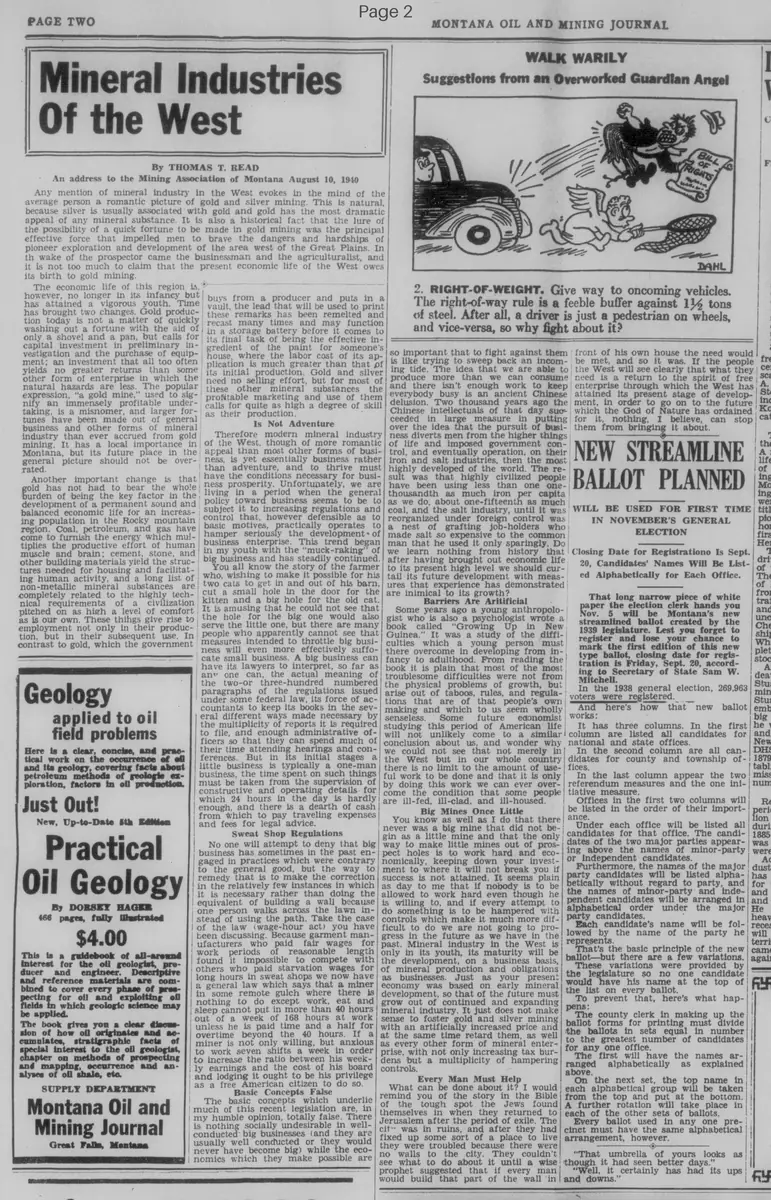
Any mention of mineral industry in the West evokes in the mind of the average person a romantic picture of gold and silver mining. This is natural, because silver is usually associated with gold and gold has the most dramatic appeal of any mineral substance. It is also a historical fact that the lure of the possibility of a quick fortune to be made in gold mining was the principal effective force that impelled men to brave the dangers and hardships of pioneer exploration and development of the area west of the Great Plains. In the wake of the prospector came the businessman and the agriculturalist, and it is not too much to claim that the present economic life of the West owes its birth to gold mining.
The economic life of this region is, however, no longer in its infancy but has attained a vigorous youth. Time has brought two changes. Gold production today is not a matter of quickly washing out a fortune with the aid of only a shovel and a pan, but calls for capital investment in preliminary investigation and the purchase of equipment: an investment that all too often yields no greater returns than some other form of enterprise in which the natural hazards are less. The popular expression, "a gold mine," used to signify an immensely profitable undertaking, is a misnomer, and larger fortunes have been made out of general business and other forms of mineral industry than ever accrued from gold mining. It has a local importance in Montana, but its future place in the general picture should not be overrated.
Another important change is that gold has not had to bear the whole burden of being the key factor in the development of a permanent sound and balanced economic life for an increasing population in the Rocky mountain region. Coal, petroleum, and gas have come to furnish the energy which multiplies the productive effort of human muscle and brain: cement, stone, and other building materials yield the structures needed for housing and facilitating human activity, and a long list of non-metallic mineral substances are completely related to the highly technical requirements of a civilization pitched on as high a level of comfort as is our own. These things give rise to employment not only in their production, but in their subsequent use. In contrast to gold, which the government buys from a producer and puts in a vault, the lead that will be used to print these remarks has been remelted and recast many times and may function in a storage battery before it comes to its final task of being the effective ingredient of the paint for someone's house, where the labor cost of its application is much greater than that of its initial production. Gold and silver need no selling effort, but for most of these other mineral substances the profitable marketing and use of them calls for quite as high a degree of skill as their production.
Is Not Adventure
Therefore modern mineral industry of the West, though of more romantic appeal than most other forms of business, is yet essentially business rather than adventure, and to thrive must have the conditions necessary for business prosperity. Unfortunately, we are living in a period when the general policy toward business seems to be to subject it to increasing regulations and control that, however defensible as to basic motives, practically operates to hamper seriously the development of business enterprise. This trend began in my youth with the "muck-raking" of big business and has steadily continued.
You all know the story of the farmer who, wishing to make it possible for his two cats to get in and out of his barn, cut a small hole in the door for the kitten and a big hole for the old cat. It is amusing that he could not see that the hole for the big one would also serve the little one, but there are many people who apparently cannot see that measures intended to throttle big business will even more effectively suffocate small business. A big business can have its lawyers to interpret, so far as any one can, the actual meaning of the two- or three-hundred numbered paragraphs of the regulations issued under some federal law, its force of accountants to keep its books in the several different ways made necessary by the multiplicity of reports it is required to file, and enough administrative officers so that they can spend much of their time attending hearings and conferences. But in its initial stages a little business is typically a one-man business, the time spent on such things must be taken from the supervision of constructive and operating details for which 24 hours in the day is hardly enough, and there is a dearth of cash from which to pay traveling expenses and fees for legal advice.
Sweat Shop Regulations
No one will attempt to deny that big business has sometimes in the past engaged in practices which were contrary to the general good, but the way to remedy that is to make the correction in the relatively few instances in which it is necessary rather than doing the equivalent of building a wall because one person walks across the lawn instead of using the path. Take the case of the law (wage-hour act) you have been discussing. Because garment manufacturers who paid fair wages for work periods of reasonable length found it impossible to compete with others who paid starvation wages for long hours in sweat shops we now have a general law which says that a miner in some remote gulch where there is nothing to do except work, eat and sleep cannot put in more than 40 hours out of a week of 168 hours at work unless he is paid time and a half for overtime beyond the 40 hours. If a miner is not only willing, but anxious to work seven shifts a week in order to increase the ratio between his weekly earnings and the cost of his board and lodging it ought to be his privilege as a free American citizen to do so.
Basic Concepts False
The basic concepts which underlie much of this recent legislation are, in my humble opinion, totally false. There is nothing socially undesirable in well-conducted big businesses (and they are usually well conducted or they would never have become big) while the economics which they make possible are so important that to fight against them is like trying to sweep back an incoming tide. The idea that we are able to produce more than we can consume and there isn't enough work to keep everybody busy is an ancient Chinese delusion. Two thousand years ago the Chinese intellectuals of that day succeeded in large measure in putting over the idea that the pursuit of business diverts men from the higher things of life and imposed government control, and eventually operation, on their iron and salt industries, then the most highly developed of the world. The result was that highly civilized people have been using less than one one-thousandth as much iron per capita as we do, about one-fifteenth as much coal, and the salt industry, until it was reorganized under foreign control was a nest of grafting job-holders who made salt so expensive to the common man that he used it only sparingly. Do we learn nothing from history that after having brought out economic life to its present high level we should curtail its future development with measures that experience has demonstrated are inimical to its growth?
Barriers Are Artificial
Some years ago a young anthropologist who is also a psychologist wrote a book called "Growing Up in New Guinea." It was a study of the difficulties which a young person must there overcome in developing from infancy to adulthood. From reading the book it is plain that most of the most troublesome difficulties were not from the physical problems of growth, but arise out of taboos, rules, and regulations that are of that people's own making and which to us seem wholly senseless. Some future economist studying this period of American life will not unlikely come to a similar conclusion about us, and wonder why we could not see that not merely in the West but in our whole country there is no limit to the amount of useful work to be done and that it is only by doing this work we can ever overcome the condition that some people are ill-fed, ill-clad, and ill-housed.
You know as well as I do that there never was a big mine that did not begin as a little mine and that the only way to make little mines out of prospect holes is to work hard and economically, keeping down your investment to where it will not break you if success is not attained. It seems plain as day to me that if nobody is to be allowed to work hard even though he is willing to, and if every attempt to do something is to be hampered with controls which make it much more difficult to do we are not going to progress in the future as we have in the past. Mineral industry in the West is only in its youth, its maturity will be the development, on a business basis, of mineral production and obligations as businesses. Just as your present economy was based on early mineral development, so that of the future must grow out of continued and expanding mineral industry. It just does not make sense to foster gold and silver mining with an artificially increased price and at the same time retard them, as well as every other form of mineral enterprise, with not only increasing tax burdens but a multiplicity of hampering controls.
Every Man Must Help
What can be done about it? I would remind you of the story in the Bible of the tough spot the Jews found themselves in when they returned to Jerusalem after the period of exile. The city was in ruins, and after they had fixed up some sort of a place to live they were troubled because there were no walls to the city. They couldn't see what to do about it until a wise prophet suggested that if every man would build that part of the wall in front of his own house the need would be met, and so it was. If the people of the West will see clearly that what they need is a return to the spirit of free enterprise through which the West has attained its present stage of development, in order to go on to the future which the God of Nature has ordained for it, nothing, I believe, can stop them from bringing it about.
What sub-type of article is it?
What keywords are associated?
What entities or persons were involved?
Where did it happen?
Domestic News Details
Primary Location
Montana
Event Date
1940 08 10
Key Persons
Event Details
Thomas T. Read addresses the Mining Association of Montana, discussing the historical and modern role of the mineral industry in the West's economy, critiquing government regulations and controls on business, particularly their impact on small mining operations, and advocating for free enterprise to ensure future growth.