Thank you for visiting SNEWPapers!
Sign up free
Editorial
April 6, 1904
The Wichita Daily Eagle
Wichita, Sedgwick County, Kansas
What is this article about?
A Washington correspondent critiques the rising support for William Randolph Hearst's presidential bid, attributing it to his newspapers' portrayal as a defender of workers against plutocracy, alarming congressional representatives from manufacturing areas who fear a campaign focused on trade union issues.
Clipping
OCR Quality
98%
Excellent
Full Text
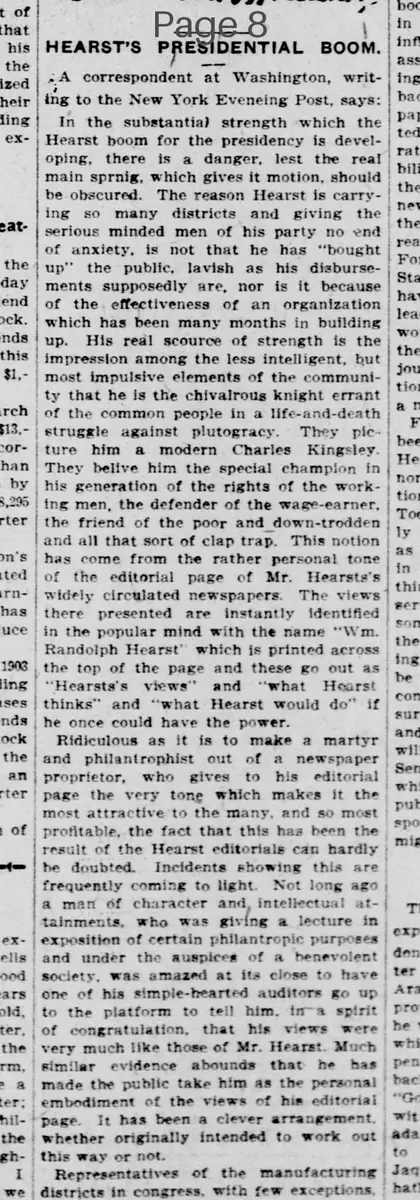
HEARST'S PRESIDENTIAL BOOM.
A correspondent at Washington, writing to the New York Evening Post, says:
In the substantial strength which the Hearst boom for the presidency is developing, there is a danger, lest the real main spring, which gives it motion, should be obscured. The reason Hearst is carrying so many districts and giving the serious minded men of his party no end of anxiety, is not that he has "bought up" the public, lavish as his disbursements supposedly are, nor is it because of the effectiveness of an organization which has been many months in building up. His real source of strength is the impression among the less intelligent, but most impulsive elements of the community that he is the chivalrous knight errant of the common people in a life-and-death struggle against plutocracy. They picture him a modern Charles Kingsley. They believe him the special champion in his generation of the rights of the working men, the defender of the wage-earner, the friend of the poor and down-trodden and all that sort of clap trap. This notion has come from the rather personal tone of the editorial page of Mr. Hearst's widely circulated newspapers. The views there presented are instantly identified in the popular mind with the name "Wm. Randolph Hearst" which is printed across the top of the page and these go out as "Hearst's views" and "what Hearst thinks" and "what Hearst would do" if he once could have the power.
Ridiculous as it is to make a martyr and philanthropist out of a newspaper proprietor, who gives to his editorial page the very tone which makes it the most attractive to the many, and so most profitable, the fact that this has been the result of the Hearst editorials can hardly be doubted. Incidents showing this are frequently coming to light. Not long ago a man of character and intellectual attainments, who was giving a lecture in exposition of certain philanthropic purposes and under the auspices of a benevolent society, was amazed at its close to have one of his simple-hearted auditors go up to the platform to tell him, in a spirit of congratulation, that his views were very much like those of Mr. Hearst. Much similar evidence abounds that he has made the public take him as the personal embodiment of the views of his editorial page. It has been a clever arrangement, whether originally intended to work out this way or not.
Representatives of the manufacturing districts in congress, with few exceptions, republicans and democrats alike, are viewing the possibility of the nomination of Hearst for the presidency with the utmost alarm. While they expect that in the country at large his reception would be even less cordial than that of Bryan in '96, they recognize that in strictly trade union centers Hearst would have sturdy support. The campaign, were he nominated, would turn largely on trade union issues. He is not much of a democrat, in the old sense, since he believes in expansion and in big military and naval academies; in the public ownership of all sorts of things, and generally in a platform more populistic and socialistic. His chief hold on the old-line democracy comes from his support of Bryan in '96 when nearly all the papers which felt any obligation of conscience turned away. He was "regular," and this is
A correspondent at Washington, writing to the New York Evening Post, says:
In the substantial strength which the Hearst boom for the presidency is developing, there is a danger, lest the real main spring, which gives it motion, should be obscured. The reason Hearst is carrying so many districts and giving the serious minded men of his party no end of anxiety, is not that he has "bought up" the public, lavish as his disbursements supposedly are, nor is it because of the effectiveness of an organization which has been many months in building up. His real source of strength is the impression among the less intelligent, but most impulsive elements of the community that he is the chivalrous knight errant of the common people in a life-and-death struggle against plutocracy. They picture him a modern Charles Kingsley. They believe him the special champion in his generation of the rights of the working men, the defender of the wage-earner, the friend of the poor and down-trodden and all that sort of clap trap. This notion has come from the rather personal tone of the editorial page of Mr. Hearst's widely circulated newspapers. The views there presented are instantly identified in the popular mind with the name "Wm. Randolph Hearst" which is printed across the top of the page and these go out as "Hearst's views" and "what Hearst thinks" and "what Hearst would do" if he once could have the power.
Ridiculous as it is to make a martyr and philanthropist out of a newspaper proprietor, who gives to his editorial page the very tone which makes it the most attractive to the many, and so most profitable, the fact that this has been the result of the Hearst editorials can hardly be doubted. Incidents showing this are frequently coming to light. Not long ago a man of character and intellectual attainments, who was giving a lecture in exposition of certain philanthropic purposes and under the auspices of a benevolent society, was amazed at its close to have one of his simple-hearted auditors go up to the platform to tell him, in a spirit of congratulation, that his views were very much like those of Mr. Hearst. Much similar evidence abounds that he has made the public take him as the personal embodiment of the views of his editorial page. It has been a clever arrangement, whether originally intended to work out this way or not.
Representatives of the manufacturing districts in congress, with few exceptions, republicans and democrats alike, are viewing the possibility of the nomination of Hearst for the presidency with the utmost alarm. While they expect that in the country at large his reception would be even less cordial than that of Bryan in '96, they recognize that in strictly trade union centers Hearst would have sturdy support. The campaign, were he nominated, would turn largely on trade union issues. He is not much of a democrat, in the old sense, since he believes in expansion and in big military and naval academies; in the public ownership of all sorts of things, and generally in a platform more populistic and socialistic. His chief hold on the old-line democracy comes from his support of Bryan in '96 when nearly all the papers which felt any obligation of conscience turned away. He was "regular," and this is
What sub-type of article is it?
Partisan Politics
Labor
Economic Policy
What keywords are associated?
Hearst Boom
Presidential Nomination
Plutocracy
Working Men
Trade Unions
Populism
Socialism
What entities or persons were involved?
Wm. Randolph Hearst
Bryan
Hearst's Newspapers
Representatives Of Manufacturing Districts
Trade Unions
Editorial Details
Primary Topic
Critique Of Hearst's Presidential Boom And Public Image
Stance / Tone
Critical And Alarmed
Key Figures
Wm. Randolph Hearst
Bryan
Hearst's Newspapers
Representatives Of Manufacturing Districts
Trade Unions
Key Arguments
Hearst's Strength Derives From His Image As A Champion Of The Common People Against Plutocracy
This Image Stems From The Personal Tone Of His Newspapers' Editorials
Public Confuses Editorial Views With Hearst's Personal Beliefs
Manufacturing District Representatives View His Potential Nomination With Alarm
Hearst Would Garner Support In Trade Union Centers
His Platform Is Populistic And Socialistic, Supporting Expansion And Big Military
His Hold On Old Line Democracy From Supporting Bryan In 1896