Thank you for visiting SNEWPapers!
Sign up free
Story
February 29, 1892
The Evening Bulletin
Maysville, Mason County, Kentucky
What is this article about?
During the Indianapolis street car strike on February 29, police attempts to run cars amid strikers lead to riots, violence, arrests, and injuries. Authorities plan to swear in 1,000 special policemen for Monday, while labor unions support the strikers.
Clipping
OCR Quality
98%
Excellent
Full Text
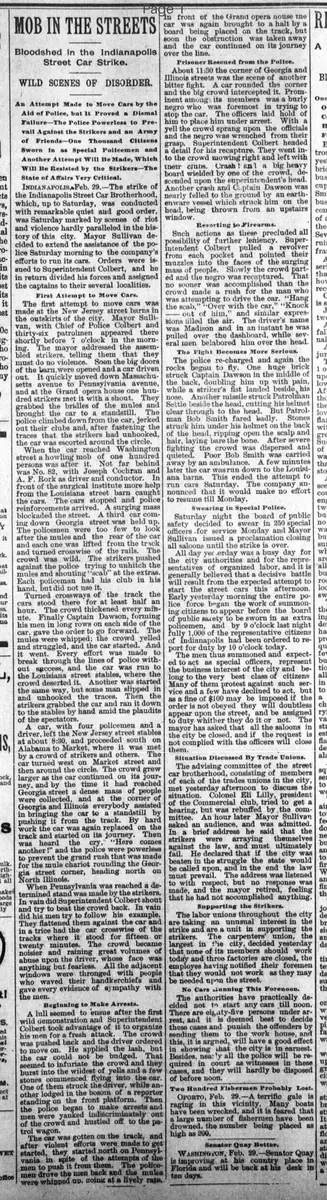
MOB IN THE STREETS
Bloodshed in the Indianapolis Street Car Strike.
WILD SCENES OF DISORDER.
An Attempt Made to Move Cars by the Aid of Police, but It Proved a Dismal Failure-The Police Powerless to Prevail Against the Strikers and an Army of Friends-One Thousand Citizens Sworn in as Special Policemen and Another Attempt Will Be Made, Which Will Be Resisted by the Strikers-The State of Affairs Very Critical.
INDIANAPOLIS, Feb. 29.-The strike of the Indianapolis Street Car Brotherhood which, up to Saturday, was conducted with remarkable quiet and good order, was Saturday marked by scenes of riot and violence hardly paralleled in the history of this city. Mayor Sullivan decided to extend the assistance of the police Saturday morning to the company's efforts to run its cars. Orders were issued to Superintendent Colbert, and he in return divided his forces and assigned the captains to their several localities.
First Attempt to Move Cars.
The first attempt to move cars was made at the New Jersey street barns in the outskirts of the city. Mayor Sullivan, with Chief of Police Colbert and thirty-six patrolmen appeared there shortly before 7 o'clock in the morning. The mayor addressed the assembled strikers, telling them that they must do no violence. Soon the big doors of the barn were opened and a car driven out. It quickly moved down Massachusetts avenue to Pennsylvania avenue, and at the Grand opera house one hundred strikers met it with a shout. They grabbed the bridles of the mules and brought the car to a standstill. The police climbed down from the car, jerked out their clubs and, after fastening the traces that the strikers had unhooked, the car was escorted around the circle.
When the car reached Washington street a howling mob of one hundred persons was after it. Not far behind was No. 82, with Joseph Cochran and A. F. Rork as driver and conductor. In front of the surgical institute more help from the Louisiana street barn caught the cars. The cars stopped and police reinforcements arrived. "A surging mass blockaded the street. A third car coming down Georgia street was held up. The policemen were too few to look after the mules and the rear of the car and each one was lifted from the track and turned crosswise of the rails. The crowd was wild. The strikers pushed against the police trying to unhitch the mules and shouting 'scab' at the extras. Each policeman had his club in his hand, but did not use it.
Turned crossways of the track the cars stood there for at least half an hour. The crowd thickened every minute. Finally Captain Dawson, forming his men in long rows on each side of the car, gave the order to go forward. The mules were whipped; the crowd yelled and struggled, and the car started. And it went. Every effort was made to break through the lines of police without success, and the car was run to the Louisiana street stables, where the crowd deserted it. Another was started the same way, but some man slipped in and unhooked the traces. Then the strikers grabbed the car and ran it down to the stables by hand amid the plaudits of the spectators.
A car, with four policemen and a driver, left the New Jersey street stables at about 8:30, and proceeded south on Alabama to Market, where it was met by a crowd of strikers and others. The car turned west on Market street and then around the circle. The crowd grew larger as the car continued on its journey, and by the time it had reached Georgia street a dense mass of people were collected, and at the corner of Georgia and Illinois everybody assisted in bringing the car to a standstill by pushing it from the track. By hard work the car was again replaced on the track and started on its journey. Then was heard the cry, "Here comes another!" and the police were powerless to prevent the grand rush that was made for the mule chariot rounding the Georgia street corner, heading north on North Illinois.
When Pennsylvania was reached a determined stand was made by the strikers. In vain did Superintendent Colbert shout and try to beat the crowd back. In vain did his men try to follow his example. They flattened them against the car and in a trice had the car crosswise of the tracks where it stood for fifteen or twenty minutes. The crowd became noisier and raining great volumes of abuse upon the driver, whose face was anything but fearless. All the adjacent windows were thronged with people who waved their handkerchiefs and gave every evidence of sympathy with the men.
Beginning to Make Arrests.
A lull seemed to ensue after the first wild demonstration and Superintendent Colbert took advantage of it to organize his men for a fresh attack. The crowd was pushed back and the driver ordered to move on. He applied the lash, but the car could not be budged. That seemed to infuriate the crowd and they burst into the wildest of yells and a few stones commenced flying into the car. One of them struck the driver, while another lodged in the bosom of a reporter standing on the front platform. Then the police began to make arrests and men were yanked indiscriminately out of the crowd and hustled off to the patrol wagon.
The car was gotten on the track, and after violent efforts were made to get started, they started north on Pennsylvania in spite of the attempts of the men to push it from them. The policemen drove the men back and the mules were whipped up, going at a lively rate.
In front of the Grand opera house the car was again brought to a halt by a board being placed on the track, but soon the obstruction was taken away and the car continued on its journey over the line.
Prisoner Rescued from the Police.
About 11:30 the corner of Georgia and Illinois streets was the scene of another bitter fight. A car rounded the corner and the big crowd intercepted it. Prominent among its members was a burly negro who was foremost in trying to stop the car. The officers laid hold of him to place him under arrest. With a yell the crowd sprang upon the officials and the negro was wrenched from their grasp. Superintendent Colbert headed a detail for his recapture. They went into the crowd mowing right and left with their clubs. Crash! and a big heavy board wielded by one of the crowd, descended upon the superintendent's head. Another crash and Captain Dawson was nearly felled to the ground by an earthenware vessel which struck him on the head, being thrown from an upstairs window.
Resorting to Firearms.
Such actions as these precluded all possibility of further leniency. Superintendent Colbert pulled a revolver from each pocket and pointed their muzzles into the faces of the surging mass of people. Slowly the crowd parted and the negro was recaptured. That no sooner was accomplished than the crowd made a rush for the man who was attempting to drive the car. "Hang the scab," "Over with the car," "Knock out of him," and similar expressions filled the air. The driver's name was Madison and in an instant he was pulled over the dashboard, while several men belabored him over the head.
The Fight Becomes More Serious.
The police re-charged and again the rocks began to fly. One huge brick struck Captain Dawson in the middle of the back, doubling him up with pain, while a striker's fist landed beside his nose. Another missile struck Patrolman Settle beside the head, cutting his helmet clear through to the head. But Patrolman Bob Smith fared badly. Stones struck him under his helmet on the back of his head, ripping open the scalp and hair, laying bare the bone. After severe fighting the crowd was dispersed and quieted. Poor Bob Smith was carried away by an ambulance. A few minutes later the car was run down to the Louisiana barns. This ended the attempt to run cars Saturday. The company announced that it would make no effort to resume till Monday.
Swearing in Special Police.
Saturday night the board of public safety decided to swear in 250 special officers for service Monday and Mayor Sullivan issued a proclamation closing all saloons until the strike is over.
All day yesterday was a busy day for the city authorities and for the representatives of organized labor, and it is generally believed that a decisive battle will result from the expected attempt to start the street cars this afternoon.
Early yesterday morning the entire police force began the work of summoning citizens to appear before the board of public safety to be sworn in as extra policemen, and by 9 o'clock last night fully 1,000 of the representative citizens of Indianapolis had been ordered to report for duty by 10 o'clock today.
The men thus summoned and expected to act as special officers, represent the business interest of the city and belong to the very best class of citizens. Many of them protest against such service and a few have declined to act, but as a fine of $100 may be imposed if the order is not obeyed they will doubtless appear upon the street, and be assigned to duty whether they do it or not. The mayor has asked that all the saloons in the city be closed, and if the request is not complied with the officers will close them.
Situation Discussed By Trade Unions.
The advising committee of the street car brotherhood, consisting of members of each of the trades unions in the city, met yesterday afternoon to discuss the situation. Colonel Eli Lilly, president of the Commercial club, tried to get a hearing, but was rebuffed by the committee. An hour later Mayor Sullivan asked an audience, and was admitted. In a brief address he said that the strikers were arraying themselves against the law, and must ultimately fail. He declared that if the city was beaten in the struggle the state would be called upon, and in the end the law must prevail. The address was listened to with respect, but no response was made, and the mayor retired, feeling that he had not accomplished anything.
Supporting the Strikers.
The labor unions throughout the city are taking an unusual interest in the strike and are a unit in supporting the strikers. The carpenters' union, the largest in the city, decided yesterday that none of its members should work today and three factories are closed, the employes having notified their foremen that they would not work as they may be needed upon the street.
No Cars Running This Forenoon.
The authorities have practically decided not to start any cars till noon. There are eighty-five persons under arrest, and it is deemed best to decide these cases and punish the offenders by sending them to the work house, and this, it is argued, will have a good effect in showing that the city is in earnest. Besides, nearly all the police will be required in court as witnesses in these cases, and they will hardly be disposed of before noon.
Bloodshed in the Indianapolis Street Car Strike.
WILD SCENES OF DISORDER.
An Attempt Made to Move Cars by the Aid of Police, but It Proved a Dismal Failure-The Police Powerless to Prevail Against the Strikers and an Army of Friends-One Thousand Citizens Sworn in as Special Policemen and Another Attempt Will Be Made, Which Will Be Resisted by the Strikers-The State of Affairs Very Critical.
INDIANAPOLIS, Feb. 29.-The strike of the Indianapolis Street Car Brotherhood which, up to Saturday, was conducted with remarkable quiet and good order, was Saturday marked by scenes of riot and violence hardly paralleled in the history of this city. Mayor Sullivan decided to extend the assistance of the police Saturday morning to the company's efforts to run its cars. Orders were issued to Superintendent Colbert, and he in return divided his forces and assigned the captains to their several localities.
First Attempt to Move Cars.
The first attempt to move cars was made at the New Jersey street barns in the outskirts of the city. Mayor Sullivan, with Chief of Police Colbert and thirty-six patrolmen appeared there shortly before 7 o'clock in the morning. The mayor addressed the assembled strikers, telling them that they must do no violence. Soon the big doors of the barn were opened and a car driven out. It quickly moved down Massachusetts avenue to Pennsylvania avenue, and at the Grand opera house one hundred strikers met it with a shout. They grabbed the bridles of the mules and brought the car to a standstill. The police climbed down from the car, jerked out their clubs and, after fastening the traces that the strikers had unhooked, the car was escorted around the circle.
When the car reached Washington street a howling mob of one hundred persons was after it. Not far behind was No. 82, with Joseph Cochran and A. F. Rork as driver and conductor. In front of the surgical institute more help from the Louisiana street barn caught the cars. The cars stopped and police reinforcements arrived. "A surging mass blockaded the street. A third car coming down Georgia street was held up. The policemen were too few to look after the mules and the rear of the car and each one was lifted from the track and turned crosswise of the rails. The crowd was wild. The strikers pushed against the police trying to unhitch the mules and shouting 'scab' at the extras. Each policeman had his club in his hand, but did not use it.
Turned crossways of the track the cars stood there for at least half an hour. The crowd thickened every minute. Finally Captain Dawson, forming his men in long rows on each side of the car, gave the order to go forward. The mules were whipped; the crowd yelled and struggled, and the car started. And it went. Every effort was made to break through the lines of police without success, and the car was run to the Louisiana street stables, where the crowd deserted it. Another was started the same way, but some man slipped in and unhooked the traces. Then the strikers grabbed the car and ran it down to the stables by hand amid the plaudits of the spectators.
A car, with four policemen and a driver, left the New Jersey street stables at about 8:30, and proceeded south on Alabama to Market, where it was met by a crowd of strikers and others. The car turned west on Market street and then around the circle. The crowd grew larger as the car continued on its journey, and by the time it had reached Georgia street a dense mass of people were collected, and at the corner of Georgia and Illinois everybody assisted in bringing the car to a standstill by pushing it from the track. By hard work the car was again replaced on the track and started on its journey. Then was heard the cry, "Here comes another!" and the police were powerless to prevent the grand rush that was made for the mule chariot rounding the Georgia street corner, heading north on North Illinois.
When Pennsylvania was reached a determined stand was made by the strikers. In vain did Superintendent Colbert shout and try to beat the crowd back. In vain did his men try to follow his example. They flattened them against the car and in a trice had the car crosswise of the tracks where it stood for fifteen or twenty minutes. The crowd became noisier and raining great volumes of abuse upon the driver, whose face was anything but fearless. All the adjacent windows were thronged with people who waved their handkerchiefs and gave every evidence of sympathy with the men.
Beginning to Make Arrests.
A lull seemed to ensue after the first wild demonstration and Superintendent Colbert took advantage of it to organize his men for a fresh attack. The crowd was pushed back and the driver ordered to move on. He applied the lash, but the car could not be budged. That seemed to infuriate the crowd and they burst into the wildest of yells and a few stones commenced flying into the car. One of them struck the driver, while another lodged in the bosom of a reporter standing on the front platform. Then the police began to make arrests and men were yanked indiscriminately out of the crowd and hustled off to the patrol wagon.
The car was gotten on the track, and after violent efforts were made to get started, they started north on Pennsylvania in spite of the attempts of the men to push it from them. The policemen drove the men back and the mules were whipped up, going at a lively rate.
In front of the Grand opera house the car was again brought to a halt by a board being placed on the track, but soon the obstruction was taken away and the car continued on its journey over the line.
Prisoner Rescued from the Police.
About 11:30 the corner of Georgia and Illinois streets was the scene of another bitter fight. A car rounded the corner and the big crowd intercepted it. Prominent among its members was a burly negro who was foremost in trying to stop the car. The officers laid hold of him to place him under arrest. With a yell the crowd sprang upon the officials and the negro was wrenched from their grasp. Superintendent Colbert headed a detail for his recapture. They went into the crowd mowing right and left with their clubs. Crash! and a big heavy board wielded by one of the crowd, descended upon the superintendent's head. Another crash and Captain Dawson was nearly felled to the ground by an earthenware vessel which struck him on the head, being thrown from an upstairs window.
Resorting to Firearms.
Such actions as these precluded all possibility of further leniency. Superintendent Colbert pulled a revolver from each pocket and pointed their muzzles into the faces of the surging mass of people. Slowly the crowd parted and the negro was recaptured. That no sooner was accomplished than the crowd made a rush for the man who was attempting to drive the car. "Hang the scab," "Over with the car," "Knock out of him," and similar expressions filled the air. The driver's name was Madison and in an instant he was pulled over the dashboard, while several men belabored him over the head.
The Fight Becomes More Serious.
The police re-charged and again the rocks began to fly. One huge brick struck Captain Dawson in the middle of the back, doubling him up with pain, while a striker's fist landed beside his nose. Another missile struck Patrolman Settle beside the head, cutting his helmet clear through to the head. But Patrolman Bob Smith fared badly. Stones struck him under his helmet on the back of his head, ripping open the scalp and hair, laying bare the bone. After severe fighting the crowd was dispersed and quieted. Poor Bob Smith was carried away by an ambulance. A few minutes later the car was run down to the Louisiana barns. This ended the attempt to run cars Saturday. The company announced that it would make no effort to resume till Monday.
Swearing in Special Police.
Saturday night the board of public safety decided to swear in 250 special officers for service Monday and Mayor Sullivan issued a proclamation closing all saloons until the strike is over.
All day yesterday was a busy day for the city authorities and for the representatives of organized labor, and it is generally believed that a decisive battle will result from the expected attempt to start the street cars this afternoon.
Early yesterday morning the entire police force began the work of summoning citizens to appear before the board of public safety to be sworn in as extra policemen, and by 9 o'clock last night fully 1,000 of the representative citizens of Indianapolis had been ordered to report for duty by 10 o'clock today.
The men thus summoned and expected to act as special officers, represent the business interest of the city and belong to the very best class of citizens. Many of them protest against such service and a few have declined to act, but as a fine of $100 may be imposed if the order is not obeyed they will doubtless appear upon the street, and be assigned to duty whether they do it or not. The mayor has asked that all the saloons in the city be closed, and if the request is not complied with the officers will close them.
Situation Discussed By Trade Unions.
The advising committee of the street car brotherhood, consisting of members of each of the trades unions in the city, met yesterday afternoon to discuss the situation. Colonel Eli Lilly, president of the Commercial club, tried to get a hearing, but was rebuffed by the committee. An hour later Mayor Sullivan asked an audience, and was admitted. In a brief address he said that the strikers were arraying themselves against the law, and must ultimately fail. He declared that if the city was beaten in the struggle the state would be called upon, and in the end the law must prevail. The address was listened to with respect, but no response was made, and the mayor retired, feeling that he had not accomplished anything.
Supporting the Strikers.
The labor unions throughout the city are taking an unusual interest in the strike and are a unit in supporting the strikers. The carpenters' union, the largest in the city, decided yesterday that none of its members should work today and three factories are closed, the employes having notified their foremen that they would not work as they may be needed upon the street.
No Cars Running This Forenoon.
The authorities have practically decided not to start any cars till noon. There are eighty-five persons under arrest, and it is deemed best to decide these cases and punish the offenders by sending them to the work house, and this, it is argued, will have a good effect in showing that the city is in earnest. Besides, nearly all the police will be required in court as witnesses in these cases, and they will hardly be disposed of before noon.
What sub-type of article is it?
Historical Event
What themes does it cover?
Justice
Misfortune
What keywords are associated?
Street Car Strike
Indianapolis Riot
Police Clashes
Strikers Resistance
Special Policemen
Labor Unions Support
What entities or persons were involved?
Mayor Sullivan
Superintendent Colbert
Captain Dawson
Colonel Eli Lilly
Where did it happen?
Indianapolis
Story Details
Key Persons
Mayor Sullivan
Superintendent Colbert
Captain Dawson
Colonel Eli Lilly
Location
Indianapolis
Event Date
February 29
Story Details
Police attempts to run street cars during the Indianapolis Street Car Brotherhood strike lead to violent clashes with strikers and crowds, resulting in cars being derailed, arrests, injuries to officers, and a rescued prisoner. Authorities plan to swear in 1,000 special policemen and close saloons, while labor unions support the strikers.