Thank you for visiting SNEWPapers!
Sign up free
Pullman Herald
Pullman, Whitman County, Washington
What is this article about?
Detailed account of the first day of the Battle of the Sea of Japan, where Japanese forces defeated the Russian fleet through precise gunnery targeting flagships, sinking several battleships including Kniaz Souvaroff, Osliabia, Alexander III., and Borodino, and persistent torpedo attacks that broke up the Russian formation.
Clipping
OCR Quality
Full Text
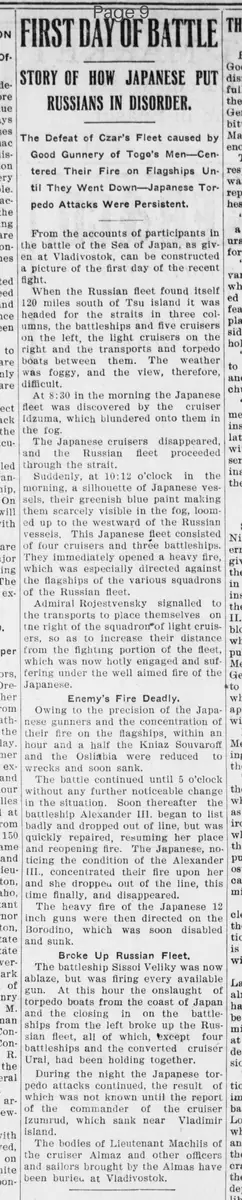
STORY OF HOW JAPANESE PUT
RUSSIANS IN DISORDER,
The Defeat of Czar's Fleet caused by Good Gunnery of Togo's Men--Centered Their Fire on Flagships Until They Went Down--Japanese Torpedo Attacks Were Persistent.
From the accounts of participants in the battle of the Sea of Japan, as given at Vladivostok, can be constructed a picture of the first day of the recent fight.
When the Russian fleet found itself 120 miles south of Tsu island it was headed for the straits in three columns, the battleships and five cruisers on the left, the light cruisers on the right and the transports and torpedo boats between them. The weather was foggy, and the view, therefore, difficult.
At 8:30 in the morning the Japanese fleet was discovered by the cruiser Idzuma, which blundered onto them in the fog.
The Japanese cruisers disappeared, and the Russian fleet proceeded through the strait.
Suddenly, at 10:12 o'clock in the morning, a silhouette of Japanese vessels, their greenish blue paint making them scarcely visible in the fog, loomed up to the westward of the Russian vessels. This Japanese fleet consisted of four cruisers and three battleships. They immediately opened a heavy fire, which was especially directed against the flagships of the various squadrons of the Russian fleet.
Admiral Rojestvensky signalled to the transports to place themselves on the right of the squadron of light cruisers, so as to increase their distance from the fighting portion of the fleet, which was now hotly engaged and suffering under the well aimed fire of the Japanese.
Enemy's Fire Deadly.
Owing to the precision of the Japanese gunners and the concentration of their fire on the flagships, within an hour and a half the Kniaz Souvaroff and the Osliabia were reduced to wrecks and soon sank.
The battle continued until 5 o'clock without any further noticeable change in the situation. Soon thereafter the battleship Alexander III. began to list badly and dropped out of line, but was quickly repaired, resuming her place and reopening fire. The Japanese, noticing the condition of the Alexander III., concentrated their fire upon her and she dropped out of the line, this time finally, and disappeared.
The heavy fire of the Japanese 12 inch guns were then directed on the Borodino, which was soon disabled and sunk.
Broke Up Russian Fleet,
The battleship Sissoi Veliky was now ablaze, but was firing every available gun. At this hour the onslaught of torpedo boats from the coast of Japan and the closing in on the battleships from the left broke up the Russian fleet, all of which, except four battleships and the converted cruiser Ural, had been holding together.
During the night the Japanese torpedo attacks continued, the result of which was not known until the report of the commander of the cruiser Izumrud, which sank near Vladimir island.
The bodies of Lieutenant Machlis of the cruiser Almaz and other officers and sailors brought by the Almas have been buried at Vladivostok.
What sub-type of article is it?
What keywords are associated?
What entities or persons were involved?
Where did it happen?
Foreign News Details
Primary Location
Sea Of Japan, Tsu Island
Event Date
First Day Of The Recent Fight
Key Persons
Outcome
kniaz souvaroff and osliabia sunk within an hour and a half; alexander iii. disabled and disappeared; borodino disabled and sunk; sissoi veliky ablaze; russian fleet broken up except four battleships and ural; izumrud sank near vladimir island; bodies of lieutenant machlis and others buried at vladivostok
Event Details
Russian fleet in three columns encountered Japanese fleet in fog south of Tsu island; Japanese opened fire at 10:12 a.m. targeting flagships; precise gunnery sank key ships; battle until 5 p.m.; torpedo attacks at night; accounts from Vladivostok participants