Thank you for visiting SNEWPapers!
Sign up free
Letter to Editor
November 6, 1801
Alexandria Advertiser And Commercial Intelligencer
Alexandria, Virginia
What is this article about?
A pseudonymous letter praises publications criticizing Thomas Jefferson's dismissal of officials based on political views, contrasts it with James Monroe's recall by George Washington, and includes extracts from Monroe's 1797 letters to Timothy Pickering decrying executive removal powers as unconstitutional.
Clipping
OCR Quality
95%
Excellent
Full Text
FROM THE WASHINGTON FEDERALIST.
Messrs. Printers,
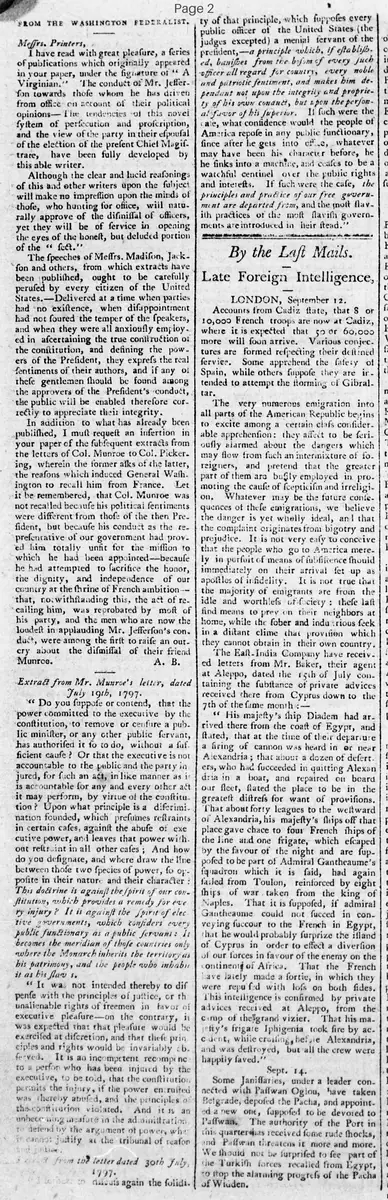
I have read with great pleasure, a series of publications which originally appeared in your paper, under the signature of "A Virginian." The conduct of Mr. Jefferson towards those whom he has driven from office on account of their political opinions--The tendencies of this novel system of persecution and proscription, and the views of the party in their espousal of the election of the present Chief Magistrate, have been fully developed by this able writer.
Although the clear and lucid reasonings of this and other writers upon the subject will make no impression upon the minds of those, who hunting for office, will naturally approve of the dismission of officers, yet they will be of service in opening the eyes of the honest, but deluded portion of the "sect."
The speeches of Messrs. Madison, Jackson and others, from which extracts have been published, ought to be carefully perused by every citizen of the United States.--Delivered at a time when parties had no existence, when disappointment had not soured the temper of the speakers, and when they were all anxiously employed in ascertaining the true construction of the constitution, and defining the powers of the President, they express the real sentiments of their authors, and if any of these gentlemen should be found among the approvers of the President's conduct, the public will be enabled therefore correctly to appreciate their integrity.
In addition to what has already been published, I must request an insertion in your paper of the subsequent extracts from the letters of Col. Monroe to Col. Pickering, wherein the former asks of the latter, the reasons which induced General Washington to recall him from France. Let it be remembered, that Col. Monroe was not recalled because his political sentiments were different from those of the then President. but because his conduct as the representative of our government had proved him totally unfit for the mission to which he had been appointed--because he had attempted to sacrifice the honor, the dignity, and independence of our country at the Shrine of French ambition-- that, notwithstanding this, the act of recalling him, was reprobated by most of his party, and the men who are now the loudest in applauding Mr. Jefferson's conduct, were among the first to raise an outcry about the dismission of their friend Monroe.
A. B.
Extract from Mr. Monroe's letter, dated July 19th, 1797.
* Do you suppose or contend, that the power committed to the executive by the constitution, to remove or censure a public minister, or any other public servant, has authorized it so to do, without a sufficient cause? Or that the executive is not accountable to the public and the party injured, for such an act, in like manner as it is accountable for any and every other act it may perform, by virtue of the constitution? Upon what principle is a discrimination founded, which presumes restraints in certain cases, against the abuse of executive power, and leaves that power without restraint in all other cases; And how do you designate, and where draw the line between those two species of power, so opposite in their nature and their character: This doctrine is against the spirit of our constitution, which provides a remedy for every injury? It is against the Spirit of elective governments, which considers every public functionary as a public servant: It becomes the meridian of those countries only where the Monarch inherits the territory as his patrimony, and the people who inhabit it as his slaves.
" It was not intended thereby to dispense with the principles of justice, or the unalienable rights of freemen in favor of executive pleasure-on the contrary, it was expected that that pleasure would be exercised at discretion, and that these principles and rights would be invariably observed. It is an incompetent recompense to a person who has been injured by the executive, to be told, that the constitution permits the injury, if the power entrusted was thereby abused, and the principles of the constitution violated. And it is an unbecoming measure in the administration to defend it by the argument of power, which cannot justify at the tribunal of reason and justice."
Extract from the letter dated 20th July 1797:
I do not wish to discuss again the solidity.
Messrs. Printers,
I have read with great pleasure, a series of publications which originally appeared in your paper, under the signature of "A Virginian." The conduct of Mr. Jefferson towards those whom he has driven from office on account of their political opinions--The tendencies of this novel system of persecution and proscription, and the views of the party in their espousal of the election of the present Chief Magistrate, have been fully developed by this able writer.
Although the clear and lucid reasonings of this and other writers upon the subject will make no impression upon the minds of those, who hunting for office, will naturally approve of the dismission of officers, yet they will be of service in opening the eyes of the honest, but deluded portion of the "sect."
The speeches of Messrs. Madison, Jackson and others, from which extracts have been published, ought to be carefully perused by every citizen of the United States.--Delivered at a time when parties had no existence, when disappointment had not soured the temper of the speakers, and when they were all anxiously employed in ascertaining the true construction of the constitution, and defining the powers of the President, they express the real sentiments of their authors, and if any of these gentlemen should be found among the approvers of the President's conduct, the public will be enabled therefore correctly to appreciate their integrity.
In addition to what has already been published, I must request an insertion in your paper of the subsequent extracts from the letters of Col. Monroe to Col. Pickering, wherein the former asks of the latter, the reasons which induced General Washington to recall him from France. Let it be remembered, that Col. Monroe was not recalled because his political sentiments were different from those of the then President. but because his conduct as the representative of our government had proved him totally unfit for the mission to which he had been appointed--because he had attempted to sacrifice the honor, the dignity, and independence of our country at the Shrine of French ambition-- that, notwithstanding this, the act of recalling him, was reprobated by most of his party, and the men who are now the loudest in applauding Mr. Jefferson's conduct, were among the first to raise an outcry about the dismission of their friend Monroe.
A. B.
Extract from Mr. Monroe's letter, dated July 19th, 1797.
* Do you suppose or contend, that the power committed to the executive by the constitution, to remove or censure a public minister, or any other public servant, has authorized it so to do, without a sufficient cause? Or that the executive is not accountable to the public and the party injured, for such an act, in like manner as it is accountable for any and every other act it may perform, by virtue of the constitution? Upon what principle is a discrimination founded, which presumes restraints in certain cases, against the abuse of executive power, and leaves that power without restraint in all other cases; And how do you designate, and where draw the line between those two species of power, so opposite in their nature and their character: This doctrine is against the spirit of our constitution, which provides a remedy for every injury? It is against the Spirit of elective governments, which considers every public functionary as a public servant: It becomes the meridian of those countries only where the Monarch inherits the territory as his patrimony, and the people who inhabit it as his slaves.
" It was not intended thereby to dispense with the principles of justice, or the unalienable rights of freemen in favor of executive pleasure-on the contrary, it was expected that that pleasure would be exercised at discretion, and that these principles and rights would be invariably observed. It is an incompetent recompense to a person who has been injured by the executive, to be told, that the constitution permits the injury, if the power entrusted was thereby abused, and the principles of the constitution violated. And it is an unbecoming measure in the administration to defend it by the argument of power, which cannot justify at the tribunal of reason and justice."
Extract from the letter dated 20th July 1797:
I do not wish to discuss again the solidity.
What sub-type of article is it?
Political
Persuasive
Historical
What themes does it cover?
Politics
Constitutional Rights
What keywords are associated?
Jefferson
Monroe
Washington
Political Dismissal
Executive Power
Constitution
Hypocrisy
What entities or persons were involved?
A. B.
Messrs. Printers
Letter to Editor Details
Author
A. B.
Recipient
Messrs. Printers
Main Argument
the letter defends george washington's recall of james monroe from france as justified by misconduct, contrasts it with thomas jefferson's politically motivated dismissals, and uses monroe's own past criticisms of executive removal powers to expose hypocrisy among jefferson's supporters.
Notable Details
References Series By 'A Virginian' On Jefferson's Persecutions
Mentions Speeches By Madison And Jackson On Constitutional Powers
Extracts From Monroe's 1797 Letters To Pickering Criticizing Executive Removal Without Cause