Thank you for visiting SNEWPapers!
Sign up free
Alexandria Daily Advertiser
Alexandria, Virginia
What is this article about?
British naval and military forces under Sir Samuel Hood and General Beresford arrived at Madeira on December 24, 1807, disembarked troops, and peacefully occupied Funchal and the island without resistance. Capitulation signed on December 26, ceding the island to Britain; Portuguese officials took oath of allegiance on January 1, 1808.
Clipping
OCR Quality
Full Text
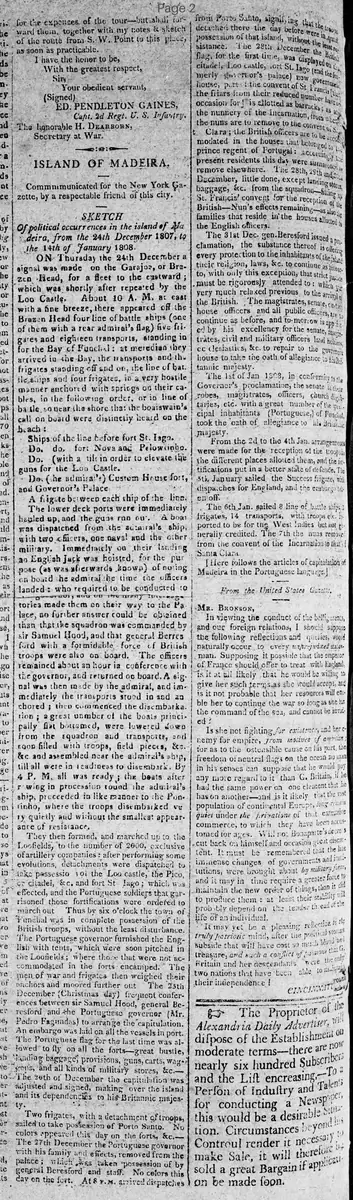
Communicated for the New York Gazette, by a respectable friend of this city.
SKETCH
Of political occurrences in the island of Madeira, from the 24th December 1807, to the 14th of January 1808.
ON Thursday the 24th December a signal was made on the Garajao, or Brazen Head, for a fleet to the eastward; which was shortly after repeated by the Loo Castle. About 10 A.M. east with a fine breeze, there appeared off the Brazen Head our line of battle ships (one of them with a rear admiral's flag) five frigates and eighteen transports, standing in for the Bay of Funchal: at meridian they arrived in the Bay, the transports and the frigates standing off and on, the line of battle ships and four frigates, in a very hostile manner anchored with springs on their cables, in the following order, or in line of battle so near the shore that the boatswain's call on board were distinctly heard on the beach:
Ships of the line before fort St. Iago.
Do. do. fort Nova and Pelorinho.
Do. (with a tilt in order to elevate the guns for the Loo Castle.)
Do. (the admiral's) Custom House, and Governor's Palace.
A frigate between each ship of the line.
The lower deck ports were immediately hauled up, and the guns ran out. A boat was dispatched from the admiral's ship, with two officers, one naval and the other military. Immediately on their landing an English jack was hoisted, for the purpose (as was afterwards known) of noting on board the admiral the time the officers landed: who required to be conducted to the Governor's house. No further answer could be obtained than that the squadron was commanded by sir Samuel Hood, and that general Beresford with a formidable force of British troops were also on board. The officers remained about an hour in conference with the governor, and returned on board. A signal was then made by the admiral, and immediately the transports stood in and anchored; then commenced the disembarkation: a great number of the boats principally flat bottomed, were lowered down from the squadron and transports, and soon filled with troops, field pieces, &c. &c. and assembled near the admiral's ship, till all were in readiness to disembark. By 4 P.M. all was ready: the boats after rowing in procession round the admiral's ship, proceeded in like manner to the Pontinha, where the troops disembarked very quietly and without the smallest appearance of resistance. They then formed, and marched up to the Loo fields, to the number of 2000, exclusive of artillery companies: after performing some evolutions, detachments were dispatched to take possession of the Loo castle, the Pico, or citadel, &c. and fort St. Iago; which was effected, and the Portuguese soldiers that garrisoned those fortifications were ordered to march out. Thus by six o'clock the town of Funchal was in complete possession of the British troops, without the least disturbance. The Portuguese governor furnished the English with tents, which were soon pitched in the Loo fields; where those that were not accommodated in the forts encamped. The men of war and frigates then weighed their anchors and moored further out. The 25th December (Christmas day) frequent conferences between sir Samuel Hood, general Beresford and the Portuguese governor (Mr. Pedro Fagundes) to arrange the capitulation. An embargo was laid on all the vessels in port. The Portuguese flag for the last time was allowed to fly on all the forts—great bustle, landing baggage, provisions, guns, carts, waggons, and all kinds of military stores, &c. The 26th of December the capitulation was adjusted and signed, making over the island and its dependencies to his Britannic majesty. Two frigates, with a detachment of troops, sailed to take possession of Porto Santo. No colors appeared this day on the forts, &c. The 27th December the Portuguese governor with his family and effects, removed from the palace; which was taken possession of by general Beresford and staff. No colors this day on the forts. At 8 p.m. arrived dispatches from Porto Santo, that the detachment had landed without opposition. The 28th December the British flag was first displayed on the citadel, Loo castle, fort St. Iago, and the formerly governor's house, now the palace of the government. Francis the nuns of the nunnery the incarnation the Clara nuns are to the British remove officers to the are convent to be ci acec s present prince remove modated regent residents in the houses this Portugal day that were belonged acoruing to The 28th 29th and 30th December little done except landing stores St Francis convent from the for squadron-atting the reception of he u families that reside in' the British-Nun s effects remaining-as houses allotted also the English officers. The 31st Dec gen. Beresford issued a proclamation the substance thereof is offering every protection to the inhabitants of their reii gion laws e to continue as hitner to, with only this exception, that strict ju must be rigorously attended to which yery much relaxed previous to the arivl the British The the magistrates senate cutm house officers and ali public officers are to continue as before and to-morrow is app int ed by his excellency for the senate magis trates civil and military officers land hokers ec clesiastics c to repair to the govemon house to take the oath of allegiance to his Britannic majesty. The 1st of Jan 1808, in conformity to the Governor's proclamation, the senate rather robes, magistrates, officers, church dignitaries, etc. with a great number of the principal inhabitants (Portuguese,) of Funchal, took the oath of allegiance to his Britannic majesty. From the 2d to the 4th Jan. arrangements were made for the reception of the troops in the different places allotted them, and the fortifications put in a better state of defence. The 5th January sailed the Success frigate, with dispatches for England, and the embargo taken off. The 6th Jan. sailed 8 line of battle ships, 5 frigates, 14 transports, with troops etc. reported to be for the West Indies but not generally credited. The 7th the nuns removed from the convent of the Incarnation to that of Santa Clara.
[Here follows the articles of capitulation of Madeira in the Portuguese language.]
What sub-type of article is it?
What keywords are associated?
What entities or persons were involved?
Where did it happen?
Foreign News Details
Primary Location
Island Of Madeira
Event Date
24th December 1807 To 14th January 1808
Key Persons
Outcome
peaceful british occupation of funchal and the island without resistance or casualties; capitulation signed ceding island to britain; portuguese governor departed; officials took oath of allegiance; detachment took porto santo without opposition.
Event Details
British fleet under Sir Samuel Hood arrived off Funchal on December 24, 1807, with troops under General Beresford. After negotiations, troops disembarked peacefully, took possession of forts and town. Capitulation signed December 26; British flag raised December 28; proclamation issued December 31 assuring protection; oath taken January 1, 1808. Some ships sailed January 6.