Thank you for visiting SNEWPapers!
Sign up free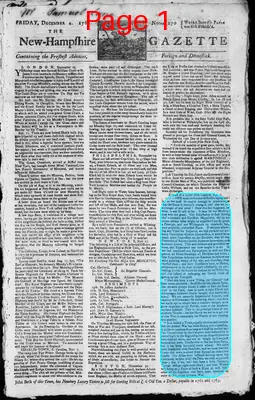
Editorial
December 4, 1761
The New Hampshire Gazette
Portsmouth, Rockingham County, New Hampshire
What is this article about?
Extract of a letter from London dated Sept. 7, candidly acknowledging shifts in public opinion on the ongoing war, criticizing British moderation and reluctance to pursue military operations aggressively, which allegedly emboldened enemies and caused divisions. It reflects on historical patterns of impatience in warfare and expresses optimism for a favorable peace, especially regarding the German war and colonial conquests.
Clipping
OCR Quality
98%
Excellent
Full Text
Extract of a letter from London, Sept. 7.
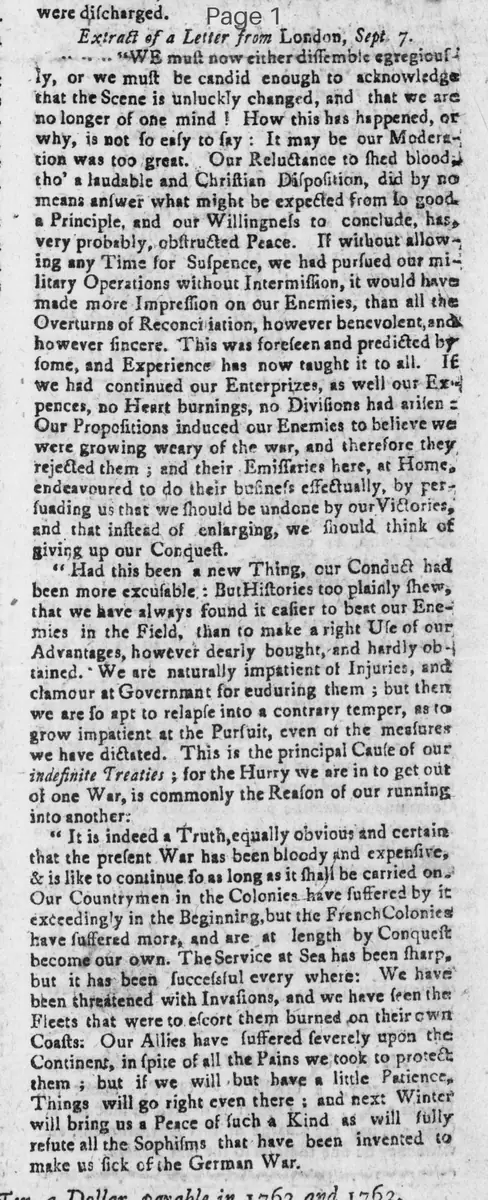
"WE must now either dissemble egregiously, or we must be candid enough to acknowledge that the scene is unluckily changed, and that we are no longer of one mind! How this has happened, or why, is not so easy to say: It may be our moderation was too great. Our reluctance to shed blood—tho' a laudable and Christian disposition, did by no means answer what might be expected from so good a principle, and our willingness to conclude has very probably obstructed peace. If without allowing any time for suspense, we had pursued our military operations without intermission, it would have made more impression on our enemies than all the overtures of reconciliation, however benevolent, and however sincere. This was foreseen and predicted by some, and experience has now taught it to all. If we had continued our enterprises, as well as our expenses, no heart burnings, no divisions had arisen. Our propositions induced our enemies to believe we were growing weary of the war, and therefore they rejected them; and their emissaries here at home endeavored to do their business effectually, by persuading us that we should be undone by our victories, and that instead of enlarging, we should think of giving up our conquests.
Had this been a new thing, our conduct had been more excusable: But histories too plainly show that we have always found it easier to beat our enemies in the field than to make a right use of our advantages, however dearly bought and hardly obtained. We are naturally impatient of injuries, and clamor at government for enduring them; but then we are so apt to relapse into a contrary temper, as to grow impatient at the pursuit, even of the measures we have dictated. This is the principal cause of our indefinite treaties; for the hurry we are in to get out of one war is commonly the reason of our running into another.
It is indeed a truth, equally obvious and certain, that the present war has been bloody and expensive, and is like to continue so as long as it shall be carried on. Our countrymen in the colonies have suffered by it exceedingly in the beginning, but the French colonies have suffered more, and are at length by conquest become our own. The service at sea has been sharp, but it has been successful everywhere. We have been threatened with invasions, and we have seen the fleets that were to escort them burned on their own coasts. Our allies have suffered severely upon the continent, in spite of all the pains we took to protect them; but if we will but have a little patience, things will go right even there: and next winter will bring us a peace of such a kind as will fully refute all the sophisms that have been invented to make us sick of the German war."
"WE must now either dissemble egregiously, or we must be candid enough to acknowledge that the scene is unluckily changed, and that we are no longer of one mind! How this has happened, or why, is not so easy to say: It may be our moderation was too great. Our reluctance to shed blood—tho' a laudable and Christian disposition, did by no means answer what might be expected from so good a principle, and our willingness to conclude has very probably obstructed peace. If without allowing any time for suspense, we had pursued our military operations without intermission, it would have made more impression on our enemies than all the overtures of reconciliation, however benevolent, and however sincere. This was foreseen and predicted by some, and experience has now taught it to all. If we had continued our enterprises, as well as our expenses, no heart burnings, no divisions had arisen. Our propositions induced our enemies to believe we were growing weary of the war, and therefore they rejected them; and their emissaries here at home endeavored to do their business effectually, by persuading us that we should be undone by our victories, and that instead of enlarging, we should think of giving up our conquests.
Had this been a new thing, our conduct had been more excusable: But histories too plainly show that we have always found it easier to beat our enemies in the field than to make a right use of our advantages, however dearly bought and hardly obtained. We are naturally impatient of injuries, and clamor at government for enduring them; but then we are so apt to relapse into a contrary temper, as to grow impatient at the pursuit, even of the measures we have dictated. This is the principal cause of our indefinite treaties; for the hurry we are in to get out of one war is commonly the reason of our running into another.
It is indeed a truth, equally obvious and certain, that the present war has been bloody and expensive, and is like to continue so as long as it shall be carried on. Our countrymen in the colonies have suffered by it exceedingly in the beginning, but the French colonies have suffered more, and are at length by conquest become our own. The service at sea has been sharp, but it has been successful everywhere. We have been threatened with invasions, and we have seen the fleets that were to escort them burned on their own coasts. Our allies have suffered severely upon the continent, in spite of all the pains we took to protect them; but if we will but have a little patience, things will go right even there: and next winter will bring us a peace of such a kind as will fully refute all the sophisms that have been invented to make us sick of the German war."
What sub-type of article is it?
War Or Peace
Foreign Affairs
Military Affairs
What keywords are associated?
War Moderation
Peace Negotiations
Military Pursuit
Colonial Conquests
German War
British Impatience
What entities or persons were involved?
Our Enemies
French Colonies
Our Allies
Editorial Details
Primary Topic
Critique Of British Moderation In The Ongoing War
Stance / Tone
Candid And Critical Of Past Restraint, Optimistic For Future Peace
Key Figures
Our Enemies
French Colonies
Our Allies
Key Arguments
Excessive Moderation And Reluctance To Shed Blood Obstructed Peace
Aggressive Pursuit Of Military Operations Would Have Impressed Enemies More Than Reconciliation Overtures
Propositions Made Enemies Believe Britain Was Weary, Leading To Rejection
Historical Pattern Of Impatience Causes Indefinite Treaties And New Wars
War Has Been Bloody And Expensive But Successful At Sea And In Conquests
Patience Will Lead To A Favorable Peace Refuting Criticisms Of The German War