Thank you for visiting SNEWPapers!
Sign up free
The Rhode Island American, And General Advertiser
Providence, Providence County, Rhode Island
What is this article about?
Editorial from Aurora critiques congressional bill excluding foreign seamen from US vessels as insufficient to resolve impressment disputes with Britain, arguing for total exclusion of British subjects to protect American seamen and justify potential war. Discusses allegiance, naturalization, and international rights.
Merged-components note: The components are a direct textual continuation of an article from the Aurora discussing the bill on foreign seamen, with matching topic and flow across the page break; relabeled to editorial due to opinionated analysis.
Clippings
1 of 2
OCR Quality
Full Text
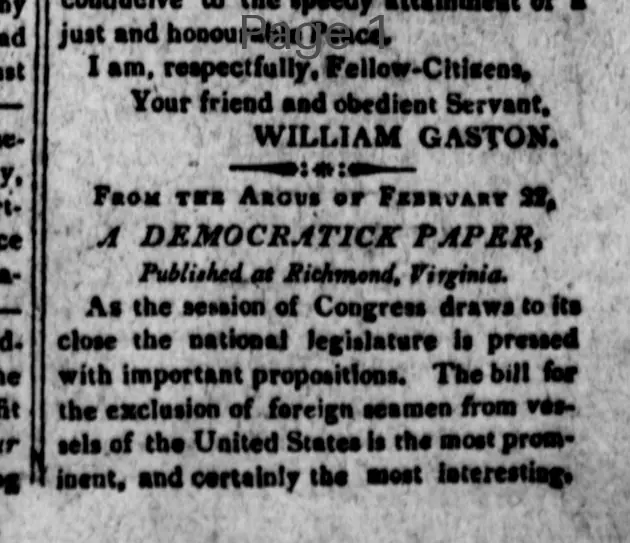
A DEMOCRATICK PAPER,
Published at Richmond, Virginia.
As the session of Congress draws to its close the national legislature is pressed with important propositions. The bill for the exclusion of foreign seamen from vessels of the United States is the most prominent, and certainly the most interesting.
It had been out 'last column, to prevent the Federalists of the Argus with some remarks on that measure,' but the turn which the question has taken, the agitation which it has occasioned, among republicans, as well as federalists, has induced us restrained, lest upon a subject, imperfectly understood, the peculiarity of our opinion might only tend to distract at a time when every effort should be made to harmonize.
We shall, moreover, take the liberty to put upon record our dissent to the creed, that the bill, as it has gone up from the house to the Senate, will settle the differences between this Country and Great-Britain, which have arisen out of the practice of impressment. Nor do we believe that the provisions of that bill, as they now stand, go effectually to the pith of the dispute.
As the basis of these sentiments we also take the liberty of stating:
1. That the right of expatriation is a question between a subject and his government, and not between nation and nation.
2. That a nation from policy may fight for the privilege of naturalising foreigners, but if she does so she fights for the policy and not for a right; and the opponent with equal justice, may fight against it.
3. That the ocean is a common, over which there is no special jurisdiction.
4. That every independent nation has an absolute right of transit for lawful things on the ocean because it is common.
5. That the flag of every independent nation has a perfect right to protect on the ocean whatsoever it lawfully represents.
6. That the American flag therefore ought to protect every thing which is American.
7. That a naturalized citizen is only citizen ex parte; for although the laws of the United States naturalized him, his original sovereign never released him from his allegiance.
8. That although the American flag has a perfect right to protect whatever is American, it has no right at all to protect what is British.
9. That the right of transit for our vessels over the watery common is liable to interruption from the circumstance of the American flag's covering English subjects.
10. That that interruption only becomes an absolute wrong when British born subjects are excluded entirely from our vessels.
11. That of course, the bill, which has gone up from the House to the Senate, does not provide against the cause of quarrel, because it does not exclude foreigners hereafter to be naturalized, from employment on board American vessels; and that it will not induce a settlement of the dispute.
All this sounds very harsh. But it is our opinion that we ought to do at first what we may with great colour of reason, be obliged to do at last. That, if the subject is legislated upon at all, it ought to be legislated upon on principles not to be shaken; and that nothing should be left for future disputation. Yet however harsh, it is not degrading. All the governments of Europe claim the perpetual allegiance of their native born subjects. France, in a special manner, by imperial decree, has, years ago, proclaimed the maxim that, once a Frenchman, always a Frenchman. When those Governments are not at war, they generally suffer their subjects to roam abroad, and seek employment where they may. Nor is there any thing contrary to humanity in the doctrine of excluding British subjects from our vessels; for if an asylum from oppression be all that they seek, that may be found in the bosom of the land, where foreigners may still be naturalized, and will be always protected.
These ideas, are the result of mature reflection. The bill in question, not going far enough, will be regarded by Great-Britain as concession, without an honest intention. A faction at home will still have room to say that the war is waged for the privilege of naturalizing British seamen, and the publick in general, not feeling the motive for war strongly, will not feel it long. But if British seamen are altogether excluded, the battle will then be, if continued, literally and truly for the protection of American seamen. Every body can thus understand it. Two sentences will then explain our side of the question. British seamen are entirely put out of dispute. Native Americans only are to be guarded. Upon such a ground, we venture to say this nation will make war for ever.
Can the alien himself seriously object? He ought not. If he does not enjoy the benefits his children will. At any rate an entire exclusion of British mariners cannot be more objectionable to that class of men than the provision in the bill which dooms them to five years residence ashore before they can be employed in our ships. Considering the habits of seamen, this is a virtual exclusion. Let us, then, do, at once, and openly, what is attempted to be done in substance.
A letter from Philadelphia, of the 12th instant, says, "Our Virginia and Ohio friends begin to think that they did not want war so much as they thought they did. A vessel is certainly preparing here to carry out Messrs. Bayard and Gallatin. The report of an armistice is again renewed. If an armistice by sea and land does take place, then I shall believe that Mr. Madison means peace by his mission to Russia."
What sub-type of article is it?
What keywords are associated?
What entities or persons were involved?
Editorial Details
Primary Topic
Critique Of Bill Excluding Foreign Seamen From Us Vessels
Stance / Tone
Opposition To Partial Exclusion, Advocating Total Exclusion Of British Seamen To Resolve Impressment Disputes
Key Figures
Key Arguments