Thank you for visiting SNEWPapers!
Sign up free
The Union Times
New Haven, New Haven County, Connecticut
What is this article about?
The Social Security Board urges Congress and states to close unemployment insurance loopholes excluding 15-20 million workers, increase benefits to $25/week for 26 weeks, reverse disqualifications, establish national systems, disability/sickness insurance, extend old age pensions to 25 million, and implement health insurance via payroll deductions.
Clipping
OCR Quality
Full Text
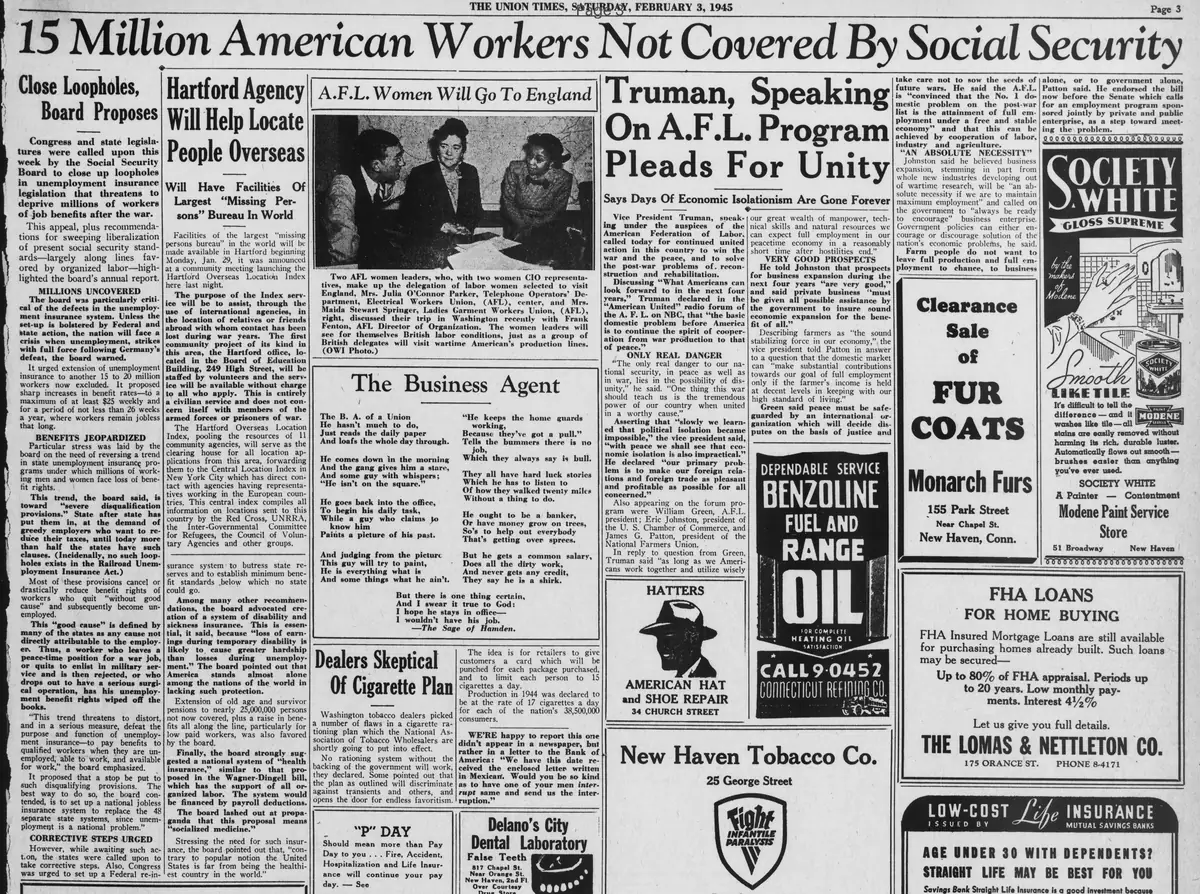
Close Loopholes,
Board Proposes
Congress and state legislatures were called upon this week by the Social Security Board to close up loopholes in unemployment insurance legislation that threatens to deprive millions of workers of job benefits after the war.
This appeal, plus recommendations for sweeping liberalization of present social security standards—largely along lines favored by organized labor—highlighted the board's annual report.
MILLIONS UNCOVERED
The board was particularly critical of the defects in the unemployment insurance system. Unless the set-up is bolstered by Federal and state action, the nation will face a crisis when unemployment, strikes with full force following Germany's defeat, the board warned.
It urged extension of unemployment insurance to another 15 to 20 million workers now excluded. It proposed sharp increases in benefit rates—to a maximum of at least $25 weekly and for a period of not less than 26 weeks a year, where workers remain jobless that long.
BENEFITS JEOPARDIZED
Particular stress was laid by the board on the need of reversing a trend in state unemployment insurance programs under which millions of working men and women face loss of benefit rights.
This trend, the board said, is toward "severe disqualification provisions." State after state has put them in, at the demand of greedy employers who want to reduce their taxes, until today more than half the states have such clauses. (Incidentally, no such loopholes exists in the Railroad Unemployment Insurance Act.)
Most of these provisions cancel or drastically reduce benefit rights of workers who quit without good cause" and subsequently become unemployed.
This "good cause" is defined by many of the states as any cause not directly attributable to the employer. Thus, a worker who leaves a peace-time position for a war job, or quits to enlist in military service and is then rejected, or who drops out to have a serious surgical operation, has his unemployment benefit rights wiped off the books.
"This trend threatens to distort, and in a serious measure, defeat the purpose and function of unemployment insurance—to pay benefits to qualified workers when they are unemployed, able to work, and available for work," the board emphasized.
It proposed that a stop be put to such disqualifying provisions. The best way to do so, the board contended, is to set up a national jobless insurance system to replace the 48 separate state systems, since unemployment is a national problem.
CORRECTIVE STEPS URGED
However, while awaiting such action, the states were called upon to take corrective steps. Also, Congress was urged to set up a Federal re-insurance system to buttress state reserves and to establish minimum benefit standards below which no state could go.
Among many other recommendations, the board advocated creation of a system of disability and sickness insurance. This is essential, it said, because "loss of earnings during temporary disability is likely to cause greater hardship than losses during unemployment."
The board pointed out that America stands almost alone among the nations of the world in lacking such protection.
Extension of old age and survivor pensions to nearly 25,000,000 persons not now covered, plus a raise in benefits all along the line, particularly for low paid workers, was also favored by the board.
Finally, the board strongly suggested a national system of "health insurance," similar to that proposed in the Wagner-Dingell bill, which has the support of all organized labor. The system would be financed by payroll deductions.
The board lashed out at propaganda that this proposal means "socialized medicine."
Stressing the need for such insurance, the board pointed out that, "contrary to popular notion the United States is far from being the healthiest country in the world."
What sub-type of article is it?
What themes does it cover?
What keywords are associated?
What entities or persons were involved?
Where did it happen?
Story Details
Key Persons
Location
United States
Story Details
Social Security Board annual report criticizes unemployment insurance defects, urges coverage for 15-20 million more workers, higher benefits, reversal of disqualifications, national system, disability/sickness insurance, extension of old age pensions to 25 million, and national health insurance via payroll deductions.