Thank you for visiting SNEWPapers!
Sign up free
The Virginia Gazette
Richmond, Williamsburg, Richmond County, Virginia
What is this article about?
Letter from General Charles Lee to General Burgoyne in Philadelphia on June 7, 1775, expressing friendship and urging him not to serve in suppressing American liberties, decrying British court corruption, taxation without representation, and praising colonial resolve against tyranny.
Merged-components note: Image bbox overlaps spatially with the story's first column bbox and follows in sequential reading order, indicating it is an illustration for the letter from General Lee.
Clipping
OCR Quality
Full Text
PHILADELPHIA, June 7, 1775
MY Dear Sir,
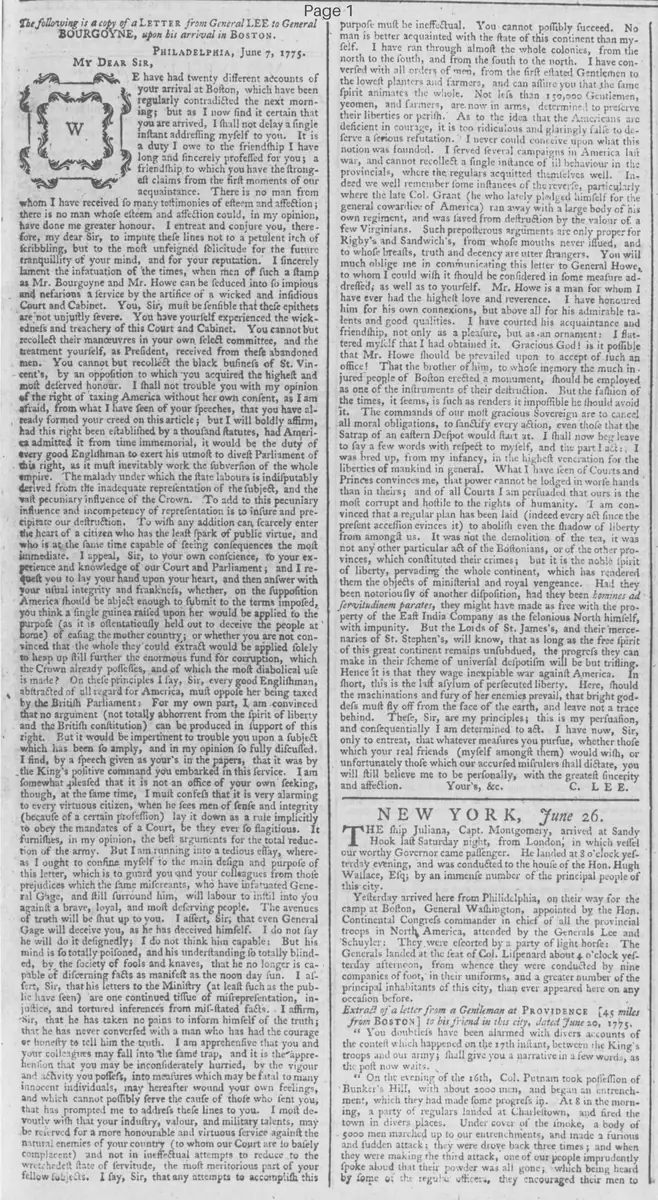
We have had twenty different accounts of your arrival at Boston, which have been regularly contradicted the next morning; but as I now find it certain that you are arrived, I shall not delay a single instant addressing myself to you. It is a duty I owe to the friendship I have long and sincerely professed for you; a friendship to which you have the strongest claims from the first moments of our acquaintance. There is no man from whom I have received so many testimonies of esteem and affection; there is no man whose esteem and affection could, in my opinion, have done me greater honour. I entreat and conjure you, therefore, my dear Sir, to impute these lines not to a petulant itch of scribbling, but to the most unfeigned solicitude for the future tranquillity of your mind, and for your reputation. I sincerely lament the infatuation of the times, when men of such a stamp as Mr. Burgoyne and Mr. Howe can be seduced into so impious and nefarious a service by the artifice of a wicked and insidious Court and Cabinet. You, Sir, must be sensible that these epithets are not unjustly severe. You have yourself experienced the wickedness and treachery of this Court and Cabinet. You cannot but recollect their manoeuvres in your own elect committee, and the treatment yourself, as President, received from these abandoned men. You cannot but recollect the black business of St. Vincent's, by an opposition to which you acquired the highest and most deserved honour. I shall not trouble you with my opinion of the right of taxing America without her own consent, as I am afraid, from what I have seen of your speeches, that you have already formed your creed on this article; but I will boldly affirm, had this right been established by a thousand statutes, had America admitted it from time immemorial, it would be the duty of every good Englishman to exert his utmost to divest Parliament of this right, as it must inevitably work the subversion of the whole empire. The malady under which the state labours is indisputably derived from the inadequate representation of the subject, and the vast pecuniary influence of the Crown. To add to this pecuniary influence and incompetency of representation is to insure and precipitate our destruction. To wish any addition can scarcely enter the heart of a citizen who has the least spark of public virtue, and who is at the same time capable of seeing consequences the most immediate. I appeal, Sir, to your own conscience, to your experience and knowledge of our Court and Parliament; and I request you to lay your hand upon your heart, and then answer with your usual integrity and frankness, whether, on the supposition America should be abject enough to submit to the terms imposed, you think a single guinea raised upon her would be applied to the purpose (as it is ostentatiously held out to deceive the people at home) of easing the mother country; or whether you are not convinced that the whole they could extract would be applied solely to heap up still further the enormous fund for corruption, which the Crown already possesses, and of which the most diabolical use is made? On these principles I say, Sir, every good Englishman, abstracted of all regard for America, must oppose her being taxed by the British Parliament: For my own part, I am convinced that no argument (not totally abhorrent from the spirit of liberty and the British constitution) can be produced in support of this right. But it would be impertinent to trouble you upon a subject which has been so amply, and in my opinion so fully discussed. I find, by a speech given as yours in the papers, that it was by the King's positive command you embarked in this service. I am somewhat pleased that it is not an office of your own seeking, though, at the same time, I must confess that it is very alarming to every virtuous citizen, when he sees men of sense and integrity (because of a certain profession) lay it down as a rule implicitly to obey the mandates of a Court, be they ever so flagitious. It furnishes, in my opinion, the best arguments for the total reduction of the army. But I am running into a tedious essay, whereas I ought to confine myself to the main design and purpose of this letter, which is to guard you and your colleagues from those prejudices which the same miscreants, who have infatuated General Gage, and still surround him, will labour to instil into you against a brave, loyal, and most deserving people. The avenues of truth will be shut up to you. I assert, Sir, that even General Gage will deceive you, as he has deceived himself. I do not say he will do it designedly; I do not think him capable: But his mind is so totally poisoned, and his understanding so totally blinded, by the society of fools and knaves, that he no longer is capable of discerning facts as manifest as the noon day sun. I assert, Sir, that his letters to the Ministry (at least such as the public have seen) are one continued tissue of misrepresentation, injustice, and tortured inferences from mis-stated facts. I affirm, Sir, that he has taken no pains to inform himself of the truth; that he has never conversed with a man who has had the courage or honesty to tell him the truth. I am apprehensive that you and your colleagues may fall into the same trap, and it is the apprehension that you may be inconsiderately hurried, by the vigour and activity you possess, into measures which may be fatal to many innocent individuals, may hereafter wound your own feelings, and which cannot possibly serve the cause of those who sent you, that has prompted me to address these lines to you. I most devoutly wish that your industry, valour, and military talents, may be reserved for a more honourable and virtuous service against the natural enemies of your country (to whom our Court are so basely compliant) and not in ineffectual attempts to reduce to the wretchedest state of servitude, the most meritorious part of your fellow subjects. I say, Sir, that any attempts to accomplish this purpose must be ineffectual. You cannot possibly succeed. No man is better acquainted with the state of this continent than myself. I have ran through almost the whole colonies, from the north to the south, and from the south to the north. I have conversed with all orders of men, from the first seated Gentlemen to the lowest planters and farmers, and can assure you that the same spirit animates the whole. Not less than 150,000 Gentlemen, yeomen, and farmers, are now in arms, determined to preserve their liberties or perish. As to the idea that the Americans are deficient in courage, it is too ridiculous and glaringly false to deserve a serious refutation. I never could conceive upon what this notion was founded. I served several campaigns in America last war, and cannot recollect a single instance of ill behaviour in the provincials, where the regulars acquitted themselves well. Indeed we well remember some instances of the reverse, particularly where the late Col. Grant (he who lately pledged himself for the general cowardice of America) ran away with a large body of his own regiment, and was saved from destruction by the valour of a few Virginians. Such preposterous arguments are only proper for Rigby's and Sandwich's, from whose mouths never issued, and to whose breasts, truth and decency are utter strangers. You will much oblige me in communicating this letter to General Howe, to whom I could wish it should be considered in some measure addressed; as well as to yourself. Mr. Howe is a man for whom I have ever had the highest love and reverence. I have honoured him for his own connexions, but above all for his admirable talents and good qualities. I have courted his acquaintance and friendship, not only as a pleasure, but as an ornament: I flattered myself that I had obtained it. Gracious God! is it possible that Mr. Howe should be prevailed upon to accept of such an office! That the brother of him, to whose memory the much injured people of Boston erected a monument, should be employed as one of the instruments of their destruction. But the fashion of the times, it seems, is such as renders it impossible he should avoid it. The commands of our most gracious Sovereign are to cancel all moral obligations, to sanctify every action, even those that the Satrap of an eastern Despot would start at. I shall now beg leave to say a few words with respect to myself, and the part I act: I was bred up, from my infancy, in the highest veneration for the liberties of mankind in general. What I have seen of Courts and Princes convinces me, that power cannot be lodged in worse hands than in theirs; and of all Courts I am persuaded that ours is the most corrupt and hostile to the rights of humanity. I am convinced that a regular plan has been laid (indeed every act since the present accession evinces it) to abolish even the shadow of liberty from amongst us. It was not the demolition of the tea, it was not any other particular act of the Bostonians, or of the other provinces, which constituted their crimes; but it is the noble spirit of liberty, pervading the whole continent, which has rendered them the objects of ministerial and royal vengeance. Had they been notoriously of another disposition, had they been homines ad servitutinem paratos, they might have made as free with the property of the East India Company as the felonious North himself, with impunity. But the Lords of St. James's, and their mercenaries of St. Stephen's, will know, that as long as the free spirit of this great continent remains unsubdued, the progress they can make in their scheme of universal despotism will be but trifling. Hence it is that they wage inexpiable war against America. In short, this is the last asylum of persecuted liberty. Here, should the machinations and fury of her enemies prevail, that bright goddess must fly off from the face of the earth, and leave not a trace behind. These, Sir, are my principles; this is my persuasion, and consequentially I am determined to act. I have now, Sir, only to entreat, that whatever measures you pursue, whether those which your real friends (myself amongst them) would wish, or unfortunately those which our accursed ministers shall dictate, you will still believe me to be personally, with the greatest sincerity and affection.
Yours, &c.
C. LEE.
What sub-type of article is it?
What themes does it cover?
What keywords are associated?
What entities or persons were involved?
Where did it happen?
Story Details
Key Persons
Location
Philadelphia, Boston, America
Event Date
June 7, 1775
Story Details
General Lee writes to General Burgoyne upon his arrival in Boston, expressing personal friendship and urging him not to participate in the British effort to suppress American liberties, arguing against taxation without representation, exposing court corruption, and asserting the strong resolve of 150,000 armed colonists.