Thank you for visiting SNEWPapers!
Sign up free
Story
October 28, 1913
The Barre Daily Times
Barre, Washington County, Vermont
What is this article about?
A retail butcher advises in Woman's Home Companion on reducing meat bills by choosing cheaper, nutritious cuts like shoulder ribs for roast beef and shoulder chops for lamb and pork, which are sweeter and more economical than premium options.
Clipping
OCR Quality
98%
Excellent
Full Text
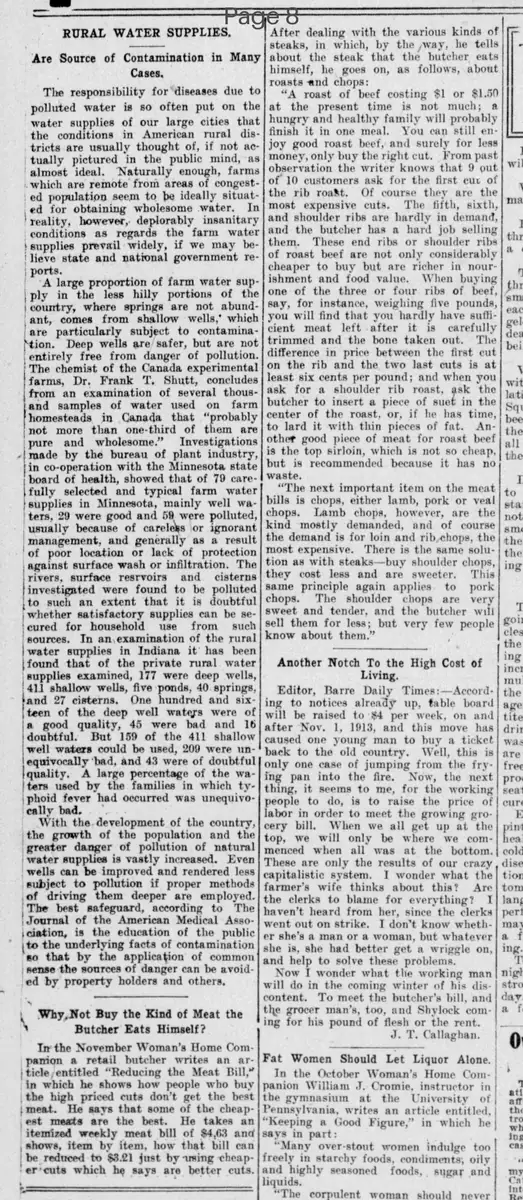
Why Not Buy the Kind of Meat the Butcher Eats Himself?
In the November Woman's Home Companion a retail butcher writes an article entitled "Reducing the Meat Bill," in which he shows how people who buy the high priced cuts don't get the best meat. He says that some of the cheapest meats are the best. He takes an itemized weekly meat bill of $4.63 and shows, item by item, how that bill can be reduced to $3.21 just by using cheaper cuts which he says are better cuts.
After dealing with the various kinds of steaks, in which, by the way, he tells about the steak that the butcher eats himself, he goes on, as follows, about roasts and chops:
"A roast of beef costing $1 or $1.50 at the present time is not much; a hungry and healthy family will probably finish it in one meal. You can still enjoy good roast beef, and surely for less money, only buy the right cut. From past observation the writer knows that 9 out of 10 customers ask for the first cut of the rib roast. Of course they are the most expensive cuts. The fifth, sixth, and shoulder ribs are hardly in demand, and the butcher has a hard job selling them. These end ribs or shoulder ribs of roast beef are not only considerably cheaper to buy but are richer in nourishment and food value. When buying one of the three or four ribs of beef, say, for instance, weighing five pounds, you will find that you hardly have sufficient meat left after it is carefully trimmed and the bone taken out. The difference in price between the first cut on the rib and the two last cuts is at least six cents per pound; and when you ask for a shoulder rib roast, ask the butcher to insert a piece of suet in the center of the roast, or, if he has time, to lard it with thin pieces of fat. Another good piece of meat for roast beef is the top sirloin, which is not so cheap, but is recommended because it has no waste.
"The next important item on the meat bills is chops, either lamb, pork or veal chops. Lamb chops, however, are the kind mostly demanded, and of course the demand is for loin and rib chops, the most expensive. There is the same solution as with steaks—buy shoulder chops, they cost less and are sweeter. This same principle again applies to pork chops." The shoulder chops are very sweet and tender, and the butcher will sell them for less; but very few people know about them.
In the November Woman's Home Companion a retail butcher writes an article entitled "Reducing the Meat Bill," in which he shows how people who buy the high priced cuts don't get the best meat. He says that some of the cheapest meats are the best. He takes an itemized weekly meat bill of $4.63 and shows, item by item, how that bill can be reduced to $3.21 just by using cheaper cuts which he says are better cuts.
After dealing with the various kinds of steaks, in which, by the way, he tells about the steak that the butcher eats himself, he goes on, as follows, about roasts and chops:
"A roast of beef costing $1 or $1.50 at the present time is not much; a hungry and healthy family will probably finish it in one meal. You can still enjoy good roast beef, and surely for less money, only buy the right cut. From past observation the writer knows that 9 out of 10 customers ask for the first cut of the rib roast. Of course they are the most expensive cuts. The fifth, sixth, and shoulder ribs are hardly in demand, and the butcher has a hard job selling them. These end ribs or shoulder ribs of roast beef are not only considerably cheaper to buy but are richer in nourishment and food value. When buying one of the three or four ribs of beef, say, for instance, weighing five pounds, you will find that you hardly have sufficient meat left after it is carefully trimmed and the bone taken out. The difference in price between the first cut on the rib and the two last cuts is at least six cents per pound; and when you ask for a shoulder rib roast, ask the butcher to insert a piece of suet in the center of the roast, or, if he has time, to lard it with thin pieces of fat. Another good piece of meat for roast beef is the top sirloin, which is not so cheap, but is recommended because it has no waste.
"The next important item on the meat bills is chops, either lamb, pork or veal chops. Lamb chops, however, are the kind mostly demanded, and of course the demand is for loin and rib chops, the most expensive. There is the same solution as with steaks—buy shoulder chops, they cost less and are sweeter. This same principle again applies to pork chops." The shoulder chops are very sweet and tender, and the butcher will sell them for less; but very few people know about them.
What sub-type of article is it?
Consumer Advice
Thrifty Cooking
What keywords are associated?
Meat Bill Reduction
Cheaper Cuts
Shoulder Ribs
Shoulder Chops
Butcher Advice
Roast Beef
Lamb Chops
What entities or persons were involved?
Retail Butcher
Story Details
Key Persons
Retail Butcher
Event Date
November
Story Details
Butcher explains how to cut meat costs from $4.63 to $3.21 weekly by selecting undervalued cuts like shoulder ribs for beef roast and shoulder chops for lamb and pork, which offer better value and nutrition.